0
0

Media confusion: DATELINE ISLAMABAD
THE clash of interests among the different parties in the current Afghan conflict is being played out in public over the media. This makes it difficult for viewers and readers to know exactly what the real facts are and to access what is actually happening.
The photograph in Dawn last Thursday showing the sea of television cameras outside the Afghan embassy in the capital is a graphic illustration of the kind of confusion that has arisen in the course of media coverage on the current events in the region.
According to the ministry of information, over a thousand foreign journalists are in Pakistan covering the Afghan scenario. Some 500 to 600 are in Islamabad, and another 200 to 300 each are in Peshawar and Quetta, both from the electronic and print media, as well as from state and privately-owned companies.
The ravenous demands of news coverage, specially on 24-hour television channels, have fuelled the race within the media industry to find and dig out news from the different parties in the conflict. There have been several instances where news reported by satellite stations or newspapers were contradicted immediately on the same day or subsequently.
On Friday, the Arabic satellite television station Al-Jazeera carried comments by a Taliban official who said that 70 to 100 American soldiers had been killed in Afghanistan since the American bombing campaign on the country began on Oct 7. On the same day, a White House spokesman denied the claim and accused the Taliban of “lying”.
This is baffling for viewers. Apart from the fact that they do not know whether the news about the deaths of 70 to 100 American soldiers in Afghanistan was correct or not, they also do not know which side is actually lying. Viewers simply do not know anymore whether they are being given the correct picture about any aspect of the war, be it the civilian casualties, or casualties of the Taliban or American troops, or what kind of bombs exactly are being dropped on Afghanistan.
This confusion is the result of the clash of interests among the different parties in the conflict, each wanting to present its own kind of information to its respective audience / readers. The news about the death of American soldiers may go down well with an Arab or Muslim audience whose sympathies are with Afghanistan. However, this news the American government would not like to be aired over American and western stations because it could encourage public opinion within America and other Western countries against the bombing campaign in Afghanistan.
The public’s doubts about media reports being doctored before being shown or published has also been raised by American and British governments asking their media to play down on public demonstrations against the bombing and civilian casualties in Afghanistan. The American media may be able to take this demand lying down but less so the British media, which is known to be more “independent”. In fact, the British media was berated last week by British ministers for “distorting” facts and engendering a loss in public faith in the West’s bombing campaign in Afghanistan.
Similarly, media viewers and readers have also to figure out whether the information they are being given is one that has been “planted” by some other government or party with conflicting interests. This often happens with news regarding Pakistan’s nuclear programme or its support for the Taliban, which the government has often to respond by denying the news.
Last Friday, a government spokesman at a news briefing denied two news items published in the international press. One was a report published in Washington Post accusing the government of Pakistan of supplying arms to the Taliban in Afghanistan. The other was about the arrest of 10 nuclear scientists. A day earlier on Thursday, Foreign Minister Abdul Sattar had rejected fears expressed in an American journal about Pakistan’s nuclear assets falling into the hands of extremists.
Perplexed viewers have also been bombarded with many other kinds of news that were contradicted the next day. The government of Pakistan had said that there was sufficient proof to indict Osama bin Laden, whereas this statement was contradicted later by other governments, including Britain. Then the President of Pakistan had said that the majority of Pakistanis were with him in the American campaign in Afghanistan, whereas a Gallup poll in the country reported that the majority of people in Pakistan did not support the American bombing of Afghanistan.
The confusion is due in part to the fact that there are more dimensions to this current conflict in Afghanistan than any other previous conflict in history. Even in the World War II, which involved so many countries, the battle lines were clearly drawn between the military expansionist powers and those who opposed them. In the present scenario, although the Western coalition claims that the target is the terrorists, the conflict actually has a multi-dimensional face.
Apart from the apparent tussle between the Americans/the West and Osama bin Laden and his terrorists network, there is the tussle between the Americans and the Taliban, whom the former wants to unseat from Kabul. Then there is the tussle between the religions of Islam and Christianity. Within Islam, there is the tussle between the “moderates” and the “fundamentalists”, viz. the Northern Alliance versus the Taliban, President Musharraf versus the “militant Islamists”, and so on. Then there is the tussle between governments, e.g. America versus Pakistan, America versus Saudi Arabia, Pakistan versus India, etc. Plus the fact that many other countries have been dragged into taking sides in the conflict.
Another crucial tussle is that between government policies and public opinion. This is where domestic politics come in, and it is a problem in America, in Pakistan, and many other countries. Media coverage is particularly important in this respect because sustained reporting about American troop and Afghan civilian casualties, and of anti-war demonstrations in different countries, could eventually even bring down the popularity ratings of those leaders who are engaged in and who support the bombing in Afghanistan.
There are no clear-cut boundaries of clash in this conflict. On the surface the line is apparently drawn between the coalition forces versus Afghanistan, the Taliban and Osama bin Laden. But the underlying ground reality is a clash among a multitude of conflicting forces and players. The result is the confusion viewers and readers are being subjected to in the media coverage.
Govt lacks clear strategy: DATELINE PESHAWAR
TRUST Maulana Sufi Mohammad, he never misses a chance to make things difficult for the government. He is out yet again leading a force of thousands of armed supporters ready to fight ‘Jihad’ in Afghanistan. This time, the government is too happy to let him cross over into Afghanistan with hordes of his men and not create any problems at home.
Governor Iftikhar is a shrewd man. In statements after statements, he has been telling the ‘Jihadis’ to go to Afghanistan rather than disrupting civil life here. But behind this facade is in fact an acknowledgement of how helpless the government is in overcoming this new tide of Islamists ready to lay down their lives for the cause of Islam.
The government must now be regretting what it has done with the state machinery in the name of the devolution of power. If the government had any inkling of the things to come following the Sept 11 terrorist attacks in Washington and New York, it would not have done what it did by ‘taking democracy to the grass roots’ as it said as the present events have made abundantly clear in Malakand division.
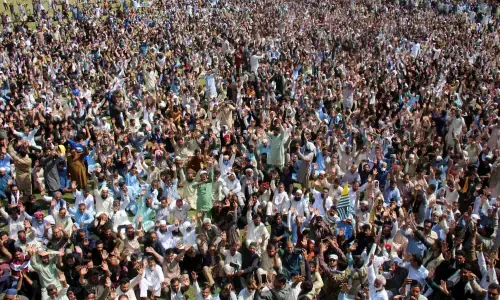
Sufi Mohammad assembled thousands of his supporters in Dir and later led them to Bajaur Agency on their way to Afghanistan, fully armed marching right before the eyes of the paramilitary forces. In Kohistan district of Malakand division, religious parties’ activists and tribesmen again armed with sophisticated weapons took positions on hilltops and put boulders to block the strategic Karakoram Highway. So much for the government’s deweaponisation policy and the rule of law.
There is little the government can do. If it had any premonition of the things to come, particularly after the Sept 11 terrorist attacks, it would not have done what it did by chopping off its executive arm. The whole government now appears to be working in a void, operating in total vacuum. It best resembles a stool with no legs. The new system of governance at the district level has proved to be ineffective and inefficient in as far as dealing with the law and order situation. Ask Governor Iftikhar. Nobody should know this well than him.
He has been convening and reconvening district Nazims in a vain attempt to educate them on their responsibilities and powers in the new system. No amount of encouragement or persuasion, however, could move the elected representatives from exercising their powers. Nazims were nowhere to be seen when the chips were down for the government. One Nazim had hidden in a hotel room not wanting to be found out by the authorities, while another one came to the relative security of Peshawar.
And why should they be charting on a different course than their own people. They are ‘elected representatives’ and will return to their respective electorate. The Nazims have not been able to restrict anti-government protesters to their own respective districts. But what to do when the police are also reluctant to exercise their powers in dealing with anti-government rallies.
They are not willing to make decisions to pay for the next day. The magistracy exists no more and therefore, nobody is willing to take risks. What better example can prove the paralysis of the government’s machinery in dealing with the law and order situation than the blockade of the Karakoram Highway. The government was clueless about what to do. There was no one to negotiate with the armed tribesmen. Had it not been for Maulana Sufi Mohammad, who upon his own initiative, had gone to Kohistan to talk to the tribesmen, and Mufti Nizamuddin Shamizai, who was brought over from Karachi, the government would still have been trying to grapple with the situation. This is an extraordinary situation and to think that the Nazims have the capacity to deal with the law and order is asking for the moon. It is never too late to learn from one’s mistake. Taking democracy to the grass roots is a lofty thing to do but entrusting Nazims with powers to handle law and order, particularly in such demanding times, is indeed a different thing altogether.
So far, the government has been reactive rather than pro-active to situations. Its handling of the TNSM, the KKH closure and demonstrations by the religious parties has been knee-jerk. What for instance was the need for placing Maulana Fazlur Rehman and Qazi Hussain Ahmad under house arrest. Notwithstanding their fiery speeches that apparently made the government nervous, the religious parties have failed to bring the large majority of the people on the streets. The people, however frustrated and concerned they maybe with the economic situation, just want to be left alone. The government lacks clear strategy. The religious parties are fighting a battle not for Afghanistan but to capitalize on the situation next door and gain as much public support as they can, undoubtedly at the expense of each other, as recent events have shown in parts of the NWFP.
The JI and the TNSM are locked in a battle of sorts in Malakand division and the JUI, JI and TNSM on the other hand in the tribal areas. Not surprisingly, therefore, those religious groups, who have nothing in common with the Taliban and belong to entirely different schools of thought have also joined the bandwagon to declare Jihad, not for the love of Afghanistan but because they fear losing whatever support they have to other more active religious parties.
The Taliban for instance always viewed the Jamaat-i-Islami with suspicion owing to the latter’s ties with Hezb-i-Islami. In fact, the first thing the Taliban did upon taking over southern Khost province was to boot out Jamaat-affiliated militants from the training camps. What has Maulana Noorani and for that matter the Pir of Manki Sharif and the Tanzim-i-Ahle Sunnat in common with the Taliban.
The truth of the matter is that all these religious parties and groups are vying for a bigger piece of the cake before their rivals make good of the opportunity and take it. And this what the government has failed to exploit. It has also failed to exploit the situation caused by the closure of the KKH by projecting the problems the blockade had caused to the people in Gilgit and Kohistan.
The people who suffered because of the blockade were Muslims and not Americans. But then you need people at the helm of affairs who appreciate the situation and accordingly make correct decisions. Three home secretaries have seen the door since the military takeover in October 1999, two under the incumbent governor.
AJK polls: doubts and despondency: COMMENT
ALTHOUGH the Azad Jammu and Kashmir assembly has been elected, claims of transparency and free electioneering methods by both Pakistan and AJK governments are being disputed openly. Some people rather prefer to call the entire affair a process of installation of dummies, instead of an election through ballot.
A number of developments that took place recently point to rather some hidden hand involved in AJK politics to gain supremacy. The way the Muslim Conference got united and Sardar Sikandar Hayat declined to accept any important party slot and later on the defeat of the People’s Party are things that provide enough food for thought.
Soon after assuming the office of the prime minister, Sikandar Hayat rushed to Murree (the new power point for AJK politics), to discuss matters with the GOC 12th division, Maj-Gen Shahid Aziz, or to get some new directions about governance. It is enough proof he is getting instructions from Islamabad via Murree.
In another development a military man, Maj-Gen Mohammad Anwar, was elected AJK president through extraordinary measures, thus negating the president of Pakistan’s claims of non-interference in the AJK affairs. Only time will tell whether the appointment was made in good faith.
In the past also Islamabad would provide all help to its allies to win election in AJK. Former prime minister Nawaz Sharif had told a public meeting at Neela Butt (AJK) that he would gift 12 seats of Kashmiri refugees settled in Pakistan to Sardar Qayyum, i.e. the Muslim Conference, a natural ally of the PML. And he did it — in the 1991 election to the AJK assembly 11 of the 12 seats of Kashmiri refugees settled in Pakistan went to the MC.
Similarly, in 1996 Benazir Bhutto provided all help to the AJKPP to win the election against the MC. Although the people blamed the defeat on the MC corruption, the way they were pushed to the wall makes the whole scenario grim.
In the most recent election, held in 2001, everyone was firm that Sultan Mahmud and his PP will once again click, if not with a very big mandate like in the past, it will at least be in a position to form government on the basis of its performance, but July 6 dawned in a different style and the Muslim Conference was made winner of the show. It has shocked many people who were predicting the victory of the AJKPP.
Analysts see a political bargain in the MC victory, followed by the acceptance of premiership by Sikandar Hayat as they link it with the PML(LM) whose ally is Sikandar Hayat.
Once again, it may be said here, nationalist parties were barred from contesting the polls in 2001 because they had refused to sign affidavits certifying their allegiance to Pakistan.
A comparative study shows the AJKPP government had always had an edge over the government of the other party for the simple reason that it had launched many projects aimed at socio-economic prosperity of the state. Again, Barrister Sultan Mahmud has done much to focus the Kashmir issue internationally. His exit from the scene at this hour is rather mysterious. Moreover, throughout his tenure he worked without confrontation with the his opponents or the allies. A plus point that did not come to his rescue in the face of what analysts term manoeuvrings from the outside.
However, a bit of nationalist in Sultan Mahmud might have worked this time against his victory in the 2001 election. Perhaps he knew it or he would not have said in a speech at Mirpur that if he exposed the reasons for the PP defeat, it would harm the integrity of Pakistan.
After such developments in AJK, it may not be possible for Pakistan to plead the Kashmir case before the international community forcefully for it may be asked about its interference in the AJK affairs.
Refusal by Sardar Abdul Qayyum Khan to accept any official slot and even that of Sardar Ateeq Ahmad has silenced the critics who tried to dub them as power-hungry. Also, it appears that Sardar Qayyum must have smelled the dangers and preferred to remain away from power to save himself from being ruled. Moreover, he may be preparing to play a role in the liberation of Kashmir by building a world opinion.
But the way he named a major-general for the slot of the AJK president raises the question, did he feel helpless before the rulers? Only time will tell why at this juncture he backed out when Sardar Sikandar and the entire party leadership were urging him to contest the presidential election.
High-rises contravene original plan, create mess: DATELINE FAISALABAD
SKY-HIGH buildings constructed in contravention of the original design and prescribed rules have not only distorted the beauty of the city, but also overshadowed its rich heritage.
The founding father, Sir James Lyall, had envisaged that no building should be constructed beyond two floors, i.e the ground and first floor. The original localities — Sanatpura, Diglouspura, Munshi Mohalla, Dhobi Ghat, Gurunankpura, Gobindpura, Muhammadpura, Partabnargar, Tariqbad, Jawalanagar, and Abdullahpur — were developed on these lines. But the regulation was flouted with impunity later.
The area of the city at the time of its establishment was only three square miles. With the passage of time, the municipal limits extended to 9.73 square miles. Now the Tehsil Municipal Administration limit is 75.20km.
The layout of the city was a master piece of town planning. Conceived by Capt. Popham Young, it had a provision for shopping centres, residential areas, educational institutions, grain, timber, vegetable and leather markets, railway station, general bus stand, hospitals, district courts, parks and gardens, well-planned drainage and water supply systems, with a cloth tower in the centre, visible from distant places and serving as a light house at night hours, from where eight bazaars emanated in all directions, making the city a replica of architectural and scenic beauty and historical value.
Attention was paid to sanitation, atmospheric pollution, noise pollution, traffic jams and parking. It was decided that to save the city from these maladies, over-concentration in the laid out area would not be allowed. Construction of multi-storey buildings and shopping plazas was, therefore, banned.
Appropriate by-laws were laid down to preserve and protect its architectural and topographical features.
Till partition, it used to give the look of a well-planned and clean city. After independence, People’s Colony, D-Type Colony, Ghulam Muhammadabad, Nazimabad, Samanabad, Jinnah Colony, Gulberg, Gulshan Colony, Civil Lines, Afghanabad, Razaabad and Model Town were developed. The architects made no deviation from the original design. Residential areas comprised buildings, having ground floors while the commercial-cum-residence units were designed with ground and upper storeys. This pattern was also adopted in development of 5,700 housing units of Allama Iqbal Colony and Sir Syed Town.
The first building having more than one storey came up in 1941. It was the Grindlay’s Bank. Thereafter, between the 70s and 80s were constructed three-storey building of the Nuclear Institute for Agriculture and Biology, eight-storey building of Habib Bank, five-storey building of the Muslim Commercial Bank and four-storey building of the National Bank of Pakistan.
Recently, the tallest building in the Punjab — the 197-foot high State Life building — consisting of 13 floors was built in the city at a cost of Rs400 million. There are about 1,250 commercial plazas and buildings having more than five storeys. Such a trend has created congestion, traffic jams, pollution and acute parking problem.
Residential flats were first introduced by the government of Zulfiqar Ali Bhutto. It allotted flats at a nominal price to industrial workers on Soosan Road in 1974. The Faisalabad Development Authority later developed three-storey flats in Madina Town, Islam Nagar, Kanak Basti, Ghulam Muhammadabad, Sir Syed Town, but they could attract the people and many are still vacant.
Unfortunately, the beauty of the city and the whole infrastructure of town planning was destroyed by thoughtless addition of dull and ugly multi-storey structures in various bazaars and residential areas. Overcrowding and congestion with all their attendant problems of traffic jams, pollution, parking, insanitation and insecurity, have put the city in a big mess. The next generation will pay heavily for the criminal negligence of the incompetent and corrupt elements of the defunct Faisalabad Municipal Corporation and the Faisalabad Development Authority, who have been overlooking the by-laws prescribed for development.
In the original plan, ample space for expansion in all directions had been provided. All that was required was to develop suitable suburbs to become parts of the expanded city.
The unabated trend of multi-storey plazas in the old city area is clearly indicative of the fact that the newly-elected councillors and Nazims have also not taken any note of this problem. Coupled with haphazard constructions and other violations of building by-laws, it has turned Faisalabad into a city of illegal settlements, which is creating social distortions and imbalances. This act of developers has become a permanent nuisance and a discomforting feature of civic life which was carried out with the collaboration of officials who reportedly shared the booty recovered from the sale of shops and offices carved out from illegally-constructed floors of plazas and commercial centres.
Instead of concentrating on long-term planning, the government has left the land open for developers to sell it to the people at exorbitant rates, with nothing going to the state exchequer. The government system, which is not meeting the increasing needs of the people, leads to the development of an informal system, making room for persons involved in illegal settlements sometimes referred to as the land mafia.
The authorities are playing the role of a silent spectator. On the one hand, they keep mum over the construction of multi-storey buildings and, on the other hand, scores of buildings in the city are in a dilapidated condition. Some of the inhabitants get these structures repaired, but most cannot afford the high construction cost.
The Tehsil Municipal Administration and the defunct FMC were responsible for sanctioning of plans of private/public buildings within the municipal limits, preparation of site development plans and town planning schemes, identification of immovable encroachments, checking and taking appropriate action according to rules, removal of unauthorized constructions and checking of dangerous buildings and declaring them as such as per rules for grant of NOCs in the light of by-laws and implementation of policy and instructions. But actually all these mandatory obligations of the FMC’s buildings branch are being flouted by moneyed people in collusion with the “corrupt mafia”.
The FDA, which was supposed to protect the city’s heritage and the framework for construction of buildings in consonance with the original concept and design, did not make the required contribution to preservation due to the apathetic and indifferent attitude of it functionaries.
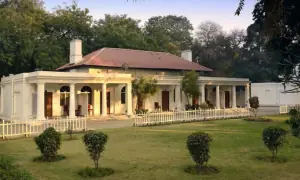
Only a four-star hotel — the Faisalabad Serena — was developed on the original design of the city. The design, brick-lining, architecture, floors, walls, roofs, main gate, lighting, fountains, plants, flowering, stairs, wood-work, doors and the overall atmosphere create an image of the peaceful environment of the original Lyallpur.
On the orders of the previous government, a special team consisting of senior officials of the housing and physical planning department, defunct FMC, FDA and building departments conducted a survey of unauthorized shopping plazas and multi-storey buildings. It found 130 plazas and multi-storey commercial centres constructed in violation of the original design. However, no step has so far been taken to curb this menace.