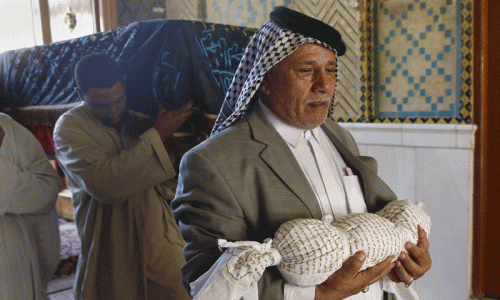
BAGHDAD: A series of bombs killed at least 25 people across Iraq on Sunday ahead of the Muslim feast of Eid al-Adha, police and medical sources said.
Altogether 16 bombs went off, the deadliest of which was in the mainly Shia city of Hilla, 100 km south of Baghdad, where two car bombs blew up in quick succession, killing at least five people, police said.
It was not immediately clear who was behind Sunday's attacks, but Sunni Islamist and other insurgents including al Qaeda, which views Shia Muslims as non-believers, have been regaining ground in Iraq this year.
More than 6,000 people have been killed in acts of violence in Iraq so far in 2013, reversing a decline in sectarian bloodshed that peaked in 2006-2007.
In Kut, 160 km southeast of Baghdad, four car bombs exploded separately, one of them near a primary school and another close to a restaurant, killing at least two people and wounding 31, police said.
Leaflets signed by al Qaeda's Iraqi affiliate were distributed in recent days on the streets of Baquba, a city northeast of the capital, telling residents not to send their children to school or they will be killed, residents and police said.
Last week, a suicide bomber drove a truck packed with explosives into the playground of a primary school in northern Iraq and blew himself up, killing 14 children along with their headmaster.
“The surge of violence in Iraq spares no one and no place,” said a statement from the United Nations following that attack.
A roadside bomb exploded near a soccer pitch where boys aged 14 to 16 were playing a match in Madaen, 30 km southeast of Baghdad, killing four of them, police and medics said.
In the capital, a series of bombs went off in busy streets in predominantly Sunni districts, killing eight people. Two car bombs exploded simultaneously near a car repair workshop in the city of Samawa, killing two people.
In Samarra, 60 km north of Baghdad, three suicide bombers clashed with policemen before detonating their vests, killing themselves and four others, police said.
Forced underground in 2007, al Qaeda's Iraqi wing has been reinvigorated by the civil war in neighboring Syria and growing resentment among the country's Sunni minority, which accuses the Shi'ite-led government of marginalising them.
A raid by government security forces on a Sunni protest camp in April touched off a backlash by militants that still continues.
Al Qaeda's Iraqi affiliate merged with its Syrian counterpart this year to form the Islamic State of Iraq and the Levant, which has claimed responsibility for attacks on both sides of the border.
Iraqi Shi'ites have also crossed into Syria, where they are fighting alongside troops loyal to President Bashar al-Assad against mainly Sunni rebels.
Shi'ite militias in Iraq, which have laid down their arms in recent years, have largely held their fire, but several incidents over the past month indicate some groups may be retaliating for attacks blamed on Sunni insurgents.