19
19

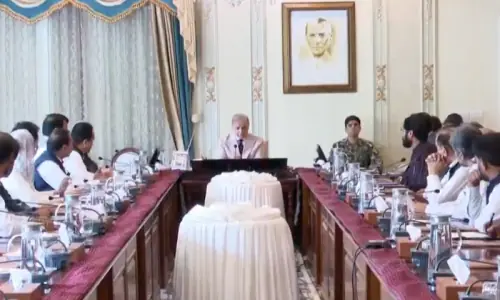
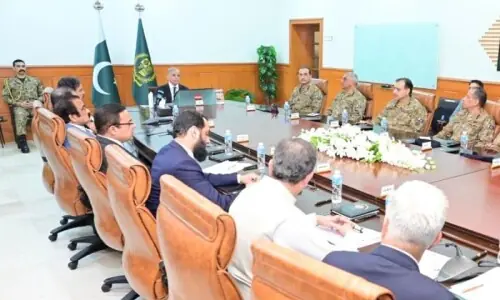
BLINK and you could have missed it. But something quite astonishing happened this week at the National Command Authority (NCA) meeting.
“Pakistan would not remain oblivious to evolving security dynamics in South Asia and would maintain a full-spectrum deterrence capability to deter all forms of aggression.”
Full-spectrum deterrence — endorsed by the NCA. Why? How? The who we know. But what does it mean?
First, a very basic, thoroughly imprecise rundown. Nuclear weapons were supposed to make war impossible. Except, not quite.
Conflict is still possible below the nuclear threshold. A tiny war as it were, because both India and Pakistan know the cost of escalating any conflict.
Escalate — say, a localised conflict along the LoC shifts to the international border where armies threaten to cross over — and Pakistan promises to pull the nuclear trigger.
That’s into big, proper war terrain and both sides are supposed to understand that a nuclear war will inflict terrible, unacceptable damage on the other. Deterrence, achieved.
Between the two — localised conflict and a big, proper war — however, lies space that India has theoretically tried to manipulate since, in particular, the Mumbai attacks.
Cold Start — the bête noire of the Pakistani security establishment.
Frustrated by Pakistan’s ability to launch attacks whose provenance is in dispute, via non-state actors, India is, in theory, working on the building blocks for rapid, punitive strikes inside Pakistani territory.
Another Mumbai happens. Then, quickly, Indian boots on the ground, planes in the air and, say, Muridke is taken out before the Indians pull back across the border — an attack that does not involve the seizing of territory, just the intention to hurt Pakistan for its perceived aggression via non-state players.
The idea is that a Cold Start attack will be limited enough to deny Pakistan the justification to escalate to full-fledged, inevitably nuclear, war and will be rapid enough to prevent the notoriously slow international community from intervening.
Enter the Pakistani response: full-spectrum deterrence. It’s a Strategic Plans Division, essentially military, concoction.
Since Pakistan can’t compete with India’s growing conventional military might, we develop mini nukes to nullify Cold Start: if the rapid-reaction Indian battle groups cross over into Pakistan, we nuke them.
India is supposed to understand that its forces being nuked in the battlefield is an unacceptable cost for whatever punitive damage Cold Start is meant to achieve.
So the gap that India may seek to exploit between a small, localised conflict and a big, proper war has been plugged. Full-spectrum deterrence: achieved, apparently.
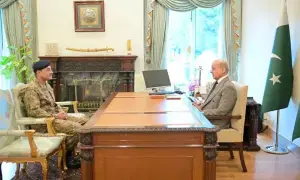
Back to the NCA meeting: the logic for mini nukes that was developed, and possibly has been operationalised, by the SPD, the military-run secretariat of the NCA, the apex nuclear policy body, was given an official imprimatur this week.
With or without the endorsement of the NCA, the SPD was going to do what it has deemed necessary in the national interest. That’s the civil-military imbalance right there.
But the NCA is, theoretically, a civilian-led body. Why would Nawaz, who heads the NCA as prime minister, want to give civilian endorsement to a military doctrine whose contours and implications have never been debated?
Possibly the civilians don’t have a clue what they have endorsed, possibly they don’t really care. But not knowing or not caring doesn’t equal to not having any effect.
Nawaz wants better ties with India. But India’s ties with Pakistan are premised on what Pakistan — ie the state, the sum of the civilians and the military — does, not what the civilians want.
The crazies and hardliners in India — and yes, for every crazy and hardliner here, India probably has two, or more, of its own — will look at full-spectrum deterrence and think, hmm, what Pakistan is really trying to do is retain the option of another Mumbai.
And now that the civilians have, almost surely unwittingly, endorsed full-spectrum deterrence, why should the Indians take Nawaz at face value or believe the already impossible, that the military will let the civilians lead on India relations?
A clueless prime minister or a complicit prime minister — neither look any good.
The truly astonishing thing about the Nawaz-led NCA endorsement of full-spectrum deterrence is that it wasn’t the point of the meeting to begin with.
The point was The Washington Post revelations of hyper American scrutiny of Pakistan’s nuclear programme and the possibility that nuclear paraphernalia could fall into the hands of militants.
Publicly, all the NCA had to say was: relax, everybody, we’ve got the safety and security of the nuclear programme under control.
That would have worked because a) it’s reasonably true and b) it’s not like the US leaked the secret information to the media — in fact, there’s a very conscious attempt to not publicly pressure Pakistan on its nuclear deterrent at the moment.
Privately, the NCA did have some work to do. The WaPo story gave cold, hard details of a massive American surveillance and intelligence-gathering effort against core assets of national defence: any time a state is given such information, it has to re-evaluate its defences and see where counter-intelligence needs to be beefed up.
That’s a job for both the civilians and the military. As the controversy several years ago over the surge of so-called American diplomats to Pakistan demonstrated, civilian alacrity is needed in something as simple as visa applications.
Incredibly, however, the Nawaz-led NCA strayed from the relatively straightforward public task and the more complex covert work necessitated by the Post’s revelations and ventured into the realm of full-spectrum deterrence.
That the smaller, military-doctrine tail has wagged the bigger, national-security dog since forever is the very basis of Pakistan’s problematic national-security articulation and structure.
Why on earth would Nawaz perpetuate that? Does he even know he has helped perpetuate it? Maybe he doesn’t know, maybe he doesn’t care — but then right there is the road to civ-mil perdition.
The writer is a member of staff.
cyril.a@gmail.com
Twitter: @cyalm