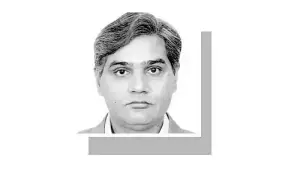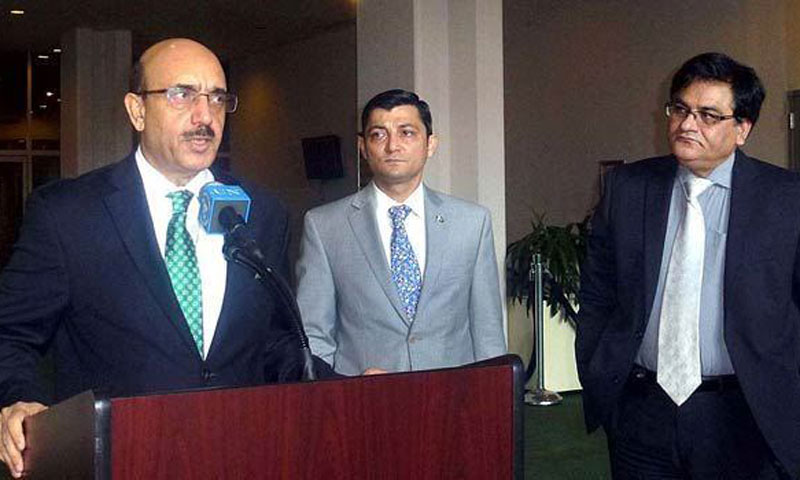
UNITED NATIONS: Pakistan’s Ambassador to the United Nations Masood Khan has said Pakistan needs to convince the Americans to cease drone attacks as part of their drawdown from Afghanistan and to revisit their military doctrine that justifies use of armed drones.“What is required is more intense, results-based engagement with the United States,” the veteran diplomat said in an interview with Dawn.
Mr Khan said: “Our legal arguments are sound and compelling. Armed drones violate Pakistan’s sovereignty. Their use infringes the principles of distinction and proportionality recognised by international humanitarian law, as applicable to asymmetrical conflicts. There is also geographical is junction between the location of drone strikes and primary battlefields.
A signature strike must be justified under IHL even if it is a legitimate act of self-defence under Article 51 of the UN Charter.
“Moreover, we argue that the use of drone attacks is counter-productive.
These attacks incense and alienate local population because of civilian casualties, whip up anti-government and anti-US sentiment, and enhance space for terrorists to win over fresh recruits for their cause. They also put the entire population of Pakistan – from Gilgit-Baltistan to Karachi – at risk of reprisal attacks.”
Masood Khan who arrived here last October from China having served there for three years as ambassador is in fact a familiar sight in the corridors of world body since he served here as Pakistan’s counsellor officer at the United Nations.
When asked what were Pakistan’s priorities in the United Nations, especially in the Security Council of which Pakistan is a non-permanent member, he said: In the UN Security Council we have contributed to the efforts to bring peace and security in Syria, the Middle East, and many parts of Africa. In many parts of Africa, for instance Somalia, Liberia, Cote d’Ivoire, Sierra
Leone, there has been a dramatic improvement. In the Democratic Republic of Congo and Mali, the situation remains complex and fraught with volatility. We are working with other Council members to steer these countries towards stability.
He was asked why the council had been inactive on Syria.
Mr Khan said the council had been quite active on the Syrian crisis. “It has supported Secretary General Ban Ki-moon’s efforts through Mr Lakhdar Brahimi, who is the Joint Special Representative of the United Nations and the Arab League. We sit together to deliberate to end the carnage in Syria and to find our way through the impasse in the Council”.
Four fault lines seem to undermine these efforts. One, the Syrian government and the opposition believe a military solution and each side believes that it can prevail militarily. Two, the veto wielding Council members are divided on how to proceed diplomatically through the Geneva process, with one side supporting the opposition while the other backing the government. Three, regional countries have become directly involved by receiving refugees and supplying arms. Four, the Geneva process sputters mainly because of bad faith. Neither side is yet ready for a smooth transition.
Answering a question about Afghanistan, he said the United Nations was in the process of assessing its role in the run up to 2014 and after that. “My sense is that its role will increase. There are multiple transitions – political, electoral, security, national reconciliation, and economic — taking place in Afghanistan in the next two years. The United Nations can play an important role in all these processes. And I believe it will.”
He said Pakistan believed that stability in Pakistan depended on peace and stability in Afghanistan. “For the past 34 years, Pakistan has absorbed the spillover and blowback of the Afghan conflict. We have hosted millions of refugees. Even today, there are … refugees on Pakistani soil. Terrorists, weapons, and narcotics trafficking have played havoc with our polity and society.”
With peace next door, he said, the people of Pakistan could live in peace.
“We also want that together with Afghanistan, we should work for cooperative economic development, and greater regional connectivity. Peace and stability in Afghanistan is a key constituent of Pakistan’s foreign policy, which is supported by all state institutions. The success of this policy requires reciprocity, trust and goodwill.”