LAC-MEGANTIC (Quebec): It was surely the most festive spot in town as a Friday night turned into a Saturday morning at the Musi-Cafe — a full house, live music, plenty of beer and nachos to animate long-time friends. Among the dozens enjoying themselves in the pub was a sizable contingent of the Lafontaine clan, celebrating the 40th birthday of a daughter of prominent local businessman Raymond Lafontaine.
Four days later — having lost a son and two daughters-in-law who were among the revellers — Lafontaine stood near a throng of reporters on a street near the town centre, watching them pepper an American railroad executive with questions.
“I wanted to see my children’s killer,” Lafontaine said. “And I wanted to see the killer of other people from here who didn’t ask to die.” Any possible culpability on the part of the railway remains to be determined; police say their criminal investigation will proceed slowly and carefully. But it is fact that an unmanned Montreal, Maine and Atlantic freight train with 72 cars carrying shale oil turned into a runaway death machine — rolling away from its overnight parking spot, barrelling for miles down an incline in the dark of night, derailing in the heart of Lac-Megantic at 1:14 am on July 6, and snuffing out 50 lives when a series of explosions set off a ferocious fire. For some, it became known as “the train of death.” For others in the close-knit, French-speaking town, it was “le train d’enfer” — or “the train from hell.”
Some residents have suggested that the train disaster is comparable in its impact on their town to how the Sept. 11, 2001, terrorist attacks affected New York City. And indeed there are similarities — sudden, deadly conflagrations; victims whose virtually vaporised remains defied easy identification; the circulation of photos of the missing, posted by relatives clinging to faint hopes that somehow their loved ones might be seen alive somewher
In mid-week, those hopes were largely dashed when Quebec police informed families that the people still listed as missing were presumed dead.
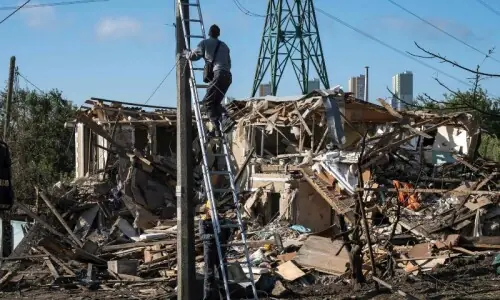
The explosions and fire destroyed 30 buildings in all, including the public library that housed irreplaceable historical archives. Roughly 2,000 people — a third of the populace — was ordered to evacuate their homes, and the town’s central business district was cordoned off throughout the week, keeping out journalists and townspeople while scores of police officers and other emergency responders searched for remains of victims and sought clues to aid a criminal investigation of the crash. Several hundred of the evacuees took shelter at the local high school, under the care of the Canadian Red Cross and other agencies.
French-speaking province, Lac-Megantic has much in common with some communities in neighbouring New Hampshire and Maine — its economy encompasses a range of blue-collar industries, but it relies heavily on tourism in the summer.
The three-term mayor, Colette Roy-Laroche, maintained a confident, forward-looking tone throughout the week, urging tourists not to cancel summer reservations, assuring that the lake was safe to swim in.—AP