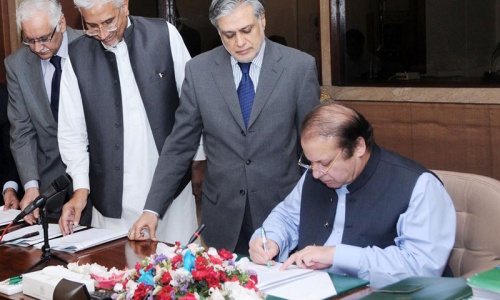
ISLAMABAD: The PML-N government unveiled on Wednesday its first budget which tried to tackle the economic and energy mess the country is facing with ambitious moves on revenue expansion, expenditure cuts and populist incentives for the youth and business.
As a result, in one go it set an ambitious target of reducing fiscal deficit by 2.5 per cent of GDP or Rs375 billion — bringing down subsidies by Rs127bn, additional tax measures of Rs205bn and austerity measures of about Rs41bn — in the fiscal year 2013-14.
Another Rs250bn in FBR tax is anticipated to automatically accrue because of 4.4pc growth in economy and 8pc inflation. As a result, the Federal Board of Revenue has been given a target of Rs2.475 trillion, an increase of 22.5pc from the current year’s expected collection of Rs2.020tr.
In his budget speech, Finance Minister Senator Ishaq Dar said fiscal deficit which is estimated at record 8.8pc of GDP this year translating into Rs2.024tr would be brought down to 6.3pc of GDP or Rs1.651tr during the next fiscal year and make a further gradual reduction to 4pc over the next three years.
The deficit would be financed through Rs1.482tr of domestic financing, a major part of Rs975bn through borrowing from commercial banks and Rs169bn of external loans.
A departure from traditional annual salary increases, the government did not offer any relief to government servants perhaps to absorb the impact of over 125pc jump over the past five years, but provided a 10pc increase in pension with minimum pension at Rs5,000 instead of Rs3,000 per month.
The finance minister also announced a 30pc reduction in non-salary expenditure of all ministries and divisions, including reducing the number of federal ministries from 40 to 28. He announced a reduction in the Prime Minister Secretariat’s expenditure by 45pc to Rs396 million from Rs725m.
All these measures would save about Rs40bn.
The government slightly increased income tax rates. Those earning Rs30m a year would pay 5pc more. Besides other taxation measures like withdrawal of exemptions, the hallmark of the taxation side was a one per cent increase in general sales tax on all sales -- from 16 to 17pc. It will fetch over Rs50bn.
Wealth tax has been revived.
Mr Dar said the budget put before the nation an “economic vision” and its consistent implementation would take forward the country and regain its lost image and respect in the comity of nations.
He said all indicators from economic development to prices and revenues to expenditure, public debt and circular debt, monetary expansion and exchange rate and balance of payment did not suggest the affairs were being run in the national interest and it appeared as if the economic system was on an “auto pilot mode”.
He said the public debt which had stood at Rs5.6 trillion on March 31, 2008, was estimated to reach Rs14.3tr or 63.5pc of GDP. Likewise, the retirement of central bank debt at Rs1.4tr which was to be eradicated in eight years had in fact been increased to Rs2.3tr, making it difficult for the current government to retire it in six years with average Rs400bn per year.
Confusion over budget size The confusion over government’s figures emerged soon after the budget speech ended. The budget documents put the total outlay of the budget at Rs3.985 trillion, about 14.8pc higher than the current year’s revised estimate of Rs3.478tr.
But the finance minister in his speech said the estimate for overall expenditure for the next year was estimated at Rs3.591tr, against the current year’s revised estimate of Rs3.577tr, showing a “negligible increase” of less than 0.4pc and a “first sign of austere budget in line with imperatives of the economy”.
Similarly, the budget documents put the next year’s current expenditures at Rs3.196tr, compared to the current year’s revised expenditure of Rs2.907tr, up by 9.94pc. But Mr Dar said the current expenditure was “estimated at Rs2.829tr, against a revised estimate of Rs2.720tr for the current year, showing an increase of 4pc”.
Despite repeated attempts, Finance Secretary Dr Waqar Masood Khan and Adviser on Finance Rana Assad Amin were not taking calls to explain these glaring discrepancies.
Total development expenditure for the next fiscal year has been pitched at Rs789bn against the current year’s Rs571bn, up by 38pc. Of this, federal PSDP has been put at Rs540bn against this year’s Rs388bn, up by 39pc. Another Rs171bn has been estimated for development for next year to be arranged by corporations like Wapda, against the current year’s Rs107bn.
The defence budget for the next year has been estimated at Rs627bn, an increase of 10pc, against the current year’s revised expenditure of Rs570bn.
An amount of Rs1.154 trillion has been allocated for interest payments.
Pension budget has been estimated at Rs171bn.
Subsidies and energy The government has set aside Rs240bn for indirect subsidies, compared to this year’s Rs367 billion, showing a reduction of Rs127bn or about 35pc.
The power sector will see a substantial reduction of 38pc in subsidies from Rs265bn to Rs165bn. Of this, inter-Disco (distribution companies) tariff differential subsidy has been brought down by 40pc to Rs150bn from Rs250bn. The tariff differential subsidy for KESC has also been reduced by 34.5pc to Rs55bn from Rs84bn.
Although the finance minister said a comprehensive recovery plan for the energy sector would be separately announced by the prime minister soon, he reiterated to end the circular debt in 60 days, run all power plants at maximum possible capacity, reduce loadshedding and take steps to stop recurring of the circular debt.
To this end, Mr Dar said the office of federal adjuster would be reorganised to recover unpaid bills by the provincial governments – a hint for at-source deduction of electricity bills out of provincial share in the federal divisible pool.
Likewise, he said the 425MW Nandipur project would be revived in a few weeks. The project’s cost had increased from Rs23bn to Rs57bn because of “criminal negligence” of the previous government, he alleged.
Separately, an amount of Rs228bn will be provided to the power sector through development budget.
The estimates for total tax revenue for the next year have been set at Rs2.598tr, against this year’s Rs2.12tr. It includes direct taxes of Rs975bn and indirect taxes of Rs1.62tr. The estimates for non-tax revenue have been put at Rs822bn, compared to this year’s Rs711bn.
The finance minister said the government would soon auction third generation telecom licences in a transparent manner and recover $800m from UAE’s Etisalat on account of PTCL privatisation proceeds held up for five years to become integral part of non-tax revenue besides entering into capital markets for additional resource mobilisation.
Incentives for business The finance minister announced that maximum corporate tax rate would be reduced by one per cent annually from 2014-15 to bring it down to 30pc from the existing 35pc to promote the culture of corporatisation. Likewise, income tax exemption for investment in special economic zones would be increased to 10 years from five years.
To facilitate the transport sector, income tax paid along with provincial motor vehicle tax has been made adjustable. To provide a level-playing field to all taxpayers, the facility of carry forward of unadjusted minimum tax available to the corporate sector will also be available to the non-corporate tax sector.
Talking about the reform in income tax, Mr Dar said withholding tax would be imposed on hotels, clubs, marriage halls and restaurants to encourage them to file tax returns.
The budget applied a minimum tax on builders and developers at the rate of Rs50 per square foot of the constructed area or Rs100 per sq. yard of the developed land.
To tax affluent class on the basis of its expenses, adjustable withholding tax will be introduced at 5pc on annual fee of Rs200,000 paid to an educational institution.
An additional sales tax of 5pc has been imposed on electricity and gas bills for the unregistered consumers having commercial or industrial connections. It will come to an end when they register themselves.
Stipend for youth The youth with 16 years of education will be given Rs10,000 per month as stipend, with training for one year if they are unable to get a job. The government would also provide loans of Rs100,000 to Rs2m at 8pc mark-up to the youth to start their own business. In the first year, 50,000 youths will be provided loans for which the government would pick up the mark-up more than 8pc.
To replicate the laptop distribution scheme of the Punjab government, the centre would provide free laptops to distinguished students of higher education on a merit scheme to be developed by the Higher Education Scheme.
Likewise, tuition fees of students of less developed areas like interior Sindh, Multan, Bahawalpur and D.G. Khan pursuing masters and doctorate degrees would be borne by the government while a Rs5bn Qarze Hasna scheme would be introduced for micro enterprise activities.