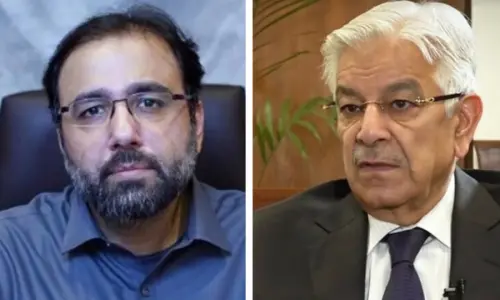
THE ghosts of Pakistan's violent political past continue to haunt the country. Extraordinary statements by a former IB chief and a former corps commander of Karachi have triggered a bitter row between the MQM and PML-N this week. First, some history. During Nawaz Sharif's first tenure as prime minister, Sindh was facing a grave law and order crisis. Banditry had reached epidemic levels in the interior of the province and the cities in the south were unsettled. At the time, the MQM and the Nawaz Sharif-led alliance, the IJI, were in government together, but the MQM was blamed for fomenting the crisis and the army was called in to deal with the issue. As is the nature of such matters, few things are known for certain. It does seem though that the PML and the MQM were sucked into a conflict where other players, such as President Ghulam Ishaq Khan and army chief Asif Nawaz, had other agendas and axes to grind. The upshot was that the MQM was weakened as a party and its reputation sullied by the allegation that it wanted a separate homeland, the so-called Jinnahpur, which stretched from Karachi to Thatta.
Now, Brig Imtiaz Ahmed (retd), formerly close to Mr Sharif and rumoured to have had his recent overtures to the PML-N rebuffed, along with Gen Naseer Akhtar (retd) has claimed that the Jinnahpur maps were fake and the separatist claim baseless. The MQM has leapt on the admissions and gone into overdrive to proclaim its bona fides as a Pakistani party that was maliciously slandered by its opponents. Puzzling as the timing of the retired army officials' statements is and unseemly as the MQM-PML-N spat is, Altaf Hussain has perhaps made the most pertinent suggestion the need for a truth and reconciliation commission. In truth, few political parties in this country can claim to have clean hands when it comes to dealing with one another. So perhaps, as they collectively steer the country's latest transition to democracy, what the parties need most is to demonstrate that they can bury the past and genuinely work with one another towards institutional stability. A truth and reconciliation committee would be an important first step in that direction.