0
0

Reviewed by Mahvesh Murad
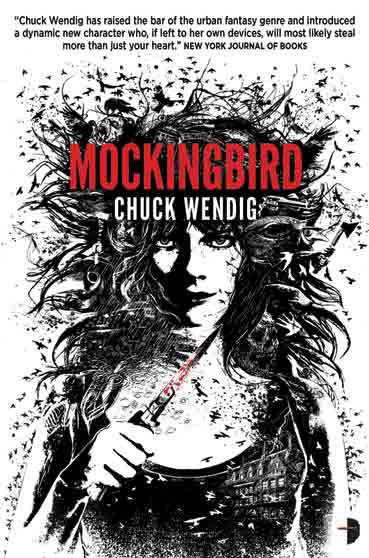
Miriam Black is back and she’s worse than ever. She has been cooped up in a trailer park surrounded by meth addicts, spending her days working at a grocery store where she wears gloves to keep her ‘gift’ at bay. Meanwhile Louis, her would-be saviour, is always away on the road. Of course, trapped as she is, she’s a ticking time bomb in Mockingbird, especially in the hands of Chuck Wendig, who is craftier than ever.
Miriam entered the lives of urban fantasy fans in Wendigs’s Blackbirds. She’s a perfectly nasty individual, the kind of fast-talking, hard-drinking grifter who no one would ever expect to be the protagonist of a story — or for that matter, even expect to be an empathetic protagonist — but she is. Of course, her special ‘gift’ never allows her to be the ordinary sort of hard-boiled hero — Miriam can tell by touching people when and how they will die. Many of her own demons feed off her intense need to use this gift and hence, to look death in the face. She is, no matter how hard she has been trying, unable to live like everyone else, to resist “that urge, that familiar urge, the tingle in the tips of her fingers and the sweat-slick creases of her palm.”
She finds herself in a strange situation when she agrees to help out a friend of Louis’ by using her ability as a sort of litmus test for the terminally ill. Because this is Miriam Black, anti-hero hero extraordinaire, nothing can be straight forward. At a private school for troubled young women, Miriam comes into accidental contact with a number of girls who seem to have very similar, gruesome ritualised deaths ahead of them. She has visions of young women gagged with barbed wire, tied up and tortured, but she has no idea who is behind the murders-to-be. In trying to find out more and save the women who are heading towards a slow, painful death, Miriam finds herself embroiled in a much larger and far more evil scheme than any one could have expected — least of all her.
Once again Wendig has not written for the faint of heart. Admittedly, the urban fiction genre itself is defined by a certain amount of grit, profanity and violence but Wendig pushes the limits of the language until everything is stretched taut and sharp, but his command over the story is supreme. Never does a character or an arc get away from him. Much like Blackbirds, the narrative structure of Mockingbird is both very well-planned and executed, with no loose ends. This book is a stellar example of how an organised plan can take a narrative much, much further in terms of pacing of action and readability. Wendig writes on his blog, “For me, outlines are like vitamins. Nobody wants to take ‘em. But when I do, I feel better.”
That Miriam is a bit of a train wreck was established in Blackbirds. That she is not a stagnant one is explored further in Mockingbird. There is a risk when a single protagonist is the anchor for an entire series of books, such as these. There is a chance that readers will become bored with the protagonist, or worse still, they will find the character and her actions predictable. No such risk with Miriam Black though, since she grows quite steadily through both books. Mockingbird explores her background, her childhood and her family in order to understand her better. Potential of further exploration of her relationship with her estranged mother is offered up as well. Of course, Mockingbird can just as well be read as a stand-alone novel, but even as the middle part of a series there’s no danger of repetition or of a formulaic plot — Wendig appears to have enough tricks up his sleeve to up the ante with each installment.
The element of fantasy in this series is played out better, and with deeper understanding, in Mockingbird. Miriam’s own personal demons appear to her in a variety of forms, including as deceased past lovers and talking blackbirds. They take on a more important role, adding to the element of mystery surrounding Miriam’s ability. References to Poe’s raven, avian names and situations are linked thematically and are spread through the book with more sensitivity than in most standard popular crime fiction. But for all of Wendig’s craft, his ultimate strength lies in the pace of the novel — Mockingbird is much like its protagonist: relentless, violent and arresting. It is a lean, mean, ugly little beastie that wants to skulk around the dirtiest corners of your mind, dragging in all sorts of filth with it.
Mockingbird
(Novel)
By Chuck Wendig
Angry Robot Books, UK
ISBN 9780857662323
384pp.