0
0
PARIS: Euro 2012 co-hosts Ukraine have repeatedly insisted that sport and politics don't mix, amid threats from European leaders to boycott games in the former Soviet state over the treatment of a jailed opposition leader.
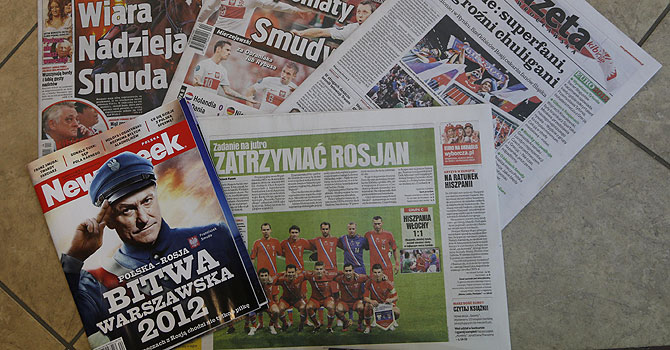
But history and geopolitics are an inescapable feature of the tournament, on the eve of the high-octane Group A clash between Poland and Russia and with other teams in the showpiece international competition sharing bloody and painful histories.
Present woes have not been absent either, with a number of the 16 countries taking part hard hit by the eurozone debt crisis, including the title-holders Spain, and dedicating their campaigns to putting a smile back on their compatriots' faces.
Sporting encounters between Poland and Russia always have an extra edge due to antipathy spanning the Tsarist and Soviet eras, stoked by Moscow's resurgence under Kremlin strongman Vladimir Putin.
Nevertheless, some of the language used by politicians and the press, particularly in Poland, has left few in doubt that the legacy of the iron rule imposed by successive Polish governments at the behest of communist Russia still weighs heavily.
Poland winger Kamil Gronicki summed up the mood in the co-hosts squad before Tuesday's game.
“We all know what a match against the Russians means. It is one of those games -- against Russia or Germany -- where, speaking colloquially, you have to leave your guts on the pitch,” he told reporters.
The European championships have moved on, though, from the days when some teams refused to play one another for geopolitical or ideological reasons.
In 1960, fascist dictator General Francisco Franco withdrew the Spanish team before they were due to play the communist Soviet Union in the quarter-finals, although he had no qualms four years later when the two sides faced each other in the final in Madrid.
Spain won the match 2-1.
Germany are among the tournament favourites, but for many Poles the present-day generation is still seen through the prism of atrocities committed by the Nazi regime on Polish soil in World War II.
Nazi crimes against the Poles, though, are not what is most associated with their occupation but the concentration and death camp at Auschwitz-Birkenau in southern Poland, where 1.3 million people from across Europe perished, most of them Jews.
It was in this context that a delegation from the German football federation, including Polish players Lukas Podolski and Miroslav Klose, toured Auschwitz before the tournament began in a visit loaded with symbolism. Similar, but less well-known ghosts, may re-emerge should Germany progress to the final in the Ukrainian capital, Kiev, which suffered significant damage during World War II and was occupied by Nazi troops.
Ukraine was also the site of the worst mass-killings on the eastern front, when nearly 34,000 Jews were killed in a single day at Babi Yar in 1941 in retaliation for a Soviet attack on German military and civil installations in Kiev.
Tournament co-host Ukraine may no longer be part of the former Soviet Union but it has found it hard to free the shackles of history.
An AFP reporter in the Euro 2012 host city Lviv, in western Ukraine, last week witnessed a demonstration by purists of the Ukrainian language against attempts to make Russian an official language.
A feminist group famous for bare-breasted protests meanwhile has already used the high profile of the tournament to highlight Ukraine's human rights record and Russia is facing a UEFA fine after its fans displayed “Russian Empire” flags at one game.
The flags are seen as deeply provocative in some parts of eastern Europe that used to be under Moscow's thumb.
During the Auschwitz visit, the head of the German football federation Wolfgang Niersbach evoked the former German president Richard von Weizsaecker who said: “Whoever closes his eyes to the past is blind to the present.”During Euro 2012, the past has been unavoidable.