0
0

LAHORE, May 24: At least 14-hour loadshedding for cities and more than 20-hour power suspension for rural areas returned to the country on Thursday -- a week after President Asif Ali Zardari came up with a promise “to improve the situation.”
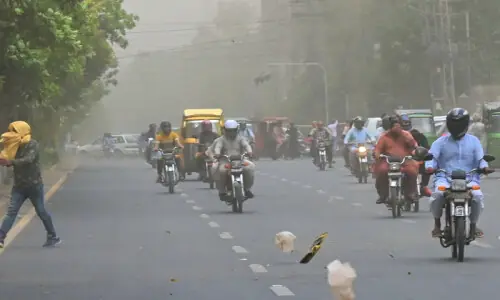
On Thursday, the electricity shortfall shot beyond 50 per cent as scorching heat gripped the plains of Sindh and Punjab, with demand increasing beyond 17,000MW and generation decreasing below 9,000MW.
The situation was so bad that even official figures (from the same source – National Transmission and Dispatch Company) about shortage differed grossly. In the morning, it claimed that shortfall had jumped to 6,000MW but in a press release in the evening, it said the deficit was 5,000MW.
Sources said it was actually more than 8,500MW, particularly during the peak hours (7pm to 11pm).
According to Thursday’s figures, which differed from one official to another, the power generation was just below 9,000MW and demand well above 17,000MW. The hydel contribution, which according to the Pepco officials was 3,760MW, was actually, on average, 3,000MW.
Similarly, Pepco’s own thermal units generated only 1,300MW against a capacity of over 2,500MW. The contribution from the Independent Power Producers (IPPs) was 6,000MW, they said.
“Actually, the situation is so bad that no one is ready to own it, especially for political and social fallout,” said an official of the ministry. The kind of loadshedding being carried out throughout the country suggests there is no electricity. It is almost a national emergency situation. “Everyone knows that shortly it would rekindle protests and violence. For this reason, no official is ready to own or offer any solution. Everyone is waiting for the president to act. Meanwhile, the situation keeps worsening as there is no money, no solution and no political will,” he regretted.
“The smaller IPPs, which put the government on sovereign default notice, have still not got any money despite repeated promises,” said a CEO of an IPP. The solution that the ministry, after prolong and tedious negotiation, offered was: eight IPPs would get capacity payment even when they are not operating because of a lack of payment. Practically, it means nothing as far as the generation is concerned. The crisis is payment for fuel. As long the IPPs don’t get that, they would not be able to operate.
Even on Thursday, they were producing half of the capacity, as they were doing when they put the government on notice.
Once people take to the street and social and political pressure builds up, the government wakes up to the crisis for a while.
Meanwhile, an NTDC press release blamed 2,000MW drop in hydel generation as a cause of crisis, saying poor hydrology is causing the problem. Otherwise, the NTDC has added over 600MW to the national grid in the last few days.