2
2

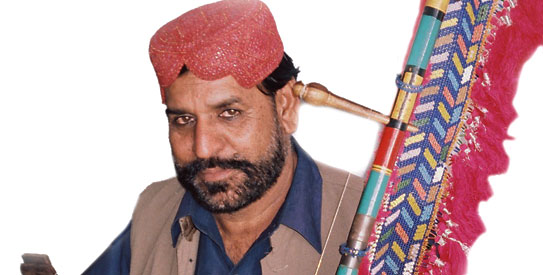
One may come across many wandering musicians in different towns and villages of the Larkana district who earn their livelihood by playing traditional musical instruments and singing folk songs. In Nasirabad, Warah, Lalu Rank, Badah, Dokri and Wagan towns, there are many faqirs of Chanan Jan (Malamatiya Sufi) playing yaktaro (one-string instrument) and sufi songs praising their mentors.
Khedkar, a small village located on the right bank of Ghar Wah in Larkana district, is famous for Sufi singers and sarozi faqirs (fiddle players). This village has produced many eminent singers, including Wazir Ali Kalhoro.
Born in 1940 in the Khedkar village, Wazir Ali Kalhoro at 14, began learning music from his father Haji Khan Kalhoro and Muhammad Achar Mangi, a close friend of his father. Both Haji Khan and Muhammad Achar Mangi used to sing at akharo (monastic establishment) of Syed Ghulam Shah where Wazir Ali Kalhoro first developed his penchant for music and dedicated himself to singing.
Apart from the akharo of Syed Ghulam Shah, Haji Khan Kalhoro and Muhammad Achar also used to sing at the village shrines of Hasan and Mohsin, locally known as Hasu and Masu. Both were the disciples of Mian Nasir Muhammad Kalhoro (1657-1692). Sufi raag recitals were held at the shrines of Hasan and Mohsin on the first Friday of every month. Wazir Ali Kalhoro would always accompany his teachers.
Wazir Ali also remained associated with the akharo of Muhammad Faqir Kalhoro of Walida village, which was then linked with a dargah of Shahpur Jahanain. Here, Wazir Ali Kalhoro learnt from Faqir Ghulam Hyder Manganhar and Muhammad Alam Manganhar who used to sing on yaktaro and chapri. They taught him music in depth and he made eleven yatras (pilgrimages) on foot along with his teachers and sung at the shrine of Makhdoom Hasan at Shahpur Jahanian.
Wazir Ali first performed at the dargah of Muhammad Saleh Shah Qadri in Machhi market (fish market), Larkana. This performance boosted his confidence and established him as a singer. From that day onwards, he began singing at various melas (religious fairs). Later, he sang with his elder brother Nazir Ali Kalhoro. His brothers Muhammad Urs and Ramzan Ali were also well-reputed singers.
Nazir Ali, Muhammad Urus and Ramzan Ali were all devotees of Mehdi Sarkar or Sain of Shahpur Jahanian, Cheezal Shah, Rakhial Shah and Budhal Faqir Unar respectively. In the beginning, Wazir Ali was the devotee of Makhdoom Hasan of Shahpur Jahanian. Later on, he became a devotee of Rakhial Shah and Cheezal Shah of Fatehpur, Jhal Magsi. Both belonged to the Qadri sufi order.
Wazir Ali is associated with the dargah of Fatehpur and sings the poetry of both Rakhial Shah and Cheezal Shah. He has performed many times at the dargahs of his mentors. Besides, he also performed at the shrines of Hasan and Mohsin at Khedkar, Mehdi Sarkar at Shahpur Jahanian, Mian Shahal Muhammad Kalhoro, Mian Jan Muhmmad Kalhoro at Naudero, Tariq Faqir at Lalu Rank, Shah Nasir at Nowshero Feroz, Pir Sher at Larkana, Karam Ali Attar near Ghar Wah, Shah Abdul Latif Bhitai, Sachal Sarmast and Shaheed Shah Inayat of Jhok Sharif.
Wazir Ali has produced many singers of yaktaro and chapri including Masoom Faqir Gopang, Rajib Faqir Mughari, Munir Channo of Larkana, Ghulam Shabir Kalhoro and Noor Muhammad Khaskheli of Shahdadkot, Nihal Faqir Umrani of Garhi Ghairo, etc. The tradition of singing with yaktaro and chapri is deeply embedded in Sindhi culture. Many singers followed in the footsteps of Jalal Chandio (1944-2001), who was known as the king of yaktaro-chapri, including Rubina Hyderi, Gul Hasan Mirani, Subhan Chachar, Ghulam Hussain Umrani, Muhammad Urs Chandio, Nabi Baksh Chandio and Jigar Jalal.
A number of music clubs in Larkana provide a platform to singers to learn music. Newcomers are encouraged to sing on yaktaro and chapri which are symbols of rustic life. Nowadays, Wazir Ali Kalhoro runs a store on Qamber-Larkana road and finds little time for singing. However, for festivals, he accompanies his students to many dargahs providing guidance during their live performances. Sometimes, he performs as well. Presently, he only sings at the dargahs of Rakhial Shah and Cheezal Shah.
The writer is a research anthropologist at Pakistan Institute of Development Economics (PIDE), Islamabad.