0
0
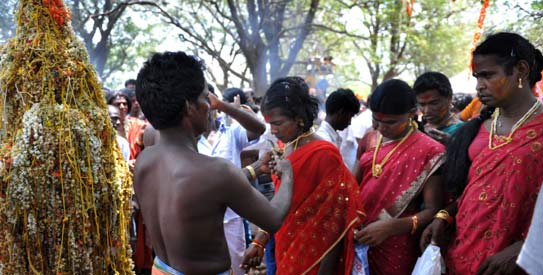
KOOVAGAM, India: Jyoti, a 62-year-old transgender Indian who was born a man, saves up money every year to buy a beautiful new wedding dress for a festival at which she gets married to a Hindu god.
This year, she played her role as a “bride” wearing a blue silk brocade sari that cost 15,000 rupees ($338) — nearly two months' earnings.
The “groom” at the annual festival in Koovagam, Tamil Nadu, was Aravan, a Hindu god celebrated as a young warrior who was killed in the ancient epic, the Mahabharata.
Heavily made-up and dripping with gold jewellery, hundreds of transgender brides excitedly discussed their wedding plans as they queued to marry Aravan in his temple.
“I have been attending the festival for 15 years,” said Jyoti, who lives in Mumbai, where like other transgender groups she makes money through donations collected at birth ceremonies and other family occasions.
“On my wedding day, I always wear real gold earrings, a necklace, bangles, anklets, and have jasmine flowers in my hair,” she said. “I do this once a year.”
The wedding date, decided according to the Tamil calendar, is the climax of an 18-day spring festival honouring Aravan.
According to Hindu mythology, before he went into battle knowing he would die, Aravan asked the god Krishna for one night with a woman.
Unable to find a woman willing to be widowed, Krishna transformed himself into a beautiful woman, Mohini, and spent the night with Aravan.
The tale resulted in Aravan becoming a patron god of transgender people and, for hundreds of years, they have been participating in mass weddings with the deity at the Koothandavar temple in Koovagam.
Janaki, a catering manager from the south Indian city of Coimbatore, explained that the festival was a celebration of a lifestyle that often attracts disgust and violence.
“My heart is happy to be here, where I get lots of love from friends,” she said. “I have no fear. I come here and I feel good. I feel like a woman. I sing and dance, today I will stay with god. I look forward to this day all year.”
Janaki headed deep inside the tiny, drab temple for her “marriage” to a small statue of Aravan bedecked with flowers.
The priest tied a thaali (wedding necklace) made of yellow thread around her neck, making her Aravan's bride.
She emerged from a crush of people with a huge smile on her face.
“I am hot and sweaty but I feel great. I am married to god for the day, just one day,” she said, before joining her friends in a celebratory dance.
“I feel great peace after I come here. I know everything will go well the rest of the year, that I will be successful.”
Many transgender women at the festival said their sexuality meant they were rejected by their families and forced into a life of living rough, often suffering beatings and sexual abuse.
Such painful memories are banished as thousands of transgender groups — including transvestites and eunuchs — gather to share in the communal experience of being married to a god.
Although transgender Indians have made progress, particularly in Tamil Nadu, where the government pays for sex reassignment surgery, and where they were allowed to vote for the first time as a “third gender” in recent state elections, many still live on the margins of society.
Few are able to land decent jobs, and most of them work in the sex trade or beg for money.
Radha Amma, the 60-year-old president of a transgender rights group near Koovagam, first attended the festival 30 years ago when few turned up to celebrate with her.
“Then, we were more afraid of society,” she said. “Now we want to show people who we are.”
A few hours after the wedding ceremonies ended, a party began in the village.
Stall-owners tried to entice customers with hot food, incense, and flowers, and an elephant “blessed” those present with a touch of its trunk in exchange for a fee to its keeper.
A group of happy brides danced around a bonfire while a male crowd lustily cheered them on.
In the midst of all the revelry, state government officials distributed thousands of condoms.
The next morning, used condoms, rubber sandals, paper and plastic waste littered the fields surrounding the temple.
In a dramatic finale to the festival, small groups of brides walked to a field near the temple in sweltering heat.
As each woman came forward, one of the priests took a knife to her thaali, his blade slicing through the yellow thread, before he flung the thread onto a statue of Aravan.
Then the priest held a coconut husk next to her wrist and smashed off her bangles, signalling she had been widowed by Aravan's death in battle.
The mourning began.
The women sat on the ground, beating their breasts and wailed “Oh mother, oh sister, woe is me, poor me.”
The remnants of last night's jasmine still stuck in their dishevelled hair, their saris partly undone, sweat glistened on their skin as they screamed to the skies “Why did you take him away?”
Mohana, 29, from Bangalore, sobbed loudly.
“I have no father, no brother, no one, only god.”