19
19
Chief Justice Mian Saqib Nisar on Thursday acknowledged it was a difficult task to explain Articles 62 and 63 of the Constitution, while Advocate Asma Jahangir argued that disqualification under Article 62 (1)(f) should not be more than five years.
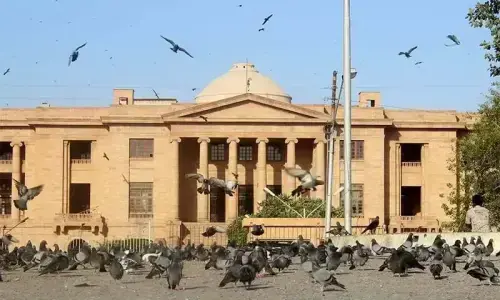
A five-member bench of the apex court ─ headed by Chief Justice Saqib Nisar and comprising Justice Sheikh Azmat Saeed, Justice Umar Ata Bandial, Justice Ijazul Ahsan and Justice Sajjad Ali Shah ─ has taken up 17 appeals against the disqualification of lawmakers.
Article 62(1)(f), which sets the precondition for a member of parliament to be "sadiq and ameen" (honest and righteous), had provided the grounds for the disqualification of the former premier from holding public office in the July 28, 2017, judgement on the Panama Papers case handed down by the apex court.
On Thursday, Asma Jahangir, representing former Pakistan Tehreek-i-Insaf (PTI) MNA Rai Hasan Nawaz who was disqualified by an election tribunal over non-disclosure of assets, termed the Article 62 (1)(f) as vague.
She said disqualifications under Article 62 (1)(f) should not be more than five years. She argued in favour of her plea and urged the bench to tackle Article 62 and 63 as interconnected.
The advocate further said that before 1985 court orders were not mandatory for the disqualification of a legislator. She went on to say that making bachelor degree compulsory had also limited the options for voters.
Under what procedure the fame or character of a person will be established, she asked. "Which court will declare the character of a person?"
The chief justice said the Article 62 and 63, both are independent Articles. He said disqualification under the law will be valid till the declaration is admissible. He, however, said that describing the Article would be a difficult task.
Presenting her arguments, Jahangir said the parliament should undertake decision making. How can the judiciary do what the parliament did not, she questioned. Jahangir also raised the issue of freedom of the parliament, however, the chief justice rejected the impression that the parliament was not free.
In response to her questions, Justice Umar Atta Bandiyal said the court could resolve solid questions and not assumptions.
After Jahangir completed her arguments, the bench adjourned the hearing till February 12 and directed the federal Attorney General to appear before the court on the next hearing to present his arguments.
It is pertinent to mention that four of the judges hearing the case, excluding Justice Shah, have given either observations or judgements in the Panama Papers case.