US President Donald Trump's immigration and refugee restrictions are “offensive”, a top Turkish official was quoted as saying on Tuesday, in the first explicit criticism by Ankara of the controversial policy.
Deputy Prime Minister Numan Kurtulmus called on Trump to reconsider the decision, which he said was motivated by Islamophobia, the Haberturk daily reported.
“It is not possible to accept this,” said Kurtulmus, who is also the chief government spokesman, according to the daily. “The policy should be reviewed.”
On Friday, Trump issued an executive order that bars US entry for travellers from seven mainly Muslim countries -- Iran, Iraq, Libya, Somalia, Sudan, Syria and Yemen -- for 90 days.
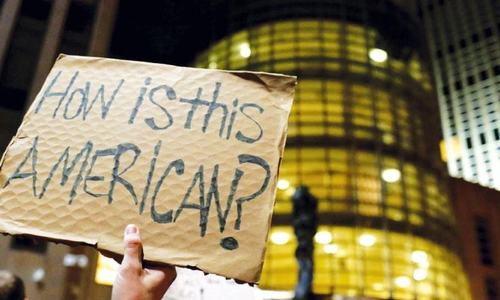
Trump defended the new policy, introduced just a week after he became president and which stirred up fresh protests this week, by saying that it would make the United States safe from “radical Islamic terrorists”.
Kurtulmus blamed rising Islamophobia, anti-immigrant feelings and xenophobia in the West for the decision, calling on the new administration to “correct” the policy.
“It is extremely offensive that such a decision was made in a country like the United States which is known as a nation with all different religions and ethnic groups in a melting pot,” he said.
“It is not correct. It is really a decision that triggers discrimination... None of the countries' citizens can be categorically branded as bad.”
A champion of the fight against Islamophobia, Ankara had until now steered clear of explicit criticism of Trump's move, although Prime Minister Binali Yildirim on Saturday warned against “putting up walls” to solve the refugee crisis.
Turkey is home to some 2.7 million Syrian refugees who have fled from the almost six-year war between rebels and President Bashar al-Assad.
Ankara has high hopes of the new American administration, seeking to amend ties that deteriorated under the Barack Obama over a number of issues including US support for Syrian Kurdish militia.
Last week, US media reported that the Pentagon would be given 90 days to craft a plan to set up “safe zones” in or near Syria -- which Ankara said it would watch closely.