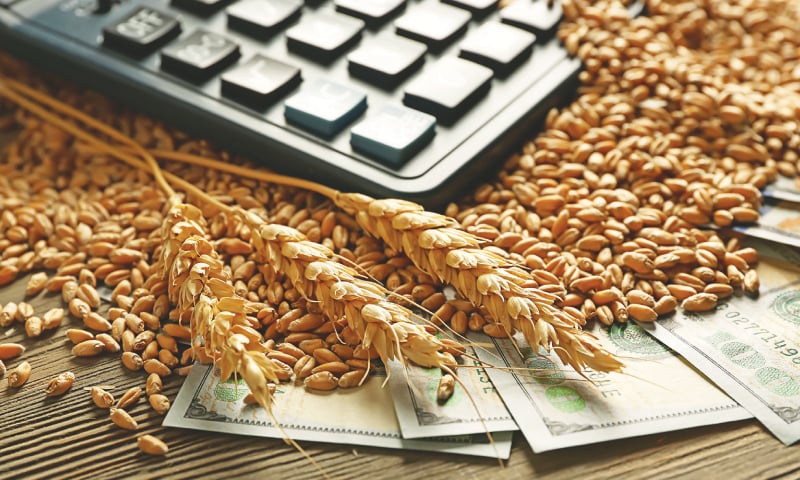
With agriculture under distress for some time now, policymakers seem to be reviewing their policies to shore up a sector that is the backbone to the country’s economy and deserves to be put at the centre of the national development strategy.
The recent speculation that the government would do away with the crop support price was followed last week by the remarks of the Minister for National Food Security and Research, at a press conference, that the ministry is not interested in enhancing the crop support price, and that reducing the cost of production is the ‘ best solution.’
The support price for wheat has been frozen for the past couple of years and sugarcane price — going by this season’s rate of Rs180 per 40 kg, fixed by Sindh — is as much as millers generally paid to sugarcane growers last year in Punjab. The next step, sooner or later, may be the withdrawal of the support prices of wheat and sugarcane if the approach to cutting the cost of production proves to be a success. Lower prices could make local commodities competitive in the international market.
The crutches being provided to the farmers need to be removed as soon as possible, and growers must be helped to stand on their own feet... There is no wisdom in draining agriculture of its resources and then subsidising it
The support price for two major food crops — wheat and sugar — had apparently become counter-productive. Except for growers representatives, who feared that bulk of the farmers would fare badly in the domestic market in the absence of support prices for the two major commodities (that also impacted the prices of other crops), there was a strong criticism by other stakeholders and experts that the support prices were producing an agricultural crisis.
According to the critics, the support price had turned into an indicative price, with the market manipulated purchase price holding sway at the cost of a vast majority of farmers, specially the small growers.
A lot of the government’s money was stuck up in stocks purchased from the market to shore up the falling rates. Export was either subsided or ruled out with domestic prices higher than the international market rate.
The announcement of enhanced support prices was promptly followed by an increase in prices of farm inputs which siphoned off a sizeable portion of the gains intended for farmers.
Similarly, the prices at farm gates are extremely low compared to the urban retail prices of food items, including fruits and vegetables, with the middle men, wholesalers, retailers and transporters all prospering at the cost of the farmers. The end result is that growers’ earnings and investment are sharply reduced due to the transfer of resources from agriculture to the urban economy.
Thus impoverished, a majority of growers cannot afford to buy an adequate quantity of farm inputs. For example, the cutting cost of production as ‘the best solution’ has come on the heels of reports that cultivators cannot afford such essential items as fertiliser; its sales have declined and stocks are piling up at the factories.
The subsidy to farmers turns out to be a real support for fertiliser manufacturers, importers and suppliers. Punjab has gone a step further by announcing Rs100bn interest-free loans for growers. Reduced cost of production of agricultural raw materials would make traditional industries like textiles, sugar mills etc more competitive.
However, the crutches being provided to the farmers need to be removed as soon as possible and growers must be helped stand on their own feet. For this the great challenge is to stop the enormous transfer of resources from the rural to urban areas. There is no wisdom in draining agriculture of its resources and then subsidising it.
The commodity pricing issue, between farmers on the one hand, and the industry and trade on the other hand, needs to be resolved by all stakeholders in their mutual interest to help the government withdraw its intervention. This can only happen when growers acquire strong economic muscle to secure a fair bargain.
The issues in agricultural productivity cannot be resolved without addressing multiple problems facing the countryside. These include: skewed landlord ownership and lack of corporate/cooperative farming; the need for development of a wide network of affordable common facilities for small farmers for mechanised farming, etc.
In short agricultural needs a culture change to revive on a durable basis.
Published in Dawn, Business & Finance weekly, October 31st, 2016