AFTER weeks of protesting against the newly passed Punjab women’s protection law, a consortium of religious parties has apparently decided to take the parliamentary route.
The consortium announced that a ‘new’ women’s protection bill, which the ulema are said to be working on, would be tabled in the National Assembly and the Senate.
Previously, a 24-member steering committee of religious leaders had termed the Punjab law un-Islamic and an instrument of ‘the West’s agenda’. The move shows maturity of mind and will translate into praise for the religious parties for taking the democratic route of debate and consensus.
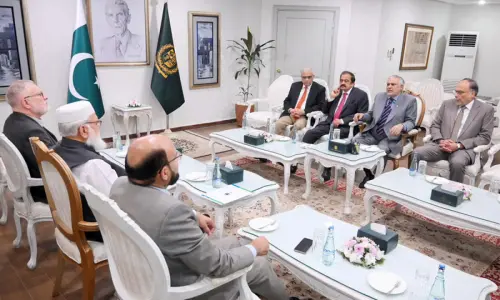
What is also welcome is that members from 35 religious parties that participated in Mansoora’s recent Nizam-i-Mustafa conference have decided to abandon their plans to put pressure on the government by holding sit-ins and causing political disruption. Instead, select religious party leaders led by the JUI-F have agreed to form a joint committee at the behest of Punjab Chief Minister Shahbaz Sharif to work towards a consensus on the women’s protection law in Punjab as well.
At a time when little is being done to counter the toxic, extremist narrative prevailing in the country, this change in attitude is welcome.
But will the religious parties agree to accept parliament’s decision at the centre and in Punjab? After all, when political parties — in government or in opposition, right-wing or otherwise — present a draft law, it is the majority vote in parliament that decides the final status of the bill.
And parliament’s prerogative must not be defied to damage democratic institutions, even if certain parties disagree with select clauses in the bill.
When the contents of both the new National Assembly and Senate bill and the provincial women’s protection bill are scrutinised and debated, the majority’s decision will prevail.
At that juncture, bullying noises to shun democratic processes will simply be seen as political point-scoring, and nothing to do with protecting women’s rights. Hopefully, the religious parties realise that no attempt should be made to thwart parliamentary consensus.
Published in Dawn, April 6th, 2016