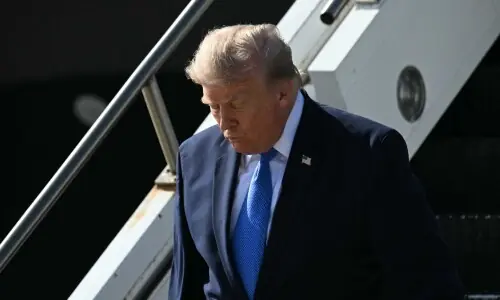


WASHINGTON: US President Barack Obama has said that the rise of the self-styled Islamic State (IS) group was an unintended outcome of the US invasion of Iraq, ordered by his predecessor George W. Bush in 2003.
The IS was a direct outgrowth of Al Qaeda in Iraq that “grew out of our invasion”. He described it as an example of “unintended consequences”. “Which is why we should generally aim before we shoot,” he warned.
President Obama explained that instead of following his predecessor, he was building a coalition of 60 nations, which he was “confident” would slowly push back IS out of Iraq.
Take a look: More war powers?
This marks the first time a US president has acknowledged a link between the rise of extremism in the Middle East and the US invasion of Iraq.
The president’s Republican opponents, however, argue that Mr Obama caused the rise of extremism in the region by withdrawing US troops from Iraq in 2011. The rapid withdrawal created space for groups like the IS to grow, they claim.
They also blame the Shia-dominated central government of Iraq for creating the present situation by refusing to bring the country’s Sunni minority into the governing process.
President Obama referred to this issue as well, saying that the fundamental problem in the Middle East today was that of “millions of young disaffected Sunnis” who had been handed a religious basis to channel their frustration.
The best way to deal with them was to provide them with the opportunity to acquire education and professional skills to build a better life, he said.
“We can’t keep on thinking about counter-terrorism and security as entirely separate from diplomacy, development, education — all these things that are considered soft, but in fact are vital to our national security,” said the president.
Addressing his opponents in the Republican-dominated Congress who accuse him of wasting billions of dollars on implementing his foreign policies, Mr Obama said: “We do not fund those.”
The Obama administration has asked Congress to approve $50 billion in fiscal 2016 for implementing its foreign policies. Out of this amount, about $3.5bn would be dedicated to counter the IS and boost humanitarian assistance.
In the interview, President Obama also underlined another issue, the Middle East’s unresolved disputes. He warned that unless there was a political solution to the internal strife affecting the region, the threat of extremism would persist.
Responding to a question, Mr Obama criticised Republican lawmakers for sending a letter to Iranian leaders last week.
In the letter, 47 lawmakers warned that Republicans would undercut any nuclear agreement they signed with Mr Obama, who would complete his final term in two years.
“I’m embarrassed for them, for them to address a letter to the ayatollah, who they claim is our mortal enemy,” the president said.
Published in Dawn March 18th , 2015
On a mobile phone? Get the Dawn Mobile App: Apple Store | Google Play