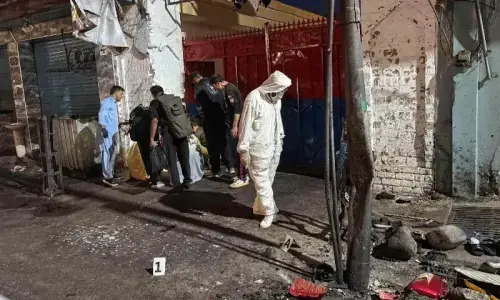
THE suicide attacks against two churches in Lahore yesterday could have been just another gruesome incident in the long list of horrors that has been inflicted on this country in recent years.
The reaction by sections of the Christian community in Lahore and other cities of the country — with protesters taking to the streets and some turning to violence that resulted in two deaths — though suggests that the state’s halting response to the terrorism threat is leading to dangerous ruptures in society.
Know more: 15 killed in Taliban attack on Lahore churches
When non-Muslim and sectarian communities take to the streets in protest and turn to mob violence, it surely reflects the acute stress and intolerable strain that they are under. While all mob violence is deplorable, perhaps the lesson for the state here is that endless violence and horrors visited on a population lead to fear taking over and ugliness manifesting itself.
The state and the security establishment in particular will likely point to the fact that the group which has claimed responsibility, the Jamaatul Ahrar, is under renewed pressure both inside Pakistan and in Afghanistan, at the urging of the state here.
The next phase of Operation Khyber-I does appear to place the militant group in the military’s crosshairs and the announcement of a re-merger between the TTP and the Jamaatul Ahrar over the weekend suggests that the groups are under significant pressure.
As in the past, when hard security targets become more difficult to attack and a militant group is in the throes of being significantly diminished, strikes on soft targets such as places of worship or markets have spikes.
Perhaps, then, that is what the latest attack in Lahore indicates: a desperate effort by the militants to try and stoke a societal backlash and in doing so put pressure on the state to curb its anti-militant operations.
Even if that were the case, however, there are still some serious questions to be asked. Why, for example, has the production of suicide bombers reached the level where they can be dispatched seemingly to any part of the country on any given day by any one of several militant groups?
Given the young age of many of the bombers used in recent attacks, they have clearly not been indoctrinated in the distant past. So, how, why and where is this almost industrial-scale indoctrination programme continuing without the state being able to find and dismantle it?
Beyond that there is the question of the failure to deal with the more complicated, and even vexing, aspects of the National Action Plan.
Even the military appears to acknowledge that a militarised strategy cannot end militancy and terrorism, but there seems to be no real effort to try and think beyond military operations in Fata and counterterrorism operations in the cities. Will — can — that change?
Published in Dawn March 16th , 2015
On a mobile phone? Get the Dawn Mobile App: Apple Store | Google Play