3
3


FOR decades now our tax system has been riddled with holes opened up arbitrarily through the use of discretionary powers given to the tax bureaucracy to grant exemptions to select parties.
Over time, the number of exemptions granted and the amount of tax revenue lost as a result has grown to such enormous proportions that it rivals some of the largest expenditure heads in the budget.
It stands to reason that only those with the right connections can avail themselves of the benefits of selective exemption, meaning that the poor, who pay their share of taxes through the GST levied on all items of daily consumption, are left at a disadvantage.
Know more: Government moves to widen tax net, but big fish yet to be caught
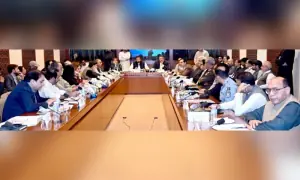
The chairman of the Federal Board of Revenue recently found an occasion to dilate upon the government’s efforts to roll back these exemptions in a meeting with officials from the office of the Auditor General of Pakistan. He reminded the AGP officers that his government has rolled back close to Rs100bn worth of exemptions, and intends to roll back another Rs250bn worth in the coming years.
This is not a new issue. It has been the subject of donor advice since at least the early 1980s. Most recently, the commerce minister touched on it again when talking at the launch of a new report that shows very high levels of inequality in the country, where the top 10pc has a 31pc share in total spending, while the bottom 40pc spend only 20pc.
In response to the state of inequality in the country, the minister reminded his audience that vast sectors of the economy remain undocumented, notably in retail and wholesale trade, and therefore inaccessible for tax purposes.
The fiscal machinery has a role to play in helping close the growing inequalities in the country, most importantly by helping to document large sectors, but also by making revenue available for directed social welfare programmes, areas highlighted by the report as important dimensions of inequality.
But documentation measures are far more long term than tackling exemptions, and whereas the government’s efforts to roll back exemptions should be acknowledged, it should also be emphasised that far more ground needs to be covered.
Eliminating exemptions and rolling back the whole culture of discretionary powers in the FBR can play a central role in redressing some of the problems raised by the authors of the report on inequality, and that step begins with mustering political will.
Published in Dawn, March 13th, 2015
On a mobile phone? Get the Dawn Mobile App: Apple Store | Google Play