7
7

IF any proof were required that when it comes to Pakistan’s relationship with China, people tend to lose their minds, then Tuesday’s session of the Senate provided it in considerable quantity.
Some senators hailing from parties from Balochistan and Khyber Pakhtunkhwa led a loud protest against what they alleged were changes being made in the route of the Pakistan-China economic corridor, a project that aims to connect the port of Gwadar to China’s Xinjiang region.
Also read: Livid over corridor route, senators walk out of Senate twice
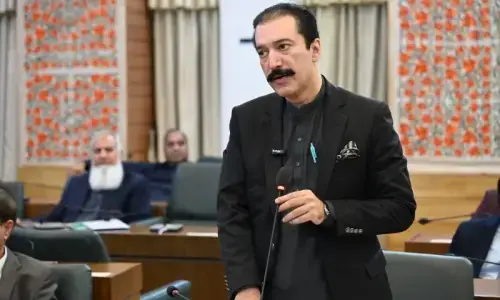
The senators, from parties including the PkMAP and the ANP, as well as an independent, first made angry speeches against the alleged route change then walked out of the Senate in protest, even as the government members tried in vain to tell them that no such change in route had been approved.
One senator, independent Humayun Mandokhel, was so swept away with emotion that he decided to switch loyalties altogether and sit on the opposition benches, where he was received with loud thumping on the desks.
There is a point when desk thumping begins to sound like chest beating, and this was one example. The rhetoric that was hurled at the government included allusions to Kalabagh dam, and a dire warning from Senator Ilyas Bilour of the ANP that “the country will not remain united if the route is changed”.
What is this if not overwrought emotionalism regarding what is otherwise a fairly straightforward infrastructure project? What evidence is there of a route change? And how will the country “not remain united” if there is indeed a route change? What is it about this proposed road project that got the senators so worked up when other far more pressing matters regarding their respective provinces hardly elicit much concern from them?
If the senators in question have evidence of an arbitrary change of route, designed to benefit a few individuals rather than satisfy the technical requirements of the project, they should present it.
For its part, the government should also bring more transparency into its dealings with China, especially in the reasons behind the shelving of the Gadani power projects.
Many politicians tend to go overboard when it comes to the country’s China conversation, with the government employing the usual rhetoric about Sino-Pak friendship and, in this case, opposing politicians invoking Kalabagh dam and the unity of the country.
What is lost sight of every time is that the projects being negotiated with China are purely commercial ventures with little more than the cold play of geopolitics behind them. They should not be vested with such over-the-top emotion, nor be seen as some sort of prize to be fought over so bitterly.
A little level headedness and transparency will go a long way to ensure that our China conversation remains focused on the country’s national interests, as opposed to the parochial interests of a few.
Published in Dawn, February 5th, 2015
On a mobile phone? Get the Dawn Mobile App: Apple Store | Google Play