3
3


ISLAMABAD: On Tuesday, the Supreme Court may have expressed its intention of determining the limits of some of the fundamental rights like freedom of speech and assembly, but the bigger event of the day was the clearing up of his position by Chief Justice Nasir-ul-Mulk.
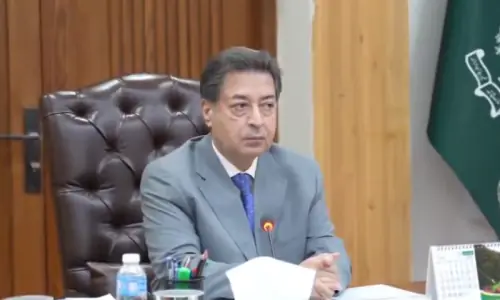
“I want to clarify certain statements appeared in the media that I have some kind of understanding with the leadership (of the Pakistan Tehreek-i-Insaf),” the chief justice said, referring to the allegations levelled by Javed Hashmi who quoted Imran Khan as saying that the new chief justice would be a PTI sympathiser and help throw the PML-N government out of power to form a government of technocrats.
Another significant development of the day was issuance of notices to parties on both sides of the political divide, including the PML-N, PPP, PTI, Jamaat-i-Islami, Muttahida Qaumi Movement, Awami National Party, Balochistan National Party, APML and Pakistan Awami Tehreek. They are required to submit their suggestions for an amicable way to end the current political impasse.
Although a larger Supreme Court bench resumed the hearing on a set of petitions against sit-ins by the PTI and PAT on the Constitution Avenue, a sort of clarification by the chief justice was expected because the allegations levelled against the superior judiciary created doubts in the minds of many.
“I have met Imran Khan only once and that too along with his counsel Hamid Khan when I was officiating as acting Chief Election Commissioner,” the chief justice said, adding that the two had come to discuss introduction of the biometric system in the local government polls in Khyber Pakhtunkhwa on an election petition. About having an understanding with someone directly or indirectly, he said it was not his position to issue clarifications.
Advocate Hamid Khan, who is senior vice president of the PTI but appeared before the court on his own as a senior member of the bar, also endorsed the chief justice’s statement, but regretted that the office of the chief justice had been dragged unnecessarily.
This made Justice Jawwad S. Khawaja to state that the entire bench and, not a single judge, decided matters in the court.
Justice Anwar Zaheer Jamali deplored that it had become a tendency to malign institutions by hurling accusations, disregarding consequences.
The court asked Hamid Khan to explain what he meant by suggesting to the court to initiate a suo motu notice on the current political situation.
The counsel explained that when the court took up a suo motu cognisance it had a wider jurisdiction than the limited scope of a petition before it. Besides, he said, court’s orders were always binding and the court could seek political parties’ views for resolving the standoff.
Citing a book titled “Justice” by Indian writer Chakravarti, Justice Saqib Nisar said time had come when the Supreme Court should determine the parameters of the competing fundamental rights enshrined in the Constitution like the freedom of speech. He referred to a Monday night’s TV talk show in which a barrister heaped abuses on the judiciary.
At this Advocate Zulfikar Naqvi, representing the High Court Bar Association Rawalpindi, drew the court’s attention to his petition in which he had named at least 15 political parties respondents.
But he was reminded by the court that he had missed many parties in the list and should include them as well so that notices could also be issued to them.
Advocate Ali Zafar, representing the PAT, said that as a citizen he was extremely depressed over what was going on. A number of people were killed and injured but politicians failed to resolve the issue.
He said he had talked to the PAT leaders who told him to inform the court that they had immense respect for the superior judiciary but would not give any suggestion because the current issue was a political one in which the court should not intervene.
But the court observed that it was not fair and explained that this was not a political dispute, but a constitutional one.
Justice Khawaja said that like members of parliament, judges had also taken oath under the Constitution, but the oath not taken under the Constitution was the oath of allegiance to Queen of England, obliquely referring to the dual nationality of PAT chief Dr Tahirul Qadri.
“What right any individual has to storm the state television and then congratulate for occupying PTV and the parliament,” Justice Jamali said, adding that the court had been exercising patience and restraint despite double face being shown to it.
Published in Dawn, September 3rd, 2014