Inadequate spending on education has left Pakistan lagging far behind other countries. What better way to make education a national priority than by increasing education spending to at least 4 per cent of the GDP?
While budget priorities are being finalised, special interest groups are busy peddling for special treatment. Primary and secondary education remain a cause without a champion. This has harmed the long-term prospects of the nation.
Underspending on education has created huge disparities in Pakistan where public sector schools, though affordable, lag far behind in quality than privately operated schools (which only the affluent can afford). Let this budget be the one that makes the boldest statement on education in the recent history of this nation.
Education spending averages around 2 per cent of the GDP in Pakistan. In comparison, Pakistan has spent 47 per cent more proportionately on the military. It is time to get our priorities right. Let this be the budget where education spending exceeds that of the military.
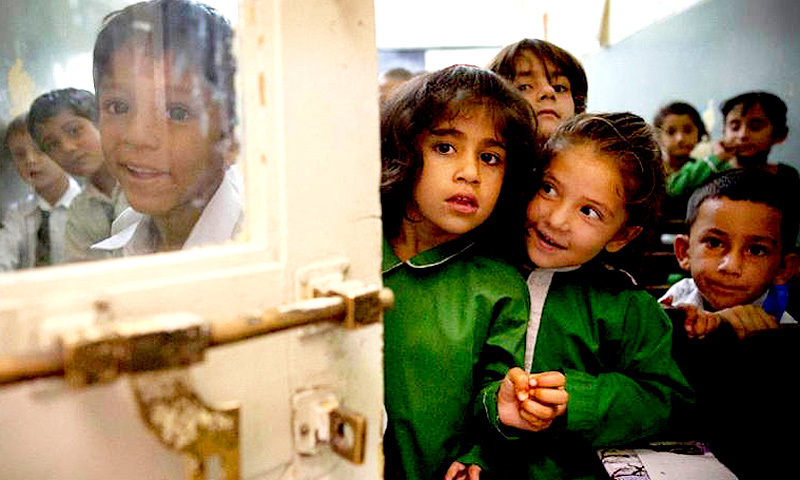
We owe this to the 5.5 million out-of-school children in Pakistan and millions more whose schooling is not worth much.
A report by UNESCO revealed in 2013 that Pakistan boasted the second largest number of out-of-school children in the world. The only other country bypassing Pakistan in this notoriety was Nigeria.
With 5.5 million children not attending school, Pakistan’s ruling elite has to wonder why Pakistan has three times more out-of-school children than India, while her population is less than one-fifth of India’s population.
It is not reasonable to compare Pakistan’s spending on education, which has averaged around 2 per cent of the GDP, with that of developed countries, which has averaged around 5 per cent. A more reasonable comparison will be with countries that share a similar socio-economic profile. But even then, Pakistan reports much less spending on education than her comparables.
While others are investing heavily in education, Pakistan seems lost in its spending priorities. Nepal’s spending on education, for instance, averaged around 4.7 per cent of the GDP, which is 235 per cent more than that of Pakistan. At the same time, Maldives education spending has averaged around 7 per cent of her GDP. And what about Swaziland and Kenya in Africa whose education spending is almost 7 per cent of their respective GDPs? Pakistan’s immediate neighbours also outspend her in education. Iran’s spending on education has been around 3.7 per cent of the GDP while India's has hovered around 3.2 per cent.
 |
A comparison of military spending, on the other hand, presents Pakistan as a much more endowed country. Pakistan has historically spent around 3.13 per cent of its GDP every year on its military. Nepal’s spending on military is merely 1.4 per cent of the GDP and Kenya’s 1.96 per cent. Even Pakistan’s immediate neighbours spend much less on military than her. Iran’s military spending stands at 2.19 per cent of the GDP and India’s at 2.4 per cent. While recent statistics are not available on how much Afghanistan has spent on education, her military spending stands at 3.6 per cent of the GDP.
There is no escape from admitting the reality that Pakistan’s underspending on education has contributed to raising a society tending toward illiteracy and intolerance and which has, because of decades of neglect, embraced militancy and extremist ideologies.
As government spending on education lagged behind, the demand generated by the rapidly growing young population, millions of school-aged children either failed to attend schools at all, or they dropped out of schools because of poverty. Young girls face additional constraints caused by unjust taboos associated with educating girls.
While our governments failed to provide ‘secular education’ through schools, militants and religious hardliners stepped in to fill the void with seminaries that not only offered free religious education, but also room and board for children from poor households, thus effectively serving as foster homes for those children whose parents failed to feed and educate them. Many madrassahs (not necessarily all) in Pakistan have instead radicalised the youth and have prepared them for militancy in conflicts around the world, including Pakistan. With nearly 50,000 terrorism related deaths in Pakistan, which have almost always involved radicalised youth, the immediate need is to invest in the current and future generations’ education.
Pakistan’s recent past reveals that military spending has done little to secure Pakistan against internal threats. Lessons from other nations that have beaten the same odds as Pakistan suggest the need to invest in education. This budget presents the Nawaz Sharif government the opportunity to increase spending on education to 4 per cent of the GDP.
Let this be the decade when Pakistan educates its young and secures her future.
- Data reported in this blog is obtained from World Bank’s World Development Indicators. Statistics available for the most recent year have been cited in the blog.