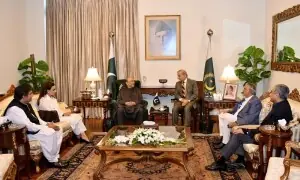
ISLAMABAD: Prime Minister Nawaz Sharif said on Tuesday that his government’s foreign policy was driven by economic considerations and focussed on opportunities being offered by the resource-rich Middle East.
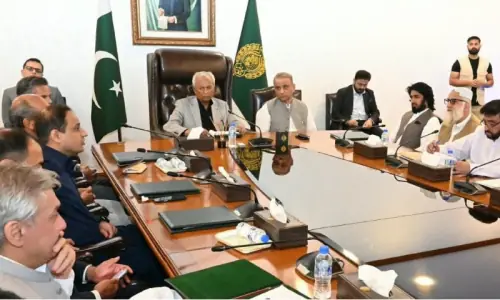
The prime minister, who was speaking at a conference of the country’s envoys to Middle East and Gulf countries, sent out a message to Tehran ahead of his May 11 visit to Iran that Pakistan’s “special relationship” with Saudi Arabia was not at the cost of ties with Iran.
The three-day conference deliberated on how to maintain balance in ties with regional countries, particularly between arch rivals Iran and Saudi Arabia.
The prime minister mentioned “special relationships with fraternal countries in the Gulf and Middle East” as reflected by the recent high-level exchanges with Saudi Arabia and Bahrain.
The growing closeness between Islamabad and Riyadh has caused concerns in Tehran.
But Mr Sharif’s message for the Iranian government was: “We have an equal aspiration to forge closer bilateral ties with all countries in the region. Our efforts to develop bilateral ties with one country are not, and will not be, at the expense of another. Pakistan remains ready to take two steps to greet a hand extended in friendship.”
He explained the rebalancing of foreign policy nuances by his government and attributed it to the need for greater integration with the rest of the world and efforts to strengthen economy.
“Foreign policy has also virtually become economic policy. My emphasis on economic diplomacy stems from this belief,” he said.
With its booming energy sector, developing infrastructure, thriving services sector and enhanced focus on connectivity, Middle East offered immense opportunities, he said.
Answering critics at home who accused the government of changing policy on Syria under Saudi pressure, and at the same time reassuring wary Iran, the prime minister said his government would continue a policy of non-interference in the internal affairs of other countries.
Mr Sharif said his government desired peace and tranquillity in Middle East.
Pakistan’s policy towards transition in the Arab world would continue to be guided by the principles enshrined in the United Nations’ charter.
In pursuance of the principles, Pakistan remained neutral during the early phase of Arab Spring which brought about changes in Egypt, Libya and Tunisia.
Mr Sharif said the defining principle of Pakistan’s foreign policy remained “peace for development” -- building a peaceful external environment so that the core national objective of economic development could be advanced.
“On the external front, our central emphasis has been on building a peaceful neighbourhood. Accordingly, I have pursued a policy of constructive engagement with all our neighbours,” he said.
He urged the envoys to intensify economic diplomacy, ensure welfare of Pakistani diaspora and project Pakistan’s positive image.