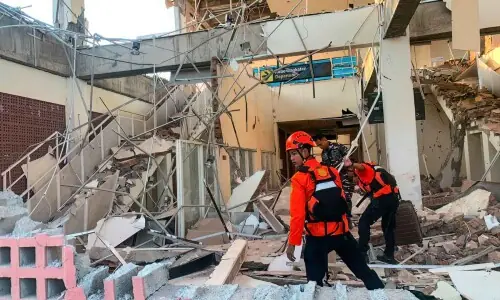
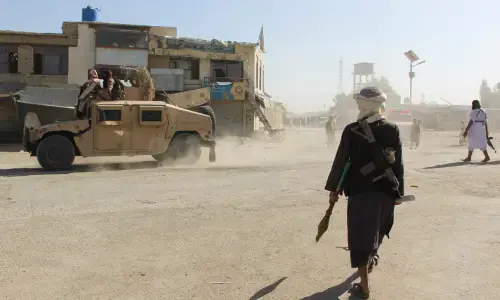
HOW many have died in sectarian violence in Pakistan since 2008? More than 2,000 was the answer Minister of State for Interior Balighur Rehman gave in the Senate on Wednesday. The bald number may be grim enough, but so are the details that Mr Rehman shared: from Fata to Islamabad and Balochistan to Khyber Pakhtunkhwa, no part of the country has been spared sectarian violence. What the raw numbers do not tell though is the evolving pattern of the violence. What began as targeted killings of members of the Shia community (and, on a much lesser scale, reprisal attacks against virulently sectarian Sunni elements) has now escalated to indiscriminate attacks on markets, buses, religious sites and really any place where a gathering of a particular sect can be identified and targeted. It is a war on entire communities, even if it has not reached anywhere near the term ‘genocide’ that is unhappily bandied about without much regard for reality. What is real is the pervasive fear that has gripped certain communities and many parts of the country.
What happens next depends on how seriously the state takes the threat and how the communities themselves react. So far, other than in small pockets, there has been no communal violence, but tensions are rising because of the continuing proliferation of hate speech and paraphernalia. The question is really that of a tipping point and how far society is from it at the moment. Historically, despite all the allegations of a proxy Saudi-Iran war playing out inside Pakistan, sectarian violence has been sporadic and, usually, quickly contained. Part of that may have to do with demographics, as the sectarian equation is not overwhelmingly lopsided and sects are not confined to a few geographical zones, so there is much side-by-side existence. In fact, the communities do mingle and mix a great deal. Yet, this much is also clear: the historical pattern can be changed and tolerance can be eroded if elements bent on doing so are allowed to operate freely and the narrative of hate is not pushed back against.
So, what is the state doing about any of that? The interior ministry provided the province-wise breakdown of sectarian violence over the last six years, but how many of the murders have been investigated, how many of the killers identified and how many prosecutions secured? Surely, it is only a fraction, if that, of the violence that has been enumerated by the interior ministry. Meanwhile, the tentacles of fear continue to spread. In Karachi, the Majlis-i-Wahadat-i-Muslimeen have claimed several Shias have been killed in recent days, while the Ahl-i-Sunnat Wal Jamaat has alleged their members have also been killed. And Karachi is just one part of the national sectarian cauldron that is bubbling ominously. Does the state have any answers?