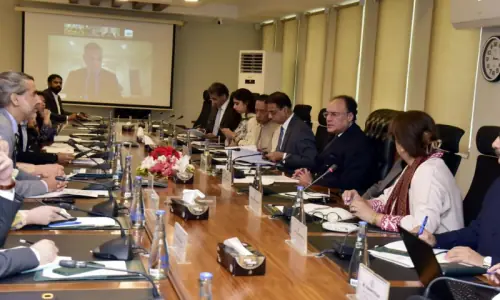
THE first face-to-face session between the government negotiation team and the TTP leadership was tense and difficult, but, if the various insider accounts are parsed carefully, it does appear that both sides were laying down markers for future rounds.
Predictably, the TTP rolled out its two key initial demands: the release of prisoners and a zone in which the TTP can move around unimpeded during the dialogue process.
On the prisoner front, at least this much has now been admitted by the TTP: they are in a position to dictate the release of Shahbaz Taseer, Haider Gilani and Ajmal Khan, a former vice chancellor of Peshawar University.
While the TTP was allegedly unwilling to release the men tied to the PPP, a twist in incentives could nudge the government to keep up the pressure on the militants: securing the release of the two PPP scions could blunt some of the strongest criticism of the dialogue process by the political left in the country.
Yet, there may be more disturbing twists ahead, especially with the TTP now providing a list of the so-called non-combatant prisoners held by the state. While the TTP can and does lie to manipulate public opinion, if it were to turn out that the state has in fact held in detention even a few women, children or elderly people as leverage, it could turn public sympathy in the TTP’s favour.
So, instead of going back to the TTP in secret and updating them on the government’s search for the alleged prisoners, the government should go public with the list and clarify that none of the people named are in the custody of any state agency.
Beyond that, the government will have to think hard about making further concessions to the TTP.
Already a concession has been made by essentially sending the government negotiating team to meet the group on its own turf.
Is negotiating on the TTP’s own turf more of an embarrassment or less so than giving the TTP its own enclave for free movement in or near the tribal area, as it has demanded? It is a tricky question and the TTP has been clever in making where and how negotiations are to be held a part of the pre-negotiation process.
Yet, whatever the modalities, ultimately what matters is what long-term concessions are made. So
far, the government has at least insisted on the need for talks to take place within the parameters of the Constitution and the democratic nature of the polity.
But what long-term shape would a deal with any part or even the whole of the TTP take? What kind of role does the TTP see for itself in a post-deal Pakistan? It is one thing to talk to absolutely anyone. It is quite another to find acceptable compromises.