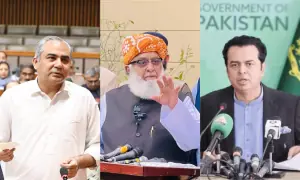
MUZAFFARABAD: Sounding pessimistic about chances of success of the government-Taliban dialogue, Maulana Fazlur Rehman, chief of his own faction of the Jamiat Ulema-i-Islam (JUI-F), asserted on Friday that the ‘establishment’ could play an effective role.
When asked at a press conference about his views on the talks, he said the objective of achieving amity was appreciable but the task required wisdom and workable strategy.
“It’s the strategy that gives confidence to the people and in our view the strategy is not of the level required to resolve the issue. And it’s imperative that the establishment is also on board.
“If the establishment decides that this issue has to be settled I think there will be no need for any committees,” he said.
The JUI-F chief, who arrived here to attend the observance of the Kashmir Solidarity Day on Feb 5, said his party had always called for talks with the Taliban and undertook efforts required by the magnitude of the dispute.
He recalled that a big jirga comprising elders from all tribal regions and all political and religious parties had supported the efforts.
“The first thing we proposed to the new government was to rid the country of lawlessness and the consensus among all political and religious parties and their support for the tribal jirga should be honoured and implemented,” he said.
“We are ready to extend cooperation to the process of peace and reconciliation but we are not part of it because in our view the solution requires a workable mechanism and fulfilling the pledges made to the tribal jirga,” he said.
“Whatever is happening may create news for the media but it does not have the potential to produce results expected by the nation,” he said.
Speaking at a reception earlier, the JUI-F chief who is chairman of parliament’s Kashmir Committee, said the policy to combat terrorism adversely affected the struggle of nations for freedom.
“It’s for this reason that while our struggle and sacrifices for freedom are being dubbed terrorism, India’s state terrorism against the struggle is being endorsed.”
Without naming the US, he said: “If they have to eliminate terrorism and resolve the issue of Afghanistan, I would like to tell them that the path to solve the Afghan problem passes through Kashmir.”
Stressing that he represented parliament and not the government, he said the Kashmir cause had suffered due to “our wrong policies that subsequently shrank our role”.
“Our energies were employed to meet the demands of international coalition instead of devising a strategy for Kashmir. We will have to think where we are standing today due to the global environment,” he said.