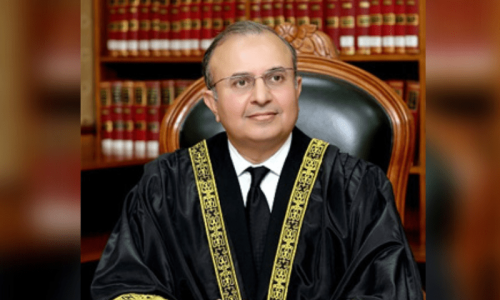
ISLAMABAD: Chief Justice Tasadduq Hussain Jillani has called upon the executive and the legislature to enact and implement laws to curb extremism, sectarianism, terrorism, enforced disappearances and extra-judicial killings.
“Pakistani society is passing through hard times due to prevalent law and order situation and a culture of terrorism, extremism, sectarianism and extra-judicial killings,” observed the chief justice at a reception hosted in his honour by the Supreme Court Bar Association (SCBA) on Monday.
“Since Sept 11, 2001, governments throughout the world have frequently asserted that threats to international peace and security often come from the world’s weakest states. Such countries can fall prey to and spawn a host of trans-national security threats, including terrorism, weapons proliferation, organised crime, environmental degradation and civil conflicts that spill over borders,” he said. In this socio-political milieu, Justice Jillani observed, a strengthened and independent judicial system could play an assertive and decisive role in the promotion of rule of law -- a fundamental pillar of substantive democracy that mandated the supremacy of the constitution, equality before law and equal protection of law.
“If the legislature has to enact appropriate laws, it is the function of the executive/government to enforce human rights laws, ban and punish hate crimes and discrimination against the minorities whether committed by the state officials or by private individuals,” the chief justice observed.
“It is also the function of the executive to ensure that the people have equal access to courts so that they do not take law into their own hands and resort to violence to settle their disputes,” he said. “Laws are essential but not sufficient for countering intolerance and behaviour patterns of the people. Intolerance is rooted in ignorance and fear, to an exaggerated sense of self-worth and pride, be it personal, collective or religious,” the chief justice observed.
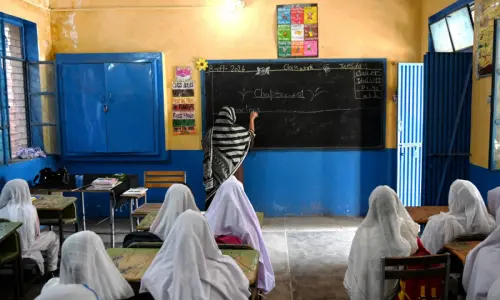
Since these notions creep at an early age, any effort to fight intolerance has to begin at home and in schools and colleges. “These are some of the functions which the executive has to perform without which the rule of law and democracy will remain platitudes and the people will continue to be deprived of the fruits of substantive democracy,” the chief justice emphasised.
He said a formal democracy was no guarantee that the society would uphold the rule of law and history was witness to the fact that democracy could be misused by the majority to trample the rule of law.