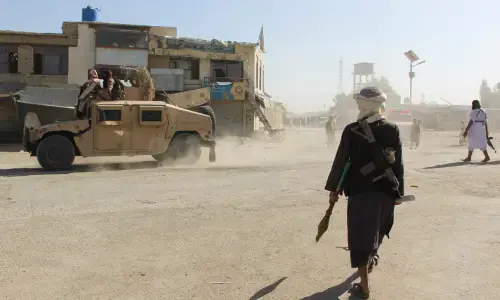
PESHAWAR: Thousands have fled North Waziristan region, which lies along the Pak-Afghan border, after airstrikes this week targeting suspected Taliban militant hideouts killed dozens of people, elders and officials said Saturday.
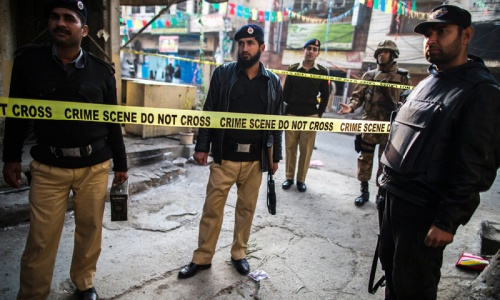
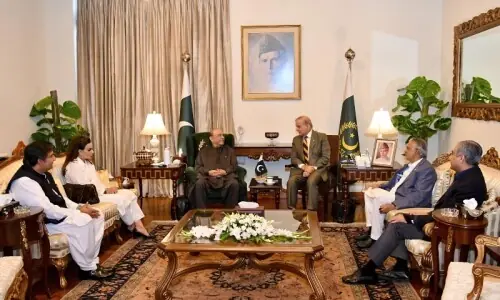
The airstrikes took place as domestic pressure grew on Prime Minister Nawaz Sharif to take tougher action against Taliban militants following a string of attacks across the country in the past week.
Pakistani military sources put the death toll at 40, all of them suspected to be militants. Tribal elders said between 15 and 24 people were killed. A Taliban source put the death toll at 27.
Military sources said fighter jets were only targeting militant hideouts. Residents said the bombardment started overnight without any warning.
Latifur Rehman, a provincial disaster management spokesman, said Saturday the strikes displaced 6,000 families, but half of them had gone back to their homes. Rehman said authorities were making arrangements to provide shelter and food to those affected.
A tribal prominent elder, Gul Saleh Khan, said more than 70,000 people had left their homes. He said people were still fleeing to nearby towns, villages and cities.
''We were sleeping at our home when the army suddenly started the airstrikes just before midnight on Monday,'' Khan said. ''We quickly moved to a farm field with women and children, and other people also spent that night under the sky.''
Khan said he arrived in Peshawar with his family on Tuesday. Local resident Raham Nawaz said many had to leave their homes due to fears of a full-fledged military operation.
''The government should have issued a warning before dropping bombs in our villages,'' Nawaz said. He said his family and other relatives were living at a school, miles away from their town of Mir Ali.
Resident Salim Khan said people continued to flee Saturday. He urged the government to making public warnings ahead of such airstrikes.
''How we can go back to our homes when we don't know what will happen tomorrow?'' Khan asked.
Angered over the increasing violence, people are pressuring the civilian government of Prime Minister Nawaz Sharif to tackle the issue of militancy aggressively. Sharif has long supported a policy of negotiating with militants.
The Pakistani Taliban said earlier this week that they would be interested in peace talks but only if the government proved it was sincere and had enough ''power,'' a reference to the perception that the army wields the real power in Pakistan.
North Waziristan is one of the seven regions in Pakistan’s Federally Administered Tribal Areas (Fata) governed by tribal laws. An extremist insurgency led by the Tehrik-i-Taliban Pakistan (TTP) plagues the region and the area is known to be infested with militants, including those from Al Qaeda and other armed extremist organisations.
The region, which lies along the Pak-Afghan border, also comes under attacks from US drones frequently which target militant hideouts in the area.