Ibn-e-Safi: the imam of Urdu detective fiction
 If you ask me to name a few persons who in my opinion influenced Urdu in a positive way and helped popularise it, I would definitely name Ibn-e-Safi in my list. Why? Many critics didn’t consider Ibn-e-Safi, one of the best-selling authors of Urdu, a writer even when he was at the pinnacle of his literary career. I insist that Ibn-e-Safi’s name must be included in that list because the very critics who denied Ibn-e-Safi a rightful recognition used to read his detective novels themselves, albeit surreptitiously. True, a few of them did acknowledge him. Ab-ul-Khair Kashfi used to say that he read Ibn-e-Safi’s novels and didn’t bother to hide them behind other books because Ibn-e-Safi wrote more chaste and elegant Urdu than those who criticised him.
But how can a writer of detective fiction be a benefactor of Urdu?
Ibn-e-Safi’s Urdu detective novels became so popular throughout Pakistan and India and elsewhere that many people learned Urdu just to be able to read these novels, notwithstanding the mutterings of self-acclaimed critics who scorned these books and called them trash. Ibn-e-Safi played a greater role in popularising Urdu than the snobbish critics and self-proclaimed intellectuals whose books put one to sleep immediately and can easily be used as tranquillisers and about whom Ibn-e-Safi wrote that these intellectuals had become so much abundant that the government must consider exporting them.
Detective novel was not a new genre in Urdu in the early 1950s when Ibn-e-Safi began writing his two record-breaking series, namely ‘Jasoosi Dunya’ and ‘Imran Series’. Munshi Teerath Ram Frozpuri’s ‘Laal Kathor’ and Zafar Umer Zubairi’s ‘Neeli Chhatri’ are credited with pioneering detective fiction in Urdu. But Ibn-e-Safi mixed espionage and suspense with humour and wit in such a lucid and flowing style that it caught the imagination of the common reader. He admitted in an article of his that in the beginning he adapted themes from English detective novels (as did his predecessors), but later on he based his novels on indigenous plots. Only eight of his about 240 detective novels have any borrowed ideas. His famous characters such as Fareedi, Imran, Hameed, X-2, Julia, Safdar, Qasim, Fayyaz and Sulaiman are a testimony to his originality and creativity.
His characters were as well-known and popular among his readers as legendary fictional characters like Sherlock Homes.
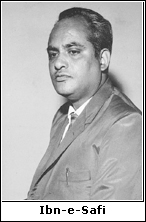 Ibn-e-Safi was born on July 26, 1928, at Nara, Allahabad district, UP. His real name was Asrar Ahmed and he was maternal grandson of Nooh Narvi, a poet of repute from Nara. Having read at the age of eight ‘Tilism-e-Hosh Ruba’, Urdu’s classical ‘daastaan’, and other literary books at his parental home, Ibn-e-Safi was later introduced to ‘Azra’ and ‘Azra Ki Wapsi’, a translation of Rider Haggard’s novel ‘She’. He later began writing with the pen name Asrar Narvi and, when he was in the seventh grade, wrote a short story ‘Nakaam-e-Aarzoo’ that was published in ‘Shahid’, a weekly from Bombay (now Mumbai). Aadil Rasheed, the editor of ‘Shahid’, considering Ibn-e-Safi to be an elderly gentleman wrote before his name in the magazine ‘nateeja-e-fikr musawwir-e-jazbaat Hazrat Asrar Narvi’ (the outcome of the thoughts of venerable Asrar Narvi). Later Ibn-e-Safi began composing poetry and, inspired by Jigar Muradabadi, compiled a collection of his poetry titled ‘Baazgasht’ which could not be published.
After graduating from Agra University and joining a school as a teacher, Ibn-e-Safi launched ‘Nikhat’, a monthly from Allahabad, in collaboration with Ali Abbas Hussaini, well-known progressive short-story writer of the Urdu language.
The magazine provided him with a platform to express his creative talent and his natural wit. He wrote about 150 satirical articles in ‘Nikhat’ and many of them were parodies of Urdu’s renowned literary pieces including Baba-e-Urdu’s ‘Qavaed-e-Urdu’, Muhammad Hussain Azad’s ‘Aab-e-Hayat’(Aab-e-Vafaat) and Qazi Abdul Ghaffar’s ‘Majnoon Ki Diary’ (Deevane Ki Dairy). Later he wrote parody of Ian Fleming’s ‘James Bond’, titled ‘Thames Fond’. But regrettably these invaluable pieces have been lost forever, save for a few of them that were retrieved and published along with some newer humorous pieces in the collection named ‘Diplomat Murgh’.
In spite of his great talent as a humorist, Ibn-e-Safi earned his fame as a detective novelist and not as a humorist. Humour permeates through his detective novels, too, and a few of his characters, especially Imran and Hameed, are a great source of wit. He took to writing detective novels when an elderly fellow lamented the flooding of Urdu literary scene with cheap romances and pornographic fiction. Ibn-e-Safi argued that it could be changed with something different, crisp, creative and moralistic. That ‘something different’ turned out to be his path-breaking detective novels. His literary genius, greatly helped by his deep study of classics and imaginative fiction and a keen sense of humour, created unique characters like Fareedi and Hameed and he launched from Allahabad a series of detective novels ‘Jasoosi Dunya’ and it caught on.
Ibn-e-Safi migrated to Pakistan in 1952 and settled in Karachi. Here he created another series ‘Imran Series’ and began publishing a novel a month, besides ‘Jasoosi Dunya’. Soon he was one of the most widely read Urdu authors and people waited for his new novel impatiently. In the early 1960s, he fell ill and could not write anything for about three years. After his recovery when he resumed writing the reception of his new novel from his fans was so overwhelming that it had to be reprinted within a fortnight, though it was published simultaneously in India and Pakistan. Many of his novels were translated into other languages if the Indo-Pakistan subcontinent, including Hindi and Gujarati.
Ibn-e-Safi had an ear for music too and when his novel was made into a movie (‘Dhamaka’), he experimented with its music. He got Mir Taqi Mir’s famous ghazal ‘Ulti Ho Gaen Sab Tadbeeren …’ put to western music and had it recited as a sonnet. Ibn-e-Safi had a keen interest in painting and also did quite good abstracts. The well-read person that he was, he had studied psychology and intended to write a book ‘Aadmi Ki Jaren’ (The Roots of Man) on human psychology but could not finish it.
In spite of all the fame and celebrity status, Ibn-e-Safi was a humble soul and abhorred ostentation and pretentiousness. He was publicity-shy and did not publish his photographs on his books, though he received thousands of letters requesting him to do so. Ultimately he gave way to the pressure but remained ever so unassuming. Despite being very popular and well-known, he never asked for any favours, neither did he ever try to influence anybody for some worldly gains. Rather, he was conned by some of his acquaintances.
It was announced some time back that a collection of his poetry, ‘Mata-e-qalb-o-nazar’, would be brought out, but the proposed publication did not see the light of day. An MPhil thesis was written on Ibn-e-Safi’s literary services about a decade ago, but it has not yet been published in book form.
Ibn-e-Safi died of pancreatic cancer in Karachi on July 26, 1980.
drraufparekh@yahoo.com
Library accessibility to all
 IF exercising is to health and singing is to entertainment, reading and thus learning is surely to knowledge, inspiration, imagination, ideas and creation.
To inculcate the reading habit and ignite the desire to learn among citizens in Islamabad, three public libraries were established in the 1990s under the Department of Libraries, Ministry of Education. These are the Model Children Library, the National Library of Pakistan and the Islamabad Public Library, inaugurated in 1991, 1993 and 1996 respectively.
Earlier in the 1980s, the National Book Foundation which was established in 1972 had introduced the Readers’ Club scheme to promote reading, under which members get a 50 per cent discount on books offered by the Foundation. Today the Readers’ Club has approximately 200,000 members.
Of the three public libraries, the National Library has the largest collection of books - about 130,000 volumes - whereas the Islamabad Public Library has over 34,000 volumes and the Model Children Library over 9,000 volumes.
However, neither the establishment of a few public libraries nor the NBF’s Readers’ Club scheme has succeeded in reaching out to the masses, particularly the less fortunate, who miss out on the vast knowledge and imagination that books contain.
How many people and how often they visit libraries depend in large part on easy and convenient access. Access to public libraries in Islamabad has been hindered in the past one and a half years by political unrest and security blockade of the roads in the vicinity of two of the three libraries.
The announced plan to establish some half a dozen new public libraries or reading rooms in different sectors of Islamabad - a joint venture between the Department of Libraries and CDA - is partly aimed at addressing this shortcoming and giving residents easier and unfettered access to books and literature.
But another way in which reading can be promoted in Islamabad is through mobile libraries, for decades a common form of library service adopted in many countries to spread the habit of reading and bring the wonderful world of books to schools and rural areas.
The first such library on wheels, which was a wagon drawn by a two-horse team, started in the early 20th century in the US and the UK. Today, some of these mobile libraries are state-of-the- art speciality vehicles equipped with computing technology and wireless internet access, offering both traditional and online library resources.
Taking the form of a brightly decorated bus or trailer literally armed with knowledge encapsulated in hundreds if not thousands of books, such a mobile library can bring the convenience of library services right at the doorsteps of Islamabad’s citizens.
A library on wheels can complement the already established libraries and services that the Department of Libraries render in Islamabad and will render in future through its planned network of new libraries or reading rooms in the different residential sectors.
A mobile library can reach out to and encourage more people, young and old, to read, especially those who may not have had the chance or time to visit the libraries as often as libraries would like them to.
A mobile library can also serve to seed and renew the general public’s interest in reading so that they will be inspired to pick up books from public libraries on their own on a regular basis.
Moreover, a bus library can also serve the less fortunate in the community and bring the joy of reading to institutions and organizations such as children’s homes, orphanages and special education schools.
While the mobile library may only carry hundreds or at best a couple of thousand books at any one time, it would have at its disposal many, many more titles, depending on which public library the mobile library team is based.
The catalogue of books that the mobile library carries can be stocked and refreshed daily according to the needs of the audience that it visits.
To transport the hundreds of books on board safely, the trailer could be fitted with shelves that are slanted inwards so that the books stay put and do not slide out of place. The shelves can also have shutters that can be secured during travel and retracted when visitors come on board to browse the collection.
Private partners could also be invited to join in the mobile library project, particularly those companies or corporations which are concerned with or interested in the promotion of reading.
If we want more citizens to develop a passion for reading, we must make accessibility of library books and services to all as our goal.
Power-Point version of Isaf’s successes
There is no ‘hot’ war in Afghanistan. Skirmishes, limited in time and space, are required to support the government of Afghanistan. Seventy seven per cent of significant activities happen in only 10 per cent of nearly 400 districts. The security situation is mainly stable in three of five regions. Isaf continues to be a success story despite being under-resourced. So far none of the objectives of the insurgents achieved. But they are still ‘darlings’ of some media. Insurgents could stage only four ‘spectacular’ attacks in recent months; one for every 500 activities, most of which were initiated by Isaf. Their activities lately have been confined to a few incidents of hit-and-run. Reconstruction improved: better infrastructure, school attendance, health service, prospects than ever before.
A highly persuasive Power-Point presentation by Group Captain Mark D. Heffron to a selected Muslim and Asian media at the Foreign and Commonwealth Office nevertheless sounded too good to be true against the backdrop of the US and western media cacophony that has been saying exactly the opposite all these recent weeks. In fact the threats of ‘hot pursuit’ into Pakistan by President Hamid Karzai and the publicly declared intentions of the US authorities and Pentagon to send troops into Fata region to destroy the so-called sanctuaries of Taliban had caused so much panic that some Pakistanis have begun equating the plight of present day Pakistan with that of Cambodia during the fag end of Vietnam war. Others see a plot to Balkanise Pakistan behind these threats.
While he talked, Group Captain Heffron, a former UK chief of information coordination at the Isaf headquarters in Kabul, sounded fairly confident but he appeared hardly so while fielding searching questions. He was too vague about why so far Isaf had not been able to help the over two million or so Afghan refugees still languishing in the squalid camps across the border to return to their country. Surprisingly he blamed the absence of a well demarcated and mutually recognised Durand Line for the free to and from movement of Afghans across the Pak-Afghan border while acknowledging that it was almost impossible to distinguish between those who crossed over for non-combatant purposes and those who do it to join the insurgency inside Afghanistan.
He thought the Taliban were buying arms from the proceeds of drug trafficking, but had no idea about what routes were being used by the Taliban to export drugs and import arms and why Isaf and Nato could not plug these routes. In fact according to the Group Captain, Isaf is not responsible for either the eradication of poppy crop or for dismantling the processing laboratories. Isaf and Nato are doing nothing more on this front than extending their vaguely defined help to the visibly weak efforts of inefficient and corrupt local authorities. When asked why this was so he gave an answer which sounded more like a lame excuse than logical: The democratic character of the mission being led by 40 countries does not allow Isaf or Nato to do anything that is being opposed by even one of the members of the mission. So, while some of the members of the mission oppose using Isaf and Nato for eradicating poppy cultivation and the destruction of the processing labs the drug menace has become deadlier than Taliban for the foreign troops in Afghanistan because of its potential to add to the firepower of the insurgents and doubly dangerous for the West and the US because of its damaging sway over whole generations in their countries.
Heffron lamented that Isaf had only 52,000 troops in Afghanistan whereas if a comparison was made with the troop strength in Kosovo, then Isaf would need 800,000 troops to achieve a similar success. By comparing the Afghan situation (population: 31,100,000; area: 647,000km; lacking transportation and information infrastructure, too far from base—US and Europe) with that of Kosovo (population: 1,900,000; area: 10.887km, having developed transportation and information infrastructure and in the neighbourhood of Europe), Isaf has come to the conclusion that it would need many more troops to achieve in Afghanistan the kind of success it did in Kosovo.
But then in Kosovo, Isaf was fighting a regular army in identifiable battle dress with battle lines clearly demarcated and the ‘enemy’ holding on to specified territory. In Afghanistan there are no battle lines, no regular army in battle dress and no specified territory in the hands of Taleban. Isaf appears to be shooting at the shadows.
On the other hand the Taliban appear to be engaged in an armed resistance. They seem to be coming out of virtually nowhere and attacking a large, visible target of occupying troops and then merging with the civilian population. They are fighting a resistance war like the one the Afghans fought in the 1980s during the Soviet occupation. A highly sophisticated and armed to teeth Soviet army with over 500,000 strong troops inside Afghanistan, failed to overcome the armed resistance and withdrew after being neutralised by a few stringer missiles.
So, more Isaf and Nato troops would only present a larger target for the Taliban to attack. Perhaps better intelligence, better monitoring of the smugglers’ trails and pitching a longish string of border posts nearer the Durand Line, rather than around settlements way inside the country, would perhaps do the job better than pressing in more troops with more firepower.