Iraq’s uncertain future
THERE are several reasons why what happened in Iraq over the last three years should matter for Pakistan. The reason — or reasons — why the administration of President George W. Bush decided to invade Iraq is a matter of concern for countries such as Pakistan that are frontline states in the American led war against terrorism.
Pakistan also belongs to the area the American president describes as the Greater Middle East. It is his administration’s belief that the introduction of democratic forms of political structure among the countries of the region will help to contain what the political scientist Samuel P. Huntington not too long ago described as the clash of civilizations. It is useful, therefore, to ask number of questions at this stage about the conflict in Iraq.
Has the Iraq war and the occupation of the country by America produced the envisaged result? Have the war’s likely benefits outweighed its costs? What is likely to be the consequence of the war for political development in the Muslim world? Will the war and its aftermath affect Pakistan in some way?
As discussed in this space last week, nothing turned out in Iraq as anticipated by the war planners other than the swift march of American troops through the Iraqi desert and the collapse of the regime in Baghdad. The Pentagon did not expect an insurgency of the type that has engaged its troops for almost three years, well beyond President George W. Bush’s “mission accomplished” proclamation on May 1, 2003, aboard an aircraft carrier anchored in the Pacific Ocean. The insurgents have taken a heavy toll on American lives, on the lives of Iraqi citizens, on the country’s fledging security apparatus, and on the economy.
By the middle of January 2006, more than 2,200 American soldiers had died along with some 32,000 Iraqis. In an oft-quoted prediction by Paul Wolfowitz, then deputy secretary of defence and now president of the World Bank, revenues from the export of oil would pay for the American mission in Iraq and the country’s reconstruction. It was also expected to finance new infrastructure that would be needed by an expanding oil economy.
This, of course, did not happen. Export of oil has not reached pre-war levels; consequently the burden of the United States’ presence in Iraq is being shouldered by its taxpayers. Washington has spent more than $250 billion since its troops crossed into Iraq in March 2003. This is the direct cost. Joseph Stiglitz, the Nobel Prize winning economist has calculated the long-term cost at between $1 trillion and $2 trillion. This will have significant long term consequences for the country’s economy.
What persuaded Washington to invade Iraq? This question will be asked for years to come no matter what happens on the ground in that country. This is the only large war America has fought in which the motives of those who sent in the country’s troops are still not clear. There is a growing body of literature that attempts to answer the question. Depending upon the author’s background and ideological predisposition, the answers range over a wide territory. Going over them is helpful since in light of America’s new emphasis on pre-emptive action it is important to understand would could provoke action by Washington once again.
The simplest and the weirdest explanation for the Iraq war may be President George W. Bush’s desire to settle an old score. In 1991, the senior Bush ordered his troops to halt at the Iraqi border and saved Saddam Hussein in office. The Americans halted their advance while Iraq’s Republican Guard, Saddam Hussein’s much touted fighting force, was hastily withdrawing from Kuwait. In spite of this, the Iraq dictator showed no gratitude.
Instead, his agents attempted to assassinate the American president. There was, therefore, the need to finish the project left incomplete a dozen years earlier. This explanation has some credence since two of the junior Bush’s closest advisers — Vice-President Dick Cheney and Defence Secretary Donald Rumsfeld — had worked in senior positions in the senior Bush’s administration and regretted his decision.
A more subtle explanation for the Iraq war is an attempt by America’s energy planners to secure a reliable source of oil supply in place of Saudi Arabia, which, Washington believes, may be headed towards an uncertain future. Once again Vice-President Cheney is a central player who, as the head of a large oil-services company before returning to public life in 2001, had gained first-hand knowledge of the global energy market.
Iraq, with reserves of oil and gas only second to those of the Saudi kingdom, could become a reliable source of supply if Saddam Hussein were to be removed from power. Once he was gone, his place would be taken by one of the several Iraqis who had left the country and had gained influence in the corridors of power in Washington. The most notable among them was Ahmad Chelabi, an American educated Iraqi who had excellent links with important people in his country. A Shia, Chelabi would have the added advantage of belonging to the religious community which, although in majority, had been denied political power, often by ruthless means.
Chelabi had done a commendable job not only of ingratiating himself with a section of the American ruling elite. He had also assiduously cultivated the liberal press; especially the New York Times. Judith Miller, of that newspaper, wrote a number of stories, often carried on the front page, that sold the idea that Saddam Hussein, if not already in possession of weapons of mass destruction, was in a good position to acquire them. Several influential members of the liberal press, although not ideologically well disposed towards the Bush administration, were inclined to support the Iraq war for their own reasons.
They had convinced themselves that the overthrow of such an obnoxious regime as the one headed by Saddam Hussein and to build a working democracy in the heart of the Arab world were noble causes worth pursuing. They had acquired in the 1990s a strong belief in the virtues of occasionally using force to make the world a better place, modelled on the United States.
A precedent for military intervention had been set in places such as Bosnia and Kosovo; the guilt for not having done something similar in Rwanda continued to haunt the liberal community. There was no telling what a despot with a vicious record such as the one assembled by Saddam Hussein would do to his own people and neighbours if he acquired weapons of mass destruction.
Or, perhaps, it was the strong Israeli lobby in Washington that was behind the decision to invade Iraq. The once powerful neo-conservatives included people such as Paul Wolfowitz, Douglas Feith and Scooter Libby, who held senior positions in the first administration of George W. Bush. A number of “neo-cons” operated from the outside. The group was very nervous about the potential Iraq had to challenge Israel. It was the only Arab country that had the resources and human development to pose a challenge to the Jewish state.
If the Iraqi threat could be removed, this group believed that Israel would be able to show greater flexibility in reaching an accommodation with the Palestinians. Saddam Hussein, by giving generous financial awards to the family members of suicide bombers, had created such a security threat for Israel that it had lost the rationality to reach an accommodation with the Palestinians.
Whatever the reason for the decision to invade Iraq, there is now a near-consensus among policy analysts in Washington and London that it is the utter incompetence of the Bush administration in handling the challenge posed by the occupation of Iraq that has produced such a monumental mess. This line of argument begins with the administration’s cavalier assumption that Iraq could be occupied and transformed without any extraordinary effort. For starters, Washington had to commit more troops to the task than it was prepared to do. According to one estimate, it takes an occupation force equal to two per cent of the size of the population being occupied to bring it under control. This implies a force of 550,000 rather than 135,000 the Pentagon was prepared to commit.
Adding to the problem created by the small size of the army ordered into Iraq was inadequate training in both doctrine and skills that would have helped US soldiers to make the transition from combat to peace-keeping. There are many stories of culturally insensitive behaviour displayed by the Americans as they sought to win the hearts and minds of Iraqis. Soldiers are known to have used binoculars to look into family courtyards from the heights they had occupied. This was a serious affront for a society that puts great value on modesty and privacy.
The planners in Pentagon also seem to have ignored the prospects and the consequences of the looting and disarray that was bound to follow the removal of the heavy hand of the regime that had used intimidation to govern an increasingly sullen population. A lot of the weaponry used by the insurgents was looted from government stores that were no longer guarded by Iraqi soldiers once American troops moved into Baghdad.
Perhaps the most unfortunate decisions taken by Paul Bremer, who succeeded the hapless General Jay Garner as the chief American administrator of Iraq, were the disbanding of Saddam Hussein’s army and declaring members of his Baath party ineligible for government jobs. With the army disbanded, the insurgency could readily find recruits for its operations who were motivated not only by the defeat they had suffered but saw no future for themselves in the new Iraq in whose birth the Americans were playing midwife. The same was true for the members of the Baath party.
Finally, the treatment of the Iraqis at Abu Ghraib prison that defied all conventions for treating prisoners of war hurt Washington’s standing in the world, particularly in Muslim countries. In light of what happened in that prison and the way prisoners were being treated at Guantanamo Bay in Cuba and at the US base in Bagram near Kabul, the American claim that their value system should be imbibed by the developing world began to sound hollow.
The longer the conflict lasts in Iraq, the greater the negative consequences for the Muslim world. There is an earnest debate in the United States at this time on what kind of exit strategy Washington should pursue. There are those who have begun to advocate setting the timetable for the withdrawal of American troops. President Bush has said that that is not an option for his administration and should not be one for his country. He still looks forward to what he describes as victory over the insurgency coupled with the political transformation of the Greater Middle East.
There is, therefore, reason to worry about Iraq and its future. Pakistan would be deeply affected by America’s worsening reputation in the Muslim world for poor planning, incompetence, and lack of respect for the people whose land it had occupied.
Perils of unchecked power
THE recent controversy over warrantless national security telephone taps, coupled with Martin Luther King’s birthday, remind me of my time in the Department of Justice in the 1960s.
It was a period of turbulent demonstrations, marches and sit-ins, many of them led by King in support of the constitutional rights denied by Southern law enforcement to black citizens.
And it was a time of growing animosity between King and J. Edgar Hoover, who had created the Federal Bureau of Investigation and led it since 1924. That animosity created a growing problem for Atty. Gen. Robert Kennedy and those of us on his staff.
Hoover had built a great institution in the FBI, essentially from nothing. In the public eye it stood for fair and decent law enforcement — the rule of law — and was a model of integrity and efficiency. Hoover was a national hero, responsible for putting killers like John Dillinger behind bars. Kids wore Junior G-Man badges. During World War II, he fought Nazi spies, and during the Cold War he went after members of the communist conspiracy.
But Hoover was getting old. He believed the world was questioning and rejecting the values he held out as fundamental — patriotism, respect for law and order, sexual mores grounded in marriage and family, the work ethic. He detested what he saw as a growing culture of permissiveness, and, as a conservative Southerner, he seriously questioned the idea of racial equality.
Hoover was troubled by the activities of King. He did not approve of the constant sit-ins and demonstrations that he saw more as breaking laws than as a protest against their unfairness. The FBI worked regularly with local law enforcement, and he wished to preserve that relationship.
What bothered him even more, however, was the frequent public criticism by King and his followers of the FBI for not protecting demonstrators from local sheriff’s deputies. One did not have to be long in the Justice Department to learn that to criticize the FBI was an inexcusable sin in Hoover’s eyes.
In October 1963, Hoover requested Atty. Gen. Kennedy to approve a wiretap on King’s telephone. At that time, taps had to be approved by the attorney-general and did not require court approval in the form of a warrant. The basis for the tap was King’s close association with Stanley Levison, who Hoover said was a prominent member of the Communist Party with influence over King in civil rights matters.
Bobby was furious. Hoover’s charge that King was a pawn of the communists could potentially taint the whole movement and bring into question everything we were doing to vindicate the constitutional rights of black citizens. It was hard to think of an issue more explosive.
To understand just how explosive, one has to remember that Hoover was both popular and enormously powerful, with great support in Congress. Some of that support was based on admiration, some on fear that he had damaging personal information in his files. Much support came from conservative Southern Democrats, opposed to King, who chaired virtually every important congressional committee. Hoover was formally a subordinate of the attorney general who could, technically, fire and replace him. That’s a big “technically.” No attorney general, including RFK and myself when I succeeded him, could fully exercise control over him. And none did.
When Hoover asked for the wiretaps, Bobby consulted me (I was then his deputy) and Burke Marshall, head of the Civil Rights Division. Both of us agreed to the tap because we believed a refusal would lend credence to the allegation of communist influence, while permitting the tap, we hoped, would demonstrate the contrary. I think the decision was the right one, under the circumstances. But that doesn’t mean that the tap was right. King was suspected of no crime, but the government invaded his privacy until I removed the tap two years later when I became attorney general. It also invaded the privacy of every person he talked to on that phone, not just Levinson.
But what we didn’t know during this period was that Hoover was doing a lot more than tapping King’s phones. As King’s criticism of the FBI continued, and as Hoover became more and more convinced there must be communist influence even though no evidence ever materialized, he determined to discredit and destroy King. He went further, putting bugs in King’s hotel bedrooms across the country. (He claimed that Atty. Gen. Herbert Brownell had authorized him to use such listening devices in cases involving “national security” back in the 1950s, and that he did not require further permission from the current attorney general, who in any case had no idea that the FBI was doing it.)
The FBI recorded tapes of King conducting extramarital affairs — and later had the tapes mailed to King anonymously, in one case actually encouraging him to commit suicide. Tapes were played for journalists, and the FBI sought to discredit King with foreign leaders, religious leaders, White House personnel and members of Congress. The bureau tried to kill a favourable magazine profile and encouraged one university to withhold an honorary degree.
I knew none of this until late 1964, when two prominent journalists told me that a bureau official had approached them and offered to play one of the salacious hotel bedroom recordings. I confronted the official — one of Hoover’s senior deputies — who categorically denied the allegation. I flew to President Johnson’s Texas ranch and asked him to help put a stop to it. I think that he did, but such was Hoover’s power I cannot be sure that even the president had the courage to do so.
It was only years later, at the Church Committee hearings held after Hoover’s death, that the full scope of Hoover’s anti-King activities became known. I was — and am — appalled. And sad. This man who was a national symbol of law and order ended up grossly violating the nation’s trust and respect in the name, he said, of national security. And the man he attacked so viciously was a great leader who never violated the law and who helped this nation realize rights guaranteed by the very Constitution Hoover was sworn to uphold.
All this is ancient history, but it has relevancy today. There is a growing movement to remove Hoover’s name from the FBI building in Washington, DC. I do not think that is the lesson to be learned. Hoover built the FBI and served for almost 50 years as its leader. His positive achievements should endure and be recognized. He served with distinction, but he served too long. Perhaps because of age accompanied by virtually unchecked power, he lost any sense of proportion in law enforcement, using his authority in what he thought was a righteous cause. To my mind, that is the lesson to be learned from Hoover’s vendetta.
Today we are again engaged in a debate over wiretapping for reasons of national security — the same kind of justification Hoover offered when he wanted to spy on King. The problem, then as now, is not the invasion of privacy, although that can be a difficulty. But it fades in significance to the claim of unfettered authority in the name of “national security.” There may be good and sufficient reasons for invasions of privacy. But those reasons cannot and should not be kept secret by those charged with enforcing the law. No one should have such power, and in our constitutional system of checks and balances, no one legitimately does.
Forcing the executive to explain its reasons for intrusive law enforcement is essential to maintaining not just privacy but freedom itself. A congressional committee must exercise oversight. So too must an independent court because Congress is also subject to possible political pressure.
Our freedom is too precious, and too much blood has been shed to preserve it, to entrust it to a single person, however sincere and however well intentioned. — Dawn/Los Angeles Times Service
The writer served in senior Justice Department positions between 1961 and 1965. He was appointed attorney general by President Johnson in February 1965 and served until October 1966.
The Balochistan crisis
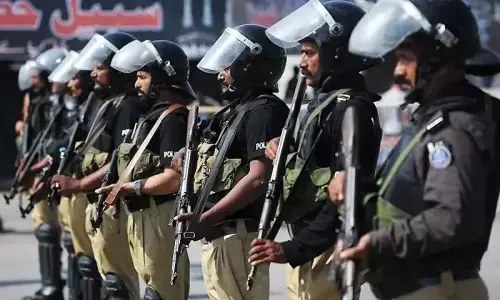
THE long simmering ethnic passion that resurfaced in Balochistan in 2004 and has recently resumed with greater intensity is a source of great anxiety to the people of Pakistan. The security forces are currently engaged in quelling the insurgency-like situation in the province.
President Pervez Musharraf’s recent declaration that the writ of the government will be restored in Balochistan indicates that a bigger military operation in that province might be on the cards. However, if Islamabad chose to resolve the on-going crisis in Balochistan by using force, the opposite would occur with serious consequences for the country, internally as well as externally.
The continuing failure of Islamabad to make adequate payment of royalty to the Balochistan provincial government and the tribal leaders in whose territory gas was found, the construction of Gwadar Port where non-Balochs are given special preferences to encourage investment and the planned construction of three new cantonments in the province there have been cited as the main reasons for the anger of the Baloch nationalists who have spearheaded anti-state militancy in the areas under their control.
Evidently, Islamabad’s carrot and stick policy has failed to woo the militants who have refused to call off their hostile activities which almost converge on insurgency. Armed clashes between the Baloch nationalists and the security forces have not only plunged Balochistan into a dangerous political imbroglio but have also shaken the very foundation of the federation of Pakistan.
Pakistan is one of the most ethnically and linguistically complex states of the world, and despite the shared religion of its overwhelming Muslim population, its leaders could not evolve a viable political system for its ethno-linguistic population which caused regional tensions and prevented the country from gaining political stability. Denial of rights to them has created a sense of deprivation and despondency among the people of the smaller provinces, particularly in Balochistan, where it has assumed a violent form.
Regrettably, successive regimes in Islamabad, including the present one, have shied away from promoting meaningful and result-oriented reforms, political as well as economic, that would have ensured long-term and lasting benefits for the people of Balochistan and, instead, settled for the partial amelioration of their political and economic grievances which, for obvious reasons, remained inconsequential. Failure to address the widespread discontent among the poor masses in Balochistan was appalling. Surprisingly, Islamabad mollified those very elements in Balochistan who, taking advantage of the sufferings of the poor masses in the province, used them to promote their political, economic and other interests.
Quaid-i-Azam Mohammad Ali Jinnah had wanted Pakistan to be a federal state so that all its constituent units enjoyed equal rights and autonomy in accordance with the principles of natural justice and did not contend against each other on this account. Regrettably, however, after the establishment of Pakistan, the smaller provinces were denied their due share in the power structure of the country and the provincial autonomy was systematically curtailed by the oligarchy that controlled the federal government. A consistent policy of centralization has created disharmony between the federal government and the smaller provinces.
When General Pervez Musharraf assumed power in 1999, he had vowed to strengthen the federation by removing inter-provincial disharmony and restore national cohesion. Surprisingly, however, six years down the road, he has not been able to fulfil his promise and the national integration continues to be a crucial problem in Pakistan. For obvious reasons, the country cannot afford the dangerous alienation between the smaller provinces and Islamabad and inter-provincial jealousies.
Pakistan is a federation of four provinces and the Constitution of the country bestows autonomy on them. In other words, all the provinces continue to have their separate legal personality.
They have formed a federation state by transferring only a part of their sovereignty to that state. Accordingly, the relationship between the federation and its constituent units has to be governed on the basis of equitability and within the defined parameters enshrined in the Constitution. It is not a moral obligation to do so but a legal postulate of the federation. Any attempt to deviate from this sacrosanct principle will be a violation of the Constitution and a betrayal of faith.
According to President Pervez Musharraf, India is supporting the trouble-maker in Balochistan. It is no secret that India, through its diplomatic missions in Afghanistan, has been engaged in fomenting trouble in Balochistan. It is believed that the arms and ammunitions being used by the militants in Balochistan are coming from Afghanistan. Needless to say, India’s involvement in Balochistan may not have been possible without the consent of the United States which is virtually in control of Afghanistan.
The Indo-US nexus, which seems reasonably established, is not merely aimed at containing the growing influence of China in the region or preventing Pakistan from making inroads into the Central Asian states through the Gwadar Port, which both these countries consider anathema to their long-term interests in the region. Both are also keeping an eye on the strategically situated Balochistan to advance their regional and global interests and will not hesitate to weaken Pakistan or even opt for its fragmentation if the exigencies of their interests so required.
In this connection, it may be recalled that some time ago the US intelligence council published a report containing a grim assessment of Pakistan’s future. According to it, Pakistan would be paralyzed completely by 2015 as a result of ethnic conflicts and deteriorating political/economic mismanagement. More or less similar predictions have also been made by Robert D Kaplan, a senior Fellow at the New America Foundation in his article “Lawless Frontier.” A similar dire prediction is contained in the US Department of Defence study undertaken by 15 US think-tanks. Prudence demands that these reports, though somewhat hypothetical, should not be summarily dismissed as actually containing the inner desires of their authors.
Pakistan is passing through a defining moment of its history and is faced with fateful choices. Its people should therefore muster the collective will to redress inequity and injustice rampant in the country, which breeds despair and despondency.
The current painful situation in Balochistan, which has ominous implications for the country, clearly presents a challenge to the state but also provides it an opportunity to make up for the lost time.
Democratization of Balochistan, which remains an alien concept there, is the only way forward that can rescue the toiling masses in the province from their economic woes and help in shaping their future.
The writer is a former ambassador.