Time to fine-tune policies
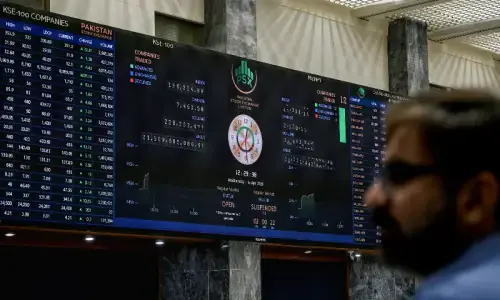
DESPITE the tightening of monetary policy, the consumer price index is still hovering around eight per cent while the increase in the cost of money has made essentials ever dearer for the poor and rendered investment in export-oriented ventures, already saddled with high utility rates, even more unattractive. The result appears critical for the overall economy in the short run. Already the large scale manufacturing (LSM) sector is showing marked signs of slowing down compared to its rate of growth in the preceding three years. And now comes the news that over 90 knitwear and sweater units have closed down owing to a host of unfavourable factors. All these are export industries and if immediate measures are not taken to get them to reopen, our exports are likely to suffer greatly in the next half of the current financial year. This would further enlarge the trade deficit which is already yawning at around five billion dollars which is almost equal to the estimated yearly income from overseas remittances. This is happening at a time when the budgetary deficit too is widening.
Pakistan has suffered from this menace of twin deficits for too long to have forgotten their negative impact on the overall economy and their ability to bring wheels to almost a standstill. Tighter monetary policy will surely slow down the inflation rate. But at the same time, it will also slow down the economy. On the other hand, a tight leash on imports would certainly reduce the trade gap, but in the process it would also cause revenue to fall, as most of the collection is foreign trade-related. So, we seem to have once again walked into an economic whirlwind. The more we try to get out of it, the deeper we seem to go into the vortex. What do we do under the circumstances? Slowing down the economy is no option at all. On the other hand, the economic czars of the world, with good reasons, will certainly caution us against trying to spend our way out of trouble. But, then, there must a middle way out. For instance, we could frame fiscal and monetary policies so as to help the economy remain geared to a reasonable momentum of growth by directing investments in export industries while, at the same time, pushing up imports of production related capital goods, intermediaries and raw material.
One hopes that it was not the gloss of doctored data that had brightened the picture of the economy in recent years. One also hopes that it was, indeed, real when the country recorded a growth rate of over eight per cent last year after having taken a turn for the better in the preceding two years. But then if all that was based on positive and sustainable fundamentals, how is it that with just one seemingly moderate bout of inflation, things related to the economic spectrum seem to be getting out of hand suddenly? It is useless today to debate whether the State Bank of Pakistan did the right thing at the right time or whether it hesitated too much before hiking interest rates to cool off the rate of inflation. What is required today is a lot of policy fine-tuning and sustained micro management of the economy to get back on the track.
MQM ‘ultimatum’ and after
THERE has been a major development over the weekend, and it is positive and political. This concerns the withdrawal of the “ultimatum” the Muttahida Qaumi Movement had given to the government on the Balochistan and Kalabagh dam issues. The MQM had threatened to quit the coalition governments unless Islamabad stopped the “military operation” in Balochistan and changed its policy on the KBD. According to the MQM, the ultimatum was withdrawn after assurances from the president and the prime minister that there would be no army operation in Balochistan, and the KBD would be built only when there was a national consensus. Basically, there is nothing new in the government’s assurances. Both President Pervez Musharraf and Prime Minister Shaukat Aziz have denied that any army action is going on in Balochistan; and they have insisted that a dam or dams will not be built without a national consensus. What the development over the weekend underlines is the importance of the political process, and that it does not matter whether a party chief happens to be in exile.
The MQM has 42 MPAs in a house of 168 in Sindh and 18 MNAs out of the National Assembly’s 342. It is the military-backed PML’s ally in both the federal and provincial governments, and it goes without saying that it has more than a simple political clout. If it chooses — and it has chosen to do so quite often in the past — it can paralyze the nation’s biggest city, and this can unsettle a government that is keen to project Pakistan’s “soft” image abroad and invite foreign investment. Unfortunately for the government, Mr Altaf Hussain is not the only leader of a major party outside Pakistan. Also living abroad are Ms Benazir Bhutto and Mr Nawaz Sharif, both of whom command a large following in the country and have been prime ministers twice. Yet the government has so far shown no inclination to open a dialogue with them also at a time when a national consensus is needed on a number of sensitive issues. The election due next year would be credible only when leaders abroad are allowed to return and take part in the electoral exercise.
As the cold wave persists
THE unusual cold wave that has gripped the nation — and which shows no signs of abating — has caused more gloom than cheer for the people who normally look forward to winter as a respite from harsh summer. Survivors of the earthquake are virtually close to freezing to death in their non-winterized tents, vulnerable to various illnesses. So far, 47 children have died of pneumonia in the northern areas of the Baltistan region while six people have died in Sahiwal. Temperatures reached record lows, with Lahore experiencing a freezing drop to minus two this past weekend after 39 years. Temperatures in other parts of the country also dropped to -13 in Kalam, -12 in Quetta and even normally warm Karachi — which usually considers itself lucky to have a week of real winter — experienced temperatures of six degrees. This spell has demonstrated how so many people were unprepared for the unexpected cold and unfortunately has also proven the administration’s short-sightedness in preparing for some of the health challenges that it now faces. The cold weather in the northern areas, while particularly unusual, is certainly not uncommon, so there is no excuse for the administration failing to stock up on cold-related medicines well in advance. Residents have made appeals for the seriously ill to be airlifted to nearby cities and the army should consider that request.
Other tragedies have also been witnessed on account of the harsh winter. Nine members of a family died in Karachi when their hut caught fire, highlighting the need to exercise caution when lighting fires to keep warm. It is equally disturbing to note that people in parts of the NWFP are complaining of gas load-shedding which is bound to cause inconvenience and add to health problems if gas heaters can’t be used. Such hurdles can, and should, be removed to alleviate the people’s winter woes.
Two years after the Saarc declaration
TWO years have passed since President Musharraf and Prime Minister Vajpayee, taking advantage of their participation in the Saarc summit, held official talks that led to the Islamabad Declaration of January 6, 2004. Since then, the two sides have met many times, including at the summit level.
Now the third round of the composite dialogue will resume with the foreign secretary’s visit to New Delhi on January 17, 2006. This is a welcome development, that renews hope for the normalization process. It is also time to look back at what has transpired in the past two years.
The declaration had been hailed as “historic”, for it not only ended the state of near-confrontation between the two countries but also reaffirmed their mutual commitment to the resolution of their disputes and differences by peaceful negotiations. It was welcomed by world powers, though some observers claimed that the document was the result of a major concession by Pakistan, namely an assurance that no “territory under Pakistan’s control (would) be used to support terrorism is any manner”.
The government may have done so genuinely desirous of curbing extremist activities that had left their mark on a myriad domestic problems. But more importantly, there was tremendous pressure on Pakistan, especially from the major powers who no longer tolerated violent acts now equated with terrorism.
This was followed by the Musharraf-Manmohan Singh meeting in September 2004 on the fringes of the UN General Assembly. There was nothing new in it as the leaders merely pledged to “explore all peaceful solutions of Jammu & Kashmir”. The Indians again insisted on, and Islamabad agreed to, reiterating the commitment of good behaviour on terrorism, offered in the Islamabad Declaration.
However, it was the president’s visit to Delhi in April 2005, that created great expectations of progress. While there, the president emphasized the centrality of the Kashmir dispute and insisted that there could be no durable peace in South Asia, without a resolution of the Kashmir issue.
The next engagement was in New York on the sidelines of the UNGA, when the president tried to jolt the Indians out of their complacency by referring to the UN resolutions on Kashmir. But the Indians responded by accusing Pakistan of continuing involvement in “cross-border terrorism”. Singh also reiterated that the borders of Jammu and Kashmir could not be redrawn, but a compromise should be found between the Indian and Pakistani positions.
Though the two sides denied that the meeting had been a failure, the president’s growing impatience was evident from his remarks at the 58th Formation Commanders Conference that the key to Pakistan-India relations was the resolution of the Kashmir dispute and that the CBMs and dispute resolution would have “to move in tandem”.
Foreign Minister Natwar Singh’s visit to Islamabad in October for the second round of the composite dialogue, was again presented as “positive”, though real progress was minimal. The meeting did, however, lead to two agreements, one on notifying each other on missile tests and the other on establishing a hotline between the coastal security forces of the two countries. Of some significance was the decision to revive the joint ministerial commission that had last met in 1989.
It was, however, the disastrous earthquake of October 8, 2005, that brought into sharp focus the importance of an early resolution of the Kashmir problem. The same month, the president signalled his willingness to accept the idea of demilitarization and self-governance for settlement of the Kashmir dispute, while observing that the disaster had opened up “an opportunity to move forward on the issue”. The Pakistan foreign office revealed, and the Indians confirmed, that Prime Minister Shaukat Aziz had broached this idea with Singh during the Saarc summit in Dhaka.
It is important to recall that the president in a speech in October 2004 had put forward a seven-district solution, one that was close to the Dixon plan for a district-wise plebiscite. While rejecting both the status quo and the LoC, the president signalled a willingness to reconsider the country’s long-held position that the Kashmir dispute should be resolved in accordance with UNSC resolutions. On later occasions, he advocated a four-step approach that was explained as: i) identify the troubled areas; ii) demilitarize the troubled areas; iii) concede self-governance to the Kashmiris; and iv) appoint a tripartite supra body comprising Kashmiris, Pakistanis and Indians to “oversee” the functioning of a self-governing Kashmir.
We thus see a sea-change in the positions of Pakistani and Kashmiri leaders. While the National Conference in Kashmir was the only party with a long history of demanding self-governance, the All Parties Hurriyat Conference, the AJK leadership and Islamabad had always insisted on the right of self-determination for the Kashmiris. Now, both the Hurriyat and Islamabad appear to have moved away from their traditional positions.
Thus, there is growing convergence between the current positions of the pro-Indian, pro-independence and pro-Pakistan groups in Kashmir. The Hurriyat’s support for self-governance is surprising, for this can be only a short-term, holding operation. It cannot satisfy either those who aspire for Kashmir’s independence or those who want an integration of their state with Pakistan.
Incidentally, the president’s proposal for self-governance bears resemblance to the New York-based Kashmir Study Group’s 1997 report, Kashmir at Fifty: Charting the Path to Peace. While not calling the new entity, the United States of Kashmir, the KSG had explained that it would have its own secular, democratic constitution, as well as its own citizenship, flag and legislature, which would legislate on all matters other than defence and foreign affairs.
It was, nevertheless, disturbing to hear Mirwaiz Umar Farooq claim that President Musharraf supported this idea, which he had proposed in a speech before an international audience in New Delhi on November 16 and had also discussed with a US congressional delegation then visiting New Delhi.
This option of a quasi-independent status entails major problems for Pakistan. We would have to abandon our historic stand in favour of UN resolutions calling for a plebiscite in the state. Since our latest offer would be neither a plebiscite in the entire state, nor even a partial plebiscite, as envisioned in the Dixon plan, it can at best be described as “a minus plebiscite stand”. It would also weaken Pakistan’s linkages with what is now Azad Kashmir. More disturbing were the Mirwaiz’s remarks at the Delhi conference that the “United States of Kashmir” would be inclusive of the Northern Areas, which were never a part of the state of Kashmir and whose people are not Kashmiris.
By offering to bring this area also within the purview of a new dispensation that would be created in the future, we have made an offer that could cause us grave damage, especially as India is not being asked to concede anything. No wonder, Pakistan’s new approach has attracted support from even pro-Indian Kashmir leaders, such as Omar Abdullah and the pro-independence Kashmiri leader Yasin Malik. Moreover, shorn of this strategic belt, Pakistan would not only lose a strategic part of its territory, it would also lose the only physical link it has with its most important ally, China.
It must be noted here that the peace process has all along been based on the premise that it consists of two major elements: one, confidence building measures and two, negotiations on the eight-point agenda that was identified as forming part of the composite dialogue process. Pakistan’s new-found enthusiasm for making major concessions, without reciprocal gestures from India, may enhance its image and promote its leadership’s reputation for “pragmatic solutions to complex issues”. But it will not resolve the Kashmir dispute.
In fact, the past two years have confirmed that India is more interested in “conflict management”, rather than in “conflict resolution”, which is of primary interest to Pakistan. Let us, therefore, remember that not all changes are necessarily advantageous. Sometimes it is better to stick with the known, than to rush into the unknown. In this case, it would appear that, for the present, the status quo is far more advantageous to Pakistan than any of the ideas floating around.
From the foregoing, two new factors can be discerned in the Pakistan-India equation. One is the president’s strong belief that he has the imagination and determination to pursue the normalization process with India, with greater skill and resolve than any of his predecessors. He also appears to believe that if Pakistan were to demonstrate a degree of flexibility, the Indians would be constrained to reciprocate.
The past two years have reaffirmed that it is foreign to India’s nature to treat its smaller neighbours as fellow-sovereign states. In fact, concessions only whet its appetite for further aggrandizement, as evident from its recent attempt to fish in the troubled waters of Balochistan.
The other factor is the role being played by the US. Washington definitely attaches importance to Pakistan’s contribution to the war on terror. This is America’s strong tactical requirement.
But its strategic interest lies in building India up as its regional partner for major global objectives, that include control over the natural resources of the Middle East and Central Asia, increasing pressure on Iran and containment of China, now viewed as a likely challenger to US hegemony. Therefore, US interest in promoting detente between the two South Asian neighbours is to promote its tactical as well as strategic goals, not to end Indian hegemony over Kashmir.