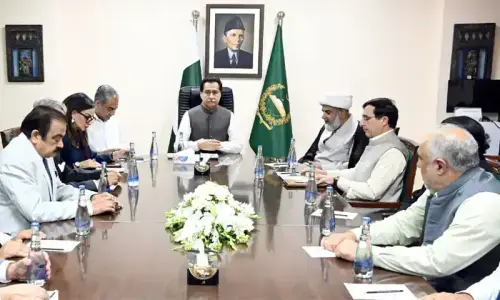
WHILE the focus of the world and the region remains on the impending US-Afghan bilateral security pact that will allow foreign troops to remain in Afghanistan until at least 2024 and on the Afghan presidential election next year, work on the most critical piece in the framework for a stable Afghanistan — the reconciliation process with the Afghan Taliban — continues quietly in the background. After meeting representatives of the Afghan High Peace Council in Islamabad on Thursday, Prime Minister Nawaz Sharif is set to travel to Kabul at the end of the month presumably to see if the dormant reconciliation process can be nudged forward, or at least ensure the groundwork is in place for a speedy process after next year’s Afghan presidential election. However, like much else he has attempted since returning to office in June, Mr Sharif and his team seem busy enough in consultations and meetings without necessarily proposing a way forward in Afghanistan.
Complicating the task for both the Afghan and Pakistani sides is the increasing interconnectedness of the two countries in matters of security and stability. With the appointment of Mullah Fazlullah as the new TTP chief, it is for the first time that both the Pakistani and the Afghan state allege that their respective principal militant foe enjoys sanctuary in the other’s country. With the Afghan Taliban long enjoying fairly unhindered movement across the Durand Line, now the TTP leadership is in the Afghan backyard, from where it targets Pakistan. Whether that improves the odds of both country’s leadership understanding that cross-border violence is in neither country’s interest or exacerbates the already tense security ties between the two countries is a question that the months ahead will reveal. Suffice it to say, in the game of proxies, every side stands to lose.
Given that neither side is about to abruptly change course so late into the scramble that will shape the next phase of Afghan history, perhaps the best that can be hoped for is that at least the cross-border movement and sanctuaries near the Durand Line on both sides are progressively discouraged. From a Pakistani perspective, the state has both much to offer and gain. Nudging the Afghan Taliban towards an internal, Afghan-led settlement in Afghanistan ought to buy some space when it comes to dealing with Pakistan’s internal security problems with the TTP. Surely, both the Afghan and Pakistani states must be aware of the ultimate nightmare: the TTP and the Afghan Taliban uniting to wage war in both countries.