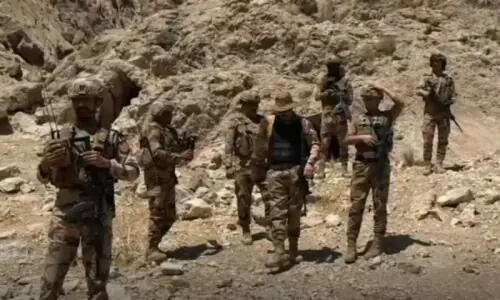
WASHINGTON: Camouflage may be designed to blend in, but for the US military, a plethora of combat uniforms offers a way for each branch of the armed forces to distinguish itself.
In Congress, the costly proliferation of camouflage has angered lawmakers, who see it as an illustration of Pentagon extravagance.
Before 2001, American troops all wore the same camouflage uniform, a green version for temperate climates and a beige model for the desert.
But as military spending mushroomed after the September 11 attacks, the US Marine Corps, Army, Navy and Air Force crafted their own combat uniforms for the wars in Iraq and Afghanistan.
There are now 10 different camouflage styles, from a pixel pattern to the “tiger stripe,” and even a blue “aquaflage” for sailors — also known as “blueberries”. At a time of budget austerity, the veritable fashion show has increasingly come in for criticism and ridicule both inside and outside the military.
“It’s not like the F-35 cost overruns but it is something that a common ordinary person would consider a waste of money,” said Larry Korb, a former defence official and military officer, now at the Centre for American Progress.
The Marine Corps, which touts itself as a “breed apart,” was the first service to come up with its own camouflage wear in 2002. Dubbed MARPAT, the uniform features a digitised green “woodland” pattern and a beige desert pattern.
Based on a Canadian military uniform, the design is patented and the Corps has barred the other branches of the military from using the pattern, which has the service’s emblem embroidered in the fabric.
The Corps’ proprietary approach has annoyed some senators, who want to lift the restrictions.
A proposed defence spending bill for 2014 includes an amendment saying “no military service may prevent another military service from authorising the use of any combat or camouflage utility uniform.” As for the US Army, commanders tried to introduce a universal camouflage pattern in 2005 that could be employed in any landscape but the pixel design proved a failure in Afghanistan.
Instead, the army issued a “MultiCam” uniform especially for soldiers deployed to Afghanistan. And since 2010, the service has spent millions in search of a new camouflage design.
Replacing the army’s current combat uniform could cost up to $4 billion over five years, according to the Government Accountability Office, an investigative arm of Congress.
“We can’t afford to have different camo patterns just for the argument that it’s esprit de corps. That’s what dress uniforms are for,” said Representative William Enyart, who called for the deadline.
“The military’s budget has doubled in the last 10 years and we can’t afford to waste money in today’s fiscal environment,” he said in June.—AFP