2
2
Mark Twain (1835-1910), the great American humorist, wrote in The adventures of Huckleberry Finn that “The adventures of Tom Sawyer ... was made by Mr Mark Twain, and he told the truth, mainly. There was [sic] things which he stretched, but mainly he told the truth.”
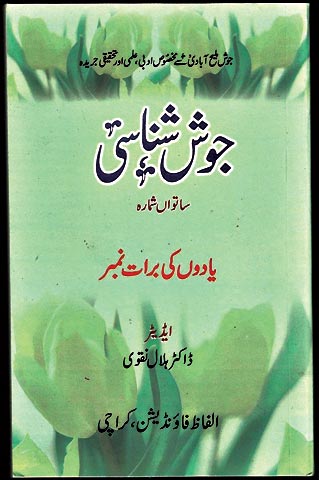
A poet flies on the wings of imagination. This sometimes gives poetry a surrealist touch and readers, too, can enjoy an odyssey through the unknown. The problem, however, arises when the poet tries his or her hand at non-fiction prose and with the stretch of imagination truth is somewhat “stretched”. Mark Twain’s words came to my mind when I began reading the seventh issue of Josh shanasi. A literary and research journal edited by Dr Hilal Naqvi, Josh shanasi is devoted to studies on Josh Maleehabadi, one of the most celebrated 20th century poets of Urdu.
Since this is a special issue on Yaadon ki baraat, Josh Maleehabadi’s famous (or rather notorious) memoirs, Dr Naqvi through sheer hard work and research, has collected almost all the memorable and valuable pieces of literary criticism written on Yaadon ki baraat. Many articles included in Josh shanasi point towards the fact that Josh’s memoirs, or autobiography, as some have called it, contains not only quite a few unbelievable incidents but the general tone and style are such that even the most ardent supporter of Josh would have to admit that certain passages in the book can easily be described as way too exaggerated, if not as lies. “ ’Tis strange — but true; for truth is always strange; Stranger than fiction,” goes Lord Byron’s famous quote. Indeed, at times Yaadon ki baraat does read like stranger than fiction.
But Yaadon ki baraat has many admirable aspects and one of them is its lovely, strikingly fresh and distinctive prose. Though sometimes in Yaadon ki baraat Josh sounds grandiose and pompous, the beauty of his prose is beyond any dispute. The reason perhaps is that when a poetic style is applied to prose it produces a captivating effect and the reader wants to consume more of it. As Rasheed Hasan Khan, one of the most respected critic and researcher of our times, says “It is inevitable to read Yaadon ki baraat in order to understand Josh’s personality and his poetic disposition... The abundance of similes, synonyms and metaphors that has rendered Josh’s poetry somewhat repetitive instead of expanding its nuances, has bestowed upon it an elegance that brightens the whole scene and detailed images of events and situations emerge.”
Rasheed Sahib’s article on Josh’s prose is also included in the special issue of Josh shanasi. Other infamous albeit contentious pieces that have made it to the issue are the ones by Abdul Majid Daryabadi and Mahirul Qadri. Both criticised Josh severely for his inaccuracies, “obscenities” and exaggerations. But Josh’s style on such occasions reminds one of what Winston Churchill has said about Stanley Baldwin: “He occasionally stumbled over the truth, but hastily picked himself up and hurried on as if nothing had happened.”
Dr Naqvi in the editorial of Josh shanasi says that “soon after the publication of Yaadon ki baraat in 1970, writers, critics and analysts crossed swords. Some were in favour of banning the book and others were eulogising it. A third group, the likes of which exist even today, neither wants to throw the book into the wastepaper basket nor does it hold the book as sacred as a scripture.” He then emphasises Yaadon ki baraat’s importance as an Urdu autobiography that revolutionised the art of writing autobiographies. A new open-mindedness quietly crept into Urdu autobiographies. He says that the purpose of revisiting and re-evaluating this book of Josh is to view it against the new research done by social sciences and psychology. It seems that despite his close association with Josh, Dr Naqvi is unemotional about Josh’s writings and wants fellow critics to study Josh fairly and impartially.
At the same time, Dr Naqvi has achieved another feat and that is by digging up the misplaced pages of Yaadon ki baraat. It is a well-known fact that a good number of pages of Yaadon ki baraat could not be published for some reasons and Dr Naqvi had been on the trail of those missing pages.
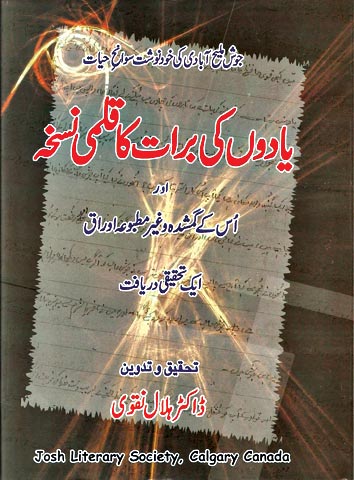
Fortunately, Rafiq Ahmed Naqsh, a scholar and academic who recently passed away, had obtained those missing pages from a source whom he was unwilling to name. Naqsh Sahib had handed over those missing pages to Dr Naqvi who has now published Yaadon ki baraat ka qalmi nuskha aur uss ke gumshuda-o-ghair matbooa auraaq, or the handwritten manuscript of Yaadon ki baraat and its missing and unpublished pages. Recently published by Josh Literary Society, Calgary Canada, the book includes the missing pages hitherto unpublished along with the facsimiles. In most of the missing pages Josh has described his contemporaries. It is indeed a great literary discovery. Dr Naqvi’s annotations have made it a research work that no Josh scholar can ignore.
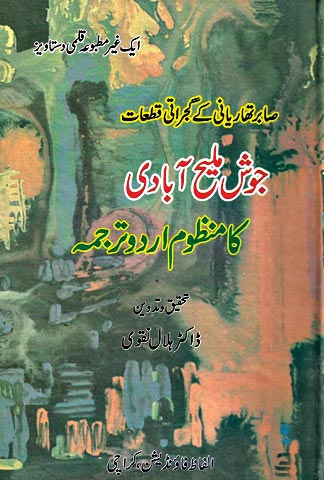
Sabir Tharyani was a Karachi-based architect, poet and journalist who composed poetry in Urdu, English and Gujarati. His Gujarati poems were translated in verse form by Josh and were published from Karachi titled Sabir ke moti. But it contained only the Urdu translations, which had many calligraphic errors. Dr Naqvi traced its original manuscript and has now published it with the facsimiles of original Gujarati poems. Published by Karachi’s Alfaaz Foundation, the book has an intro by Dr Naqvi.
Dr Naqvi has long been recognised as a conscientious Josh scholar and his three new works on Josh have clearly made him an authority on Josh that stands head and shoulder above the rest.
drraufparekh@yahoo.com