Tackling terrorism
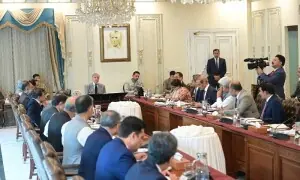
THE stars are aligning to produce the ultimate nightmare for Pakistan’s security establishment. On Pakistan’s western front, US drone attacks look set to continue having gotten the green light from the US commander-in-chief George W. Bush, who isn’t fazed by Pakistani objections. On the eastern front, media reports suggest that India’s aerial incursion into Pakistani territory was no accident and that India has actively considered strikes within Pakistan. And while Chairman of the Joint Chiefs of Staff Committee Gen Tariq Majid has signed an agreement for military cooperation with China, the Chinese did not try to scuttle the UN Security Council panel’s actions against Jamaatud Dawa and four of its leaders. Predictably, though with astonishing speed, the Mumbai attacks have been the catalyst for a shift in Pakistan’s regional situation. Equally predictably, the Pakistani security establishment’s impulse will be to push back against its perceived adversaries. What concerns us is that it may push back against the wrong forces. What Pakistan needs to decisively tackle is its terrorism problem. If the state moves firmly against terrorism — from which Pakistan has suffered grievously — the tensions on our borders will begin to subside. If a zero-sum analysis prevails, the unambiguous loser will be Pakistan.
Three weeks since the gunmen unleashed mayhem on the streets of Mumbai, there have been some encouraging signs that sense will prevail here: suspects have been detained; operations of banned groups have been curtailed; and the civilian government has taken a hard line against terrorism. However, fuelling a sense of doubt are the missing explanations. Yes, the Jamaatud Dawa has been added to a terrorist watch list by the UN so action is necessary; however, many Pakistanis, some of whom have been beneficiaries of Dawa’s welfare operations, are sceptical that it is a politically orchestrated move. They are demanding evidence of wrongdoing by the Jamaatud Dawa and other organisations. The government must build its case against terrorism and militant groups, and their front organisations, in the court of public opinion. The army of ministers and advisers and coalition partners must publicly connect the dots between militant groups, welfare organisations, terrorism and anti-state interests. They must explain clearly to the public why figures such as Masood Azhar, Hafiz Saeed and Zakiur Rehman Lakhvi are being detained or put under house arrest. Absent such explanations, the government will face growing hostility to its policies.
The case of Gen Musharraf is illustrative. He captured, detained and handed over to the Americans many individuals without bothering to justify it to the public. The result? After eight years of his rule, more Pakistanis believed he was the problem rather than the terrorists, even as violence spread across the country. The present government must not repeat the general’s mistake.
Erra in the dock
WHAT many fear may be true after all. All the details aren’t in yet but it seems that the workings of the Earthquake Reconstruction and Rehabilitation Authority have been marred by gross oversight over the years. In fact the alleged irregularities unearthed so far could be a prelude to a much bigger story given the scope of the audit report presented to the National Assembly’s Public Accounts Committee (PAC) on Monday. The report is limited to district Muzaffarabad and covers neither the rest of Azad Kashmir nor those areas in Pakistan that were badly hit by the massive quake three years ago. The PAC was informed that Erra handed out a staggering Rs94m to more than 1,000 claimants whose bona fides, it was subsequently found, could not be established. Moreover, it was discovered that nearly five per cent of the housing cash grant applications selected at random by the auditors bore neither photographs nor thumb impressions. The actual figure may well be higher if all applications are scrutinised. What’s more, by November 2006 various banks were still holding on to over Rs3.3bn in reconstruction grants instead of transferring them to the accounts of affectees. Despite the urgency of the situation, Erra apparently failed to convince them to do so forthwith. According to the audit report, millions of rupees also lay idle in the absence of effective monitoring and distribution systems. Genuine claimants, the report says, suffered as a result.
To be fair it must be said that Erra has done commendable work in some earthquake-affected areas. Its approach, however, has not been even-handed and many whose lives were destroyed three years ago are still awaiting a fresh start. And as the PAC has now learnt, a big question mark also hangs over the authority’s documentation procedures. There is surely a case here for oversight even if no evidence is found of wilful wrongdoing. Every rupee of public money, let alone massive sums earmarked for disaster relief and reconstruction, must be accounted for by the relevant authorities. It is hoped that the PAC will delve deep into the matter, for Erra’s operations need a thorough reappraisal. Total transparency must also be ensured in the utilisation of the President’s Relief Fund for Earthquake Victims. Besides wasting public funds, mismanagement of relief efforts sends all the wrong signals to foreign donors as well as the Pakistani people who came forward so generously with either cash or kind after the tragedy of 2005.
The killing fields
IRONICALLY, justice is most delayed when violated within its own precincts. According to reports in this newspaper, four police officials, including a DSP, who were booked some three weeks ago for killing a young murder suspect in their custody, remain at large. Meanwhile, despite marks of torture, their fellow officers are citing ‘cardiac arrest’ as the cause of death. Although just one of scores of injustices meted out in reformatory facilities, this episode has much in common with another gruesome custodial death in Mirpurkhas in September, where the suspect was also tortured and beaten to death. However, what sets the latter incident apart from other hundreds is the fact that the people of the town took to the streets to protest against custodial transgressions and businesses remained closed for days.
Regardless of the myriad frustrations that our police force has to contend with, police excesses such as these cannot be given quiet burials by the powers that be. It has become absolutely imperative to identify what lies beneath such unpardonable brutality. There is little doubt that the metropolis is hostage to an unresponsive force; a direct result of the absence of kinship with Karachi. A homegrown police corps has an inherent sense of belonging that curtails police crimes such as gang rapes, robberies and assaults in custody. Secondly, precious little is being done to establish and monitor prompt medico-legal and forensic assistance, which are key tools to expedite justice. Needless to say, both areas of expertise are in a particularly dilapidated condition with ill-equipped and unqualified staff. Last but not least is the scourge of political patronage that delays registration of FIRs and facilitates the escape of errant officers. Successive governments have promoted nepotism which cancels out neutrality and professionalism. In turn, the citizenry grapples with a detached, brutal force that is more of a threat than a shield. Also, human rights and legal aid groups would serve a good cause by addressing the issues of an impoverished, deprived police force, to create conviction and security, and encourage reform.
Extremism at the grass roots
THE unenviable position of being a front-line state in the war on terror has resulted in the branding of Pakistan as the most dangerous place on earth and, more recently, after the Mumbai attacks, the ‘epicentre of terror’. Unfortunately, these pronouncements are not entirely bereft of truth.
Internal threats have reached such alarming proportions that even the induction of additional troops, training of indigenous security forces and the injection of funds and equipment, though necessary, will no longer be sufficient to defeat the Al Qaeda/Taliban-led violence.
Extremist ideology, which manifests itself in rampant terrorist attacks in the country, continues to gather momentum. The obscurantist doctrines espoused by so-called religious parties target free markets, democracy, women’s rights and modernity in its diverse aspects, and have made inroads at the grass-roots level. Their efficient welfare network whereby food, clothing, shelter and education are provided to the needy, as at the time of the 2005 earthquake, further bolsters such outfits and provides them a continuous flow of radicalised recruits.
In contrast the injustices and inequality prevalent in society, inflation without economic growth, massive disinvestment, unemployment and a large yet ineffective state administration is gradually eroding the confidence of the people in democratic values and the secular parties that they brought into power less than a year ago.In societies where economic depression and injustice become unbearable, an educated middle class usually provides the impetus for civil movements to rectify and address grievances. In extreme instances, these result in revolutions. In Pakistan, however, the middle class itself is being gradually eroded and sinking into the quicksand of poverty. This socio-economic morass is being skilfully exploited by the well-organised and well-financed extremist elements, in the face of the callous neglect by the state, to gain support of the masses.
The meltdown can only be arrested if the government snaps out of its lethargy. It has to merge its disjointed efforts and strategise to win back the hearts and minds of the people. The solution lies in a mix of economic and ideological initiatives.
The ideological battle cannot be won until economic deprivations are addressed. Social and economic inequalities, the widening gap between the rich and the poor and the erosion of the middle class are playing a more pivotal role in increasing the flanks of the militants than negative indoctrination by the clerics.
The government needs to economically empower the masses by broadening the country’s economic base. To date, economic prosperity has been restricted to a few who have amassed huge fortunes. The country no longer has the time for the much-touted trickle-down benefits of growth. An island of prosperity cannot sustain itself in an ocean of poverty. Distribution of wealth through projects in vocational training, development of small- and medium-sized enterprises backed by micro-credit schemes need to be encouraged. Simultaneously, low-income housing, healthcare and education have to be developed.
These projects are, however, a part of a medium- to long-term strategy with respective gestation periods. The immediate objective is to tackle inflation (averaging 24.65 per cent for just the first five months of fiscal year 2008-09) which, without economic growth, has reached pandemic levels. Reports of suicides and the sale of children indicate the severity of the problem.
Desperate times require bold and imaginative measures. The government must lead the way. Public awareness media campaigns are required to sensitise and mobilise the more fortunate. Funds for poverty alleviation are urgently needed and can be raised from both the private and public sectors. The proper utilisation of these funds in the form of food banks, subsidies, temporary shelters and clothing must be efficiently coordinated and monitored. The luxury of procrastination is no longer available to the government which has to move with speed and determination to redress the inequities.
The ideological battle with its concomitant objective of owning the war on terror has received the same lacklustre, disjointed and sporadic support from the government. The silver lining is that the lack of direction and leadership by the state is, to an extent, being replaced by an activist civil movement.
This movement began with a single song titled: ‘Yeh hum nahin’. The message of the song was simple. It conveyed that Muslims/Pakistanis are not terrorists and that the heinous crimes committed by these extremists are anathema to the Islamic doctrine. The song is now widely considered as the anthem for the anti-terrorism movement in Pakistan.
However, it is just the first step in the ideological struggle against extremist violence. To some extent, the movement has succeeded in galvanising popular support against extremism and more such initiatives are required to take the country towards new frontiers of tolerance, stability and economic prosperity.
The writer is editor-in-chief of Criterion Quarterly.
mushfiq.murshed@gmail.comM
Treating a cold: British vs French style
SEASON of sneezes and fitful drowsiness, the poet might have written. Colds, sore throats, coughing and all kinds of wintry afflictions have already stricken European workers in recent days. Perhaps the dreaded recession has played a role in sapping their morale and weakened their immune system. Whoever the culprit is, the remedy varies enormously according to where exactly in Europe you caught your germs and where you decide to be treated. France and Britain offer opposite attitudes.
In the 13 years I have lived in Britain, I’ve used five different GPs. The scenario never changes. I get a cold; I fight for a week on my own, resorting to a cocktail of raw garlic, ginger infusion, chicken broth and hot baths. After admitting defeat, I go and consult my local GP. He or she hardly looks at me and invariably asks: “So, what is it you have and what is it you want?” “Antibiotics?” I venture. “Go back home, have some rest, and take an aspirin. If you’re still ill in a week, come back to see me.”
I leave feeling even more forlorn than when I arrived. A little angry too, even if I know, deep down, that the doctor is actually right.
Cut to the practice of my local GP in France. Jars of pate and homemade jams given by grateful patients stand by a small aquarium. Le docteur asks me how I feel. I give him all the horrid details: running nose, saliva’s discolouring and an impression of permanent fog in the brain. He seems fascinated and asks me to undress. I already feel better: somebody is taking my cold very seriously. Thorough examination ensues: nose, ears, throat, skull, chest, stomach, blood pressure. He uses a few Latin words to say that, well, I have a cold. And I leave with a long prescription of vitamins, mineral supplements, ear drops, seawater nose spray, soothing blackcurrant pastilles and antibiotics. The mist in my brain has disappeared before I even reach the nearest pharmacy. It’s called the placebo effect. I’m sure I could actually do away with the antibiotics now that I’ve been listened to and examined properly.
The question, of course, is whether it makes any sense to prescribe antibiotics for a cold which is probably only a virus and not a bacterial infection. British GPs’ no-nonsense attitude is in fact, certainly in medical terms, the most sensible to adopt. However, patients may end up feeling worse: the way GPs dismiss them, as if to say colds are for wimps, generally proves emotionally counterproductive. Of course, if you have never known any other kind of medicine, you simply get on with it. But if you have been used to the pampering French system, your local British doctor’s apparent indifference is a bitter pill.
Or perhaps, this is another case of laissez faire against dirigisme. British medicine says: laissez faire la nature and your cold will eventually go away. French medicine declares: let’s annihilate any soupcon of bacterial infection with nuclear-strength antibiotics. The first one treats its patients with harsh firmness, the second with dangerous exuberance. While we ponder on those two opposite medical options, we are left to sneeze. — The Guardian, London
OTHER VOICES - European Press
A tale of greed and fraud...
The Independent
AS Warren Buffet, the most successful investor of all time, once noted, it is when the tide goes out that the world sees who has been swimming naked. But rarely has the world witnessed an exposure quite as traumatic as the collapse of Bernard Madoff’s hedge fund.
When hedge funds first appeared on the financial scene, they were high-risk and high-yielding investment vehicles for the super-wealthy. But in recent years all manner of supposedly conservative investors, from pension funds to insurance firms, began ploughing cash into them, eager for a piece of the action. And so it is not just a handful of wealthy investors who have been scorched by the collapse of Mr Madoff’s £33bn fund.
Losses are showing up in banks and financial institutions across the world. In Britain, HSBC and the Royal Bank of Scotland have admitted that they invested millions with Mr Madoff. Even local authorities in Hampshire and Merseyside were exposed. It is not just Mr Madoff who was swimming naked, but all those who invested money with him.
It is rather rich to hear supposedly sophisticated investors such as Nicola Horlick here in Britain blaming US financial regulators for not spotting what Mr Madoff was up to.
It is no secret that hedge funds are inherently risky. Ms Horlick might do well to examine her own judgment for parking her client’s money with Mr Madoff, rather than trying to shift responsibility. Yet that is not to argue that the regulators are blameless in this sorry affair. Far from it.
The US Security and Exchange Commission, charged with regulating the American financial sector, was clearly negligent in failing to scrutinise Mr Madoff’s books. This is a symptom of a much wider regulatory malaise. The shadow banking sector, of which hedge funds are a central player, has been like the Wild West in recent years. Regulation has not been so much light-touch as non-existent. And this has been the case not just in the US but in London too, which is home to scores of hedge funds.
The Conservative Party leader, David Cameron ... said there should be tougher penalties for financial fraudsters. Few would argue with that in the present climate. But the regulators also need to call time on insolvent traders before they implode spectacularly like Mr Madoff. Better regulation is essential. Investors must take responsibility, but we all need to be able to have confidence that the financial authorities are doing their job properly.
Some will argue this is all rather academic since the hedge fund model seems to be heading for extinction courtesy of the financial downturn. Hedge fund managers claimed to be able to generate stunning returns for investors in any economic conditions. And they extracted huge personal fees on the justification of their supposedly superior investment skills. But funds managed by the sector have posted vast losses this year. And investors are rushing for the door.
We now see that the impressive returns of the sector in the boom times were primarily a result of cheap credit. Fund managers made bets on movements in the markets with huge quantities of borrowed money. Now money is no longer cheap, their performance no longer looks so impressive.
Ultimately, the market will decide whether the hedge fund sector survives or not. But either way, there can be no doubt that the Wild West is in need of a competent sheriff. — (Dec 16)