Dawn’s front page headline on 29th
September 2007 used the words “The day of the General” to sum up the 6-to-3
Supreme Court verdict given a day before, dismissing on technical grounds the
maintainability of petitions challenging the eligibility of a serving army
officer to be a candidate for the Presidency of Pakistan.
The headline was explicit as well as subtle, evoking several associations. If
headlines are sometimes to be commentative rather than factual or narrative then
a second, equally prominent headline should have been “A darker night for the
nation”. All nights are dark. But the night after this judgment was darker than
most — even with a full moon! An ominous new precedent is sought to be created
in a history already full of weird precedents given legal sanction by the
judiciary.
Of the previous three military heads who occupied the Presidency — Ayub Khan,
Yahya Khan, Zia-ul-Haq — none served simultaneously in an army command position
and in the Presidency, while also being a candidate in a competitive election,
one, moreover, where the other candidates were civilian.
Only one instance comes close. But not close enough. An adage says that a Field
Marshal never retires. But Field Marshal Ayub Khan ceased to work in a command
position in the army when he became a candidate for election contested also by
Ms Fatima Jinnah for the post of president in January 1965: General Musa had
already been appointed commander-in-chief.
Detailed comment will have to wait till the detailed judgement is released. But
the short order of the court casts a long shadow. By declaring that the
petitions could not be entertained under Article 184 (c) of the Constitution,
the majority of 6 judges out of 9 appear to have focussed on the letter of the
law, whereas wisdom demanded that the focus be on the spirit of the 1973
Constitution and on the essence of its principles. That essence survives despite
the distortions injected into the Constitution both by elected civilians and by
military officers. That essence draws a clear, unmistakable line between, on the
one hand, the civil and the political spheres, and on the other, the military
sphere.
Non-maintainability is an issue that can be decided at the level of the Supreme
Court virtually in a single hearing. Instead, the court forced several lawyers
to invest dozens of hours and arguments on the merits (which, in any case, the
court was not considering!) and kept tens of millions of people in Pakistan and
overseas engaged in an ultimately futile waiting game.
During the hearings, one of the honourable Judges, perhaps expressing views held
by some of his colleagues as well, wondered why the Supreme Court was expected
to come to the rescue when the original sins — e.g. the 17th Amendment, the dual
office law, etc — were actually the products of an elected parliament. In
effect, the Court — or part of it — was saying: “Nations get the judicial
verdicts they deserve based on the laws enacted by their elected legislatures.”
Such a view about the responsibility of the judiciary is, with respect, myopic
and evasive. In countries such as the USA and India, to cite only two,
legislatures are, by and large, freely and fairly elected, credible and strong.
They are seen as legitimate forums fully empowered to make laws. Yet even where
the bona fides of such legislatures are not in question, the Supreme Courts in
the USA and India have ruled that the judiciary has the right, if not a duty, to
protect the basic structure of the Constitution from deviationist, destructive
legislation.
In Pakistan there is recurrent controversy about the fairness of elections,
about the fairness of legislation that is sometimes contrived and enacted by
covert deals between the ruling and opposition parties. Further, in Pakistan,
unlike the USA and India, the military continues to encroach into the political
process.
Thus, more than anywhere else in the world (except Myanmar, and a couple of
other places) it is in Pakistan that the judiciary needs to go beyond literalism
and technicalities. The majority of judges seem to be of the view that one of
the major reasons for non-maintainability was that none of the petitioners is a
candidate for the presidency. Therefore, none of them faces a violation of his
fundamental rights in view of the imminent candidacy of a serving army officer.
So basic is the issue of a uniformed officer-candidate being antithetical to the
essence of the 1973 Constitution that every citizen of Pakistan, leave alone
just two or three petitioners, face a violation of their fundamental rights.
Above all, the right to benefit from the distinct separation of the
institutional roles of the civil and the military as defined by the 1973
Constitution.
The offensive implications of the statement -- “If elected, I will quit as Chief
of Army Staff before taking oath of office” -- were instantly exposed by the
other statement: “If held to be ineligible, the General will continue as Chief
of the Army Staff.” (with the absurd addendum to the effect that there is no
limitation to the tenure of an Army Chief as per the Army Act). Therefore, if
Mohtarma Benazir Bhutto can be elected “Life Chairperson” of her party, so too
can a General be a “Life Chief!”. There can be no better expression for the fait
accompli approach of: “Heads I win, tails you lose”. Come what may, “I will keep
power, either in one or the other post”.
There is then our own version of the chaos theory. Apologists justify the
eligibility of a uniformed president or a retired General in the interest of a
‘smooth transition’. The question is transition for whom? Certainly not for the
nation. Transition applies to only one individual’s change of status — while
still retaining a high office.
The transition theory, to put it as crudely as its real nature, is pure bunk.
Even the mutilated version of our Constitution today enables a smooth
transition. Remember how well it worked on 17-18 August 1988. General Zia-ul-Haq
perished in an air crash. Within hours, as per the Constitution, the Chairman of
the Senate, Ghulam Ishaq Khan, took over as president. The Armed Forces,
including the army, under a new Chief abided by the Constitution. Elections were
held within about 90 days. An elected civil, political government took over on
2nd December 1988.
Fortunately, the 6-3 verdict is the first stage of a struggle that, hopefully,
will continue — in the courts of the judiciary, and in the court of public
opinion and through peaceful public action.
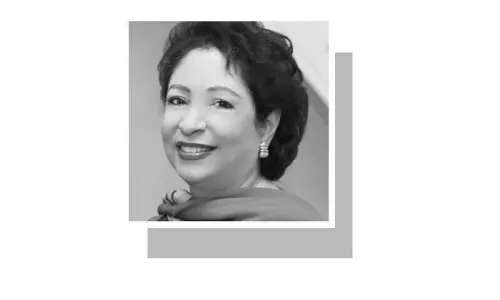
Having served with General Musharraf in his cabinet for about one year in the
first year of his government (1999-2000) this writer has no regrets at being
associated with a military-led government. That entity came into existence in
freakish, bizarre circumstances and one participated in that process on the
explicit understanding that the military intervention would be limited and
precise, respectful of the three-year limit given by the Supreme Court. And
there was not even a hint at that time that a serving officer, civil or
military, would be a candidate for election to a political office. This is not
the occasion to dwell in detail on why I resigned from the cabinet in October
2000. Suffice it to say that what one regrets today is how the same fine General
and several citizens in a country so rich in human resources have succumbed to
the indispensability syndrome.
In his eventful tenure, notwithstanding all the compromises and other flawed
policies, General Musharraf has rendered some valuable services to Pakistan.
Three are particularly notable, economic growth (despite the persistence of
poverty and inequality); the proliferation of private electronic media and
increased pluralism; the creation of reserved seats for women in district,
provincial and national legislatures.
Yet it is now time for the General to go with honour and cease to be both army
chief and president, to enable a fully civilian, political, democratic process
to re-establish itself. Even as a retired General occupying the Presidency, his
present in the transition to a truly civilian authority will be restrictive and
stilted. And as for the hour and time of his departure with dignity, he should
go in full daylight, befitting the commando he is proud to be, not in the
stealth of a dark night.