Advice or interference?
CALL it pressure or friendly advice, Washington’s interest in having a “moderate” government in which the military will share power with the PPP is becoming clearer by the day. While Assistant Secretary of State Richard Boucher denied in Islamabad on Thursday that the US was “facilitating” a deal between President Pervez Musharraf and Ms Benazir Bhutto, a White House spokesman made it clear the same day that the US was interested in seeing “a moderate political centre” in Pakistan. One American official, who did not wish to be named, was a little more specific and said that his government wanted all moderate elements to take part in the political process leading to the election of a leader who represented the “the choice of the Pakistani people”. That America is interested in continuing to have Pakistan as an ally in the war on terror goes without saying. Countries other than America have also played some part in effecting political reconciliation in Pakistan as seen in the efforts by former British Foreign Secretary Jack Straw to bring the PPP and the military-led government closer. Friendly governments taking a healthy interest in Pakistan’s internal affairs need not be viewed with suspicion so long as what they do and say do not cross the limits of diplomatic norms. However, sometimes it appears that foreign governments act in a way that looks like interference in Pakistan’s internal affairs. During his last visit, for instance, Mr Boucher met Election Commission officials. Why a foreign diplomat should go to that extent to ensure free and fair elections is beyond comprehension.
Holding a fair and free election is the responsibility of the government, and if President Musharraf and the government that comes into being after the election are to acquire democratic legitimacy and earn the world’s approval on that count, they must have a mandate from the people. Only a free and fair election, held under a caretaker government and by an election commission that is truly independent, can ensure this. Despite its denials, what America is seeking is something that the military-led government should have had the realism to realise much earlier. Until recently the Musharraf government had enjoyed the donors’ full confidence in its ability to fight religious militancy and prevent what the world fears most — a takeover of Pakistan by the extremists. However, many events — the CJ affair, the handling of the Lal Masjid brigade and the government’s plunging popularity ratings — have made America and others wonder whether they should have put all their eggs in one basket. The threat to bomb the tribal belt is, perhaps, America’s most clear message to the Musharraf government that it has not come up to Washington’s expectations in the war on terror. Washington is, of course, wrong here.
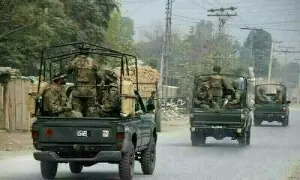
We are dealing with a tenacious enemy hiding in a mountainous terrain ideal for guerrilla war. The results so far might not be spectacular, but Islamabad has deployed nearly 100,000 troops in Fata and has suffered 800 dead. The havoc caused by suicide bombings also should make it clear to all that the war on terror is in Pakistan’s own interest. Yet the world does not have much confidence in Islamabad because the war on the Taliban is being conducted not by a popularly elected government but by a general. That, in their view, makes the future course of the war subject to the vagaries of the forthcoming elections in Pakistan.
Ensuring media freedom
THE problem with Pemra pre-dates the infamous ordinance promulgated ten weeks ago. Even the original Pemra Ordinance of 2002 gave the federal government sweeping powers to dictate policy, despite the regulatory authority’s status as an independent body. The government’s control over the regulator was tightened further under the Pemra Act 2007, which increased the number of public-sector members and allowed delegation of power to grant or revoke licences. Then, on May 29 this year, the Pakistan Electronic Media Regulatory Authority was brought under the administrative control of the information ministry — a move that put paid to any remaining pretence regarding Pemra’s independence. The driving force behind this and other retrogressive moves was the desire to suppress coverage of the activities of the then ‘non-functional’ Chief Justice of the Supreme Court. However, the most brazen curb came on June 4 with the promulgation of the Pemra (Amendment) Ordinance, a draconian law that allows the regulators to seize equipment and seal the offices of offending TV channels almost at will.
Although the ordinance was later suspended, it is yet to be officially withdrawn. On Thursday, the opposition’s demand that the ordinance be tabled and discussed in the Senate was rejected by the chairman of the Upper House. For its part, the government claimed that negotiations with media representatives were going on, and as such there was no need to table the ordinance which would most likely be withdrawn at an “appropriate” time. There would have been no harm, however, in allowing the debate to take place. The government should also withdraw the ordinance immediately so as to dispel any impression that it is being used to pressure the broadcasters into framing a code of conduct favourable to the authorities. The Pakistan Broadcasters Association has already proposed a code under which gory scenes will not be telecast and ‘live’ coverage will come with a brief time delay. This is a welcome development and the PBA should see it through to its logical end, for violations of the code will only invite censorship. At the same time, Pemra must function as a truly independent regulatory authority rather than as a tool for bullying the electronic media.
Karachi’s traffic nightmare
THE Supreme Court’s suo motu notice of the traffic chaos in Karachi reflects poorly on the ability of the traffic police to handle the worsening congestion on the city’s roads. But the buck must not stop there. For although the traffic department needs to reformulate its strategy so that a steady and organised flow of vehicles is maintained at all times, including peak hours, there is much to obstruct its endeavours as pointed out by the DIG Traffic to the court on Wednesday. Population pressures, the presence of illegal bus stops, encroachments, the movement of large intra-city buses on unauthorised routes and the perpetual digging of roads have combined to create a nightmare for commuters. One must add to this list the tight security arrangements for VVIPS that hold up traffic, sometimes for hours, and that have even led to the death of critically ill patients not able to make it to the hospital on time. The recent rains that have made many city roads impassable have compounded the problem.
There was much sense in the DIG’s suggestion that the city government and relevant departments should jointly tackle the traffic snarls that have become a regular feature in Karachi. Better communication will at least prevent the concerned departments from working at cross purposes with one another. Such cooperation will also provide a temporary reprieve to the public as more permanent solutions are sought, including the implementation of the Karachi Mass Transit Project and the revival of the circular railway. Unfortunately, this long-term solution has been superseded by the careless planning and construction of elevated expressways and signal-free corridors that have so far provided little respite. The authorities must act quickly before the situation becomes irreversible as thousands of cars are being added to the already congested roads each month.
Height of incompetence
WHAT is ailing Pakistan? If you ask any political analyst he would say “lack of social development, political instability, growth without equity and extremism.” This may be a fair assessment but what people tend to ignore is that Pakistan is beset with another major problem which we can call the “cult of incompetence”.
Some people may consider this inconsequential while others may wonder what is so important about incompetence. Let’s see how it matters at the national level when there are more important issues to focus on. Two recent examples stand out — the judicial crisis and Lal Masjid fiasco — that highlight the magnitude of this problem.
Let’s take the judicial crisis first. For a moment, let’s forget about its legal and moral aspects and see how matters were handled. In Pakistan, from the mid-fifties, governors-general, presidents, prime ministers and their nominees at the provincial level have indulged in arbitrary dismissals of elected governments, even dissolving the Constituent Assembly and passing reviled bills like the one relating to the formation of One Unit through sheer force. But everything was done methodically, thus avoiding major pitfalls.
The judges of the then Federal Court and provincial high courts must have been put under tremendous pressure by the all-powerful bureaucrats backed by the army. But it was all done avoiding a public display of arrogance.
Now let’s view Chief Justice Iftikhar Chaudhry’s case. The army’s top brass decided to get rid of him. Right, but what preparations were made to accomplish this and how was it done?
Let alone the question of whether he was called to the Army House or had gone there of his own volition. Was the president absolutely sure that he would resign? If there was a one per cent chance that he would not, what were the contingency plans? Was the reference against him ready? Were all the procedural formalities completed in time to call the Supreme Judicial Council’s meeting?
Was it clear what would be his status during the pendency of the reference? Would he be a “non-functional” Chief Justice, a Chief Justice on forced leave or a suspended one?
Every one knows what happened. Was it not the height of incompetence that without deciding on the status of the Chief Justice, an acting Chief Justice was sworn in, the Supreme Judicial Council met in a hurry and orders were passed for sending Chief Justice Iftikhar Chaudhry on forced leave?
Meanwhile, government functionaries and ministers were not briefed on how to defend the situation and continued to declare on private TV channels that he had been made non-functional. It was much later that they changed it to “forced leave”.
Coming to the reference, it was expected that the government’s top advisors would examine every aspect of the case and include only such allegations in the reference that had substance. Instead, it was prepared in a slipshod manner, and the government had to withdraw it as soon as it was presented before the full bench of the Supreme Court. Later, no one accepted the responsibility of having prepared it. Sharifuddin Pirzada said he did not know about it. The attorney-general pleaded his innocence. The law secretary said he had simply forwarded the material which was given to him.
Even Justice (Retd) Qayyum (who has been amply rewarded for his failure) had to admit that he had not read the material before it was submitted to the Supreme Court. Can anyone beat this level of carelessness? And this was not an ordinary case. It appears that instead of legal brains, the case was prepared by the intelligence agencies. Let’s see how competent they are.
The names of the top agencies — ISI, MI and IB — are awe-inspiring for ordinary people who have been the victims of their whimsical exercise of power. Ordinary Pakistanis think that they must be manned by very intelligent, highly trained and capable people, who not only collect information which is not easily available but also have the capacity to analyse it, carefully helping their bosses take intelligent decisions.
But those who watched them closely know that they are manned by the most unintelligent people, sorely lacking in commonsense. Some of their officers may be doing their job right, but the rank and file gathering information are semi-literate and use methods which are obsolete. How can one expect them to provide material for a reference against the Chief Justice of Pakistan?
However, the lowest point was reached by those who examined the material. They messed it up. No one had the courage of conviction, which is concomitant to a certain level of competence, to point out the flaws in the case and the consequences that would follow from pursuing it.
Now let us see the question of competence at another level. While the attorneys defending the Chief Justice were working as a team and devising their strategy very carefully after long hours of discussion, what was the level of competence of the lawyers representing the federation and the president of Pakistan?
There was no strategy or coherence. The attorney-general spoke in the last hearing and did not respond to many queries made by the judges of the Supreme Court. Mr Sharifuddin Pirzada, who is known as a wizard in government circles, spoke only for a few hours, mostly citing Islamic traditions about qazis not in any way relevant to the case.
The reference against the Chief Justice and the manner in which it was dealt with shows how incompetent our decision-makers can get and how reckless they become when they reach the greasy top. They survive because there is no accountability. Can we ignore the fact that we lost half our country in 1971, but that no heads rolled?
Let us come to Lal Masjid. There can be different opinions about the role of the state in allowing mullahs to turn Lal Masjid into a fortress and turning a blind eye to their activities for a long time. One can also say that the illegal occupation of state land for use as a madressah should not have been tolerated from day one.
But here we are simply discussing how this crisis was dealt with. When the action started, the initial reaction of the general public, even the prominent mullahs, was positive. There was comic relief when Maulana Abdul Aziz was captured trying to flee in a burqa. But things started going wrong just after that mainly because of the incompetence of those dealing with the crisis.
Maulana Abdul Aziz’s capture put enough pressure on Abdul Rashid Ghazi to surrender. The majority of the students started surrendering. The question is who decided that Maulana Abdul Aziz should be shown on PTV again and again, clad in a burqa and being subjected to a supposedly voluntary interview while his brother and other family members were holed up in the mosque?
PTV professionals plead helplessness. Some reportedly opposed the very idea to humiliate the maulana. People thought it in bad taste. Overnight, he became an underdog deserving sympathy. Who is to blame for all this? Obviously, the intelligence agencies. This interview resulted in a backlash and things started going against the government.
Another important point is that when Abdul Rashid Ghazi offered to surrender, provided he was given safe exit, why was the offer not accepted? Could he not be arrested afterwards? After all, he was not in a foreign country.
The incompetence of the people handling this case was evident from the fact that they did not even collect the data on the students holed up in the mosque and the madressah. Can anyone believe that for six months before the eventual battle, preparations were going on to launch an operation, but that when it did take place, the intelligence agencies and the police had no clue about the exact number of students?
‘Operation Silence’ came to an end on July 9. The mosque and the madressah came into the possession of the government on the same day. What was the first priority? To clear the place of all the remnants that could ignite public protests.But look at what the government did. The mosque was repaired and renovated and opened for juma prayers on July 27 but the “competent” people sitting in the Pakistani capital did not consider removing the rubble of the Hafsa madressah which still contained the school bags, clothes, burqas, books, even body parts of the hapless students who were killed by their own armed forces.
What would you call it? Sheer negligence, callousness or the height of incompetence or a combination of all these?
One can ask why we are touching such heights of incompetence. Why do we see deterioration all round? Why are we going downhill with a snowballing effect? The main reason is institutional decay. Instead of strengthening our institutions, we have weakened them to the extent that they refuse to work. Political instability resulting from frequent military interventions is largely responsible for the situation we find ourselves in today.
The second, and natural corollary to the reason stated above, is the over-centralisation of power. It is the person of the president from where all power emanates. There is no consultation even at the cabinet level. From parliament and the cabinet, policymaking has shifted to the intelligence agencies. We would have accepted the fait accompli with some satisfaction if the intelligence agencies were competent and the military governments had solved some of our problems.The third reason is that we ignore merit and do not put the right person in the right place, thanks to the all-pervasive culture of cronyism, ‘sifarish’ and sycophancy. When it comes to decision-making even those who are hand-picked are not given a free hand. Decisions are dictated from above.
Previously, a law and order situation which could be effectively dealt with by a district magistrate is now being handled by the interior minister, the inspector-general police and a corps commander. We saw what happened in Lal Masjid’s case and we continue to witness what is happening in South and North Waziristan.
| © DAWN Group of Newspapers, 2007 |