Many faces of the crisis
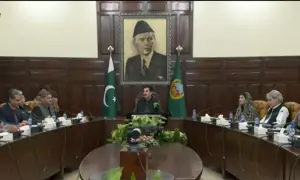
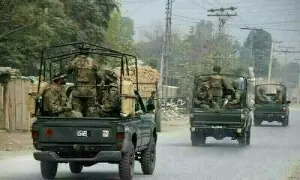
A FEELING of uncertainty has gripped the nation, worsened by a fear of the unknown. Most people are wondering what is in store for Pakistan. Each day brings more bad news. From Karachi to Khyber via Quetta and Islamabad, violence has overshadowed all other aspects of life. In the NWFP, the Taliban wave is creeping forward, for what was confined to Fata has entered ‘settled’ areas. Fanatics are threatening law-abiding citizens and kidnapping government officials and civilians, including women and children. The government’s failure to protect citizens and give them a feeling of security is evident from the goings on in Bannu, Lakki Marwat and Tank. On Saturday, 15 tribes gave a three-day notice to the government to act against the Taliban or they would do so on their own. The tribal elders alleged that the police had turned a blind eye to the Taliban’s activities and for that reason they were raising a lashkar of their own to meet the situation.
In Balochistan, the nationalists have refused to accept the amnesty offer and seem determined to carry on their movement. The recent developments in the country might have shifted the focus away from the grim situation in Balochistan, but the truth is that, despite the three years of military action and Akbar Bugti’s death last August, the militants still seem capable of carrying out acts of sabotage and terror. A political solution to the province’s grievances is nowhere in sight, despite the recommendations made by the two parliamentary committees two years ago. In Islamabad, the Lal Masjid ‘brigade’ is defying the government’s writ, and protracted negotiations have not defused the crisis. It is true that the Lal Masjid clerics’ abnormal behaviour and the antics of the girl students there call for a careful handling of the situation, given that the clerics are using a mosque to browbeat and blackmail. But the two brothers running the Lal Masjid show and others like them have been emboldened by the government’s pusillanimity and lack of will to act.
In Karachi, the wounds caused by the May 12 carnage will take time to heal. The demand for a judicial probe into the tragedy that has so far resulted in the death of 48 people has not yet been accepted and gives the impression that the federal and provincial governments have things to hide. The MQM, which is being held responsible by all opposition parties for the May 12 massacre, now blames “the establishment” for the deaths. What is meant by “establishment” defies logic because the MQM is itself part of Sindh’s coalition government. A three-day strike is due later this week, and the citizens of the metropolis are wondering whether the federal and provincial governments are aware of the gravity of the situation and whether they have taken appropriate steps to meet any eventuality.
The federal government must come clean on this issue. President Pervez Musharraf has spoken to the media and given a TV interview. But what is missing is a televised address to the nation giving his own version of the ongoing crisis and what he plans to do to come to grips with it. People wonder why a comprehensive governmental version is not forthcoming this time, unless the president thinks the May 12 tragedy is not worth all this bother. Above all, the people want to know the mode of his re-election as president and when he will discard his uniform.
New conflict in Lebanon
AGENTS both internal and external continue to destabilise Lebanon. The bloodiest internal conflict the country has faced since the end of the civil war 17 years ago was sparked on Sunday as Lebanese troops and the Fatah al-Islam militia fought it out in the northern city of Tripoli. The skirmishes continued on Monday and have so far left over 40 dead, including at least 22 security personnel. Fatah al-Islam, a relatively obscure Sunni militia linked to Al Qaeda and believed to be backed by Syrian intelligence, has its stronghold in the Palestinian refugee camp of Nahr al-Bared, the focus of the clashes. Damascus, for its part, denies any link with Fatah al-Islam. The one silver lining is that the conflict has prompted a rare show of unity from Lebanese leaders representing diverse shades of opinion. President Emile Lahoud and Prime Minister Fouad Siniora, whose supporters generally refuse to accept the other’s authority, have condemned Fatah al-Islam with one voice, as has parliament speaker Nabih Berri. Similar sentiments have been expressed by Free Patriotic Movement leader Gen Michel Aoun, anti-Syrian parliamentarian Saad Hariri (son of the slain PM Rafik Hariri), Dr Samir Geagea of the Lebanese Forces and Druze leader Walid Jumblatt, who described the fighting in northern Lebanon as the start of “something bigger and more dangerous”. Other Palestinian groups in Lebanon have also been quick to distance themselves from the increasingly isolated Fatah al-Islam. This apparent consensus is a welcome development in a country as politically and religiously fragmented as Lebanon.
Most observers are pointing the finger of blame at Syria, which has traditionally held sway over its neighbour but is now viewed with hostility by a large section of the Lebanese people. Many accuse Damascus of triggering the clashes in Tripoli to destabilise Lebanon at a time when the UN is planning to form an international tribunal to try suspects in the 2005 assassination of former Prime Minister Rafik Hariri. Syria, which is implicated in the case, is strongly opposed to the move. War-weary Lebanon cannot afford to have the conflict escalating into “something bigger and more dangerous”. A political solution is the need of the hour.
Greedy monsters
THE news of a raid on a factory in Peshawar which hid 48 containers of goods meant for earthquake victims is alarming. It is hard to understand what kind of monsters would steal goods meant for people who had lost everything in the 2005 earthquake. The raid was conducted by the investigating unit of the Central Board of Revenue on a factory in Hayatabad in Peshawar on Sunday where items donated by foreign philanthropists were found. It wasn’t just food items that were stolen; the containers had 12 jeeps, hundreds of tents, nearly 50 portable toilets, air-conditioners, heaters, generators, cooking ranges and other goods that would have helped hundreds of families whose lives have not returned to normal. Because the rehabilitation process has been difficult and aid slow in coming for the affected people, any of the recovered goods would have alleviated much of the suffering families continue to face. These may have been goods brought in by foreign organisations which had worked in camps in Muzaffarabad last year and left the items for earthquake victims when they returned to their countries. Yet nefarious elements, who only think of profiteering, somehow managed to seize them to sell later. One saw this right after the earthquake when trucks carrying relief goods were robbed. This is why one is thankful the CBR has been able to prevent another plunder of a horrific kind.
No effort must be spared in tracing those responsible for this terrible crime. They must be given exemplary punishment for trying to profit from the quake victims’ suffering. Of equal importance is the distribution of these goods to the people they were meant for. Erra can ensure that it is done in a transparent and speedy manner.
Where is nowhere?
A SECTARIAN simmer in Punjab bursts into violence; in the patterns of that fire, the shadows of an old ghost begin to dance. Slogans of Khalistan are heard, albeit from the margin. But that is sufficient for a very senior officer of the ministry of external affairs in Delhi to invite some journalists for a briefing. Pakistan, he whispers, is behind all this. The official will not permit his name to be disclosed.
A killer bomb, activated through a cell phone, goes off during Friday prayers at the Makkah Masjid in Hyderabad, among the largest mosques in Asia. Even before the echo of the blast has ebbed, “intelligence” officers of the police are talking to the media, once again on an off-the-record basis. Where do their fingers point? All the usual suspects, please, line up. Pakistan, take your place at the head of the line.
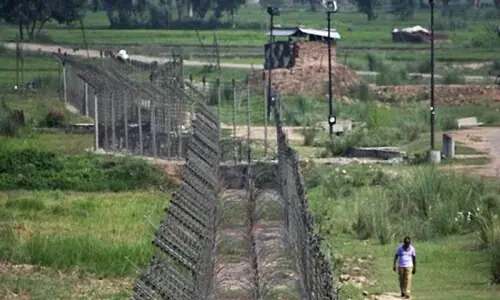
This is not unique. A dozen bombs go off in Pakistan for every one in India, and guess whom they blame for 11 of those incidents? India. The administrative systems of India and Pakistan have only one ideology left: Alibiology. They have become addicted to alibis, because no faith could be easier to follow. It is almost a miracle that the Pakistan establishment has not blamed India for the recent demonstrations and street carnage that have whittled the credibility of the Musharraf government.
The media in either country doesn’t waste any time in turning an unattributable whisper into a screeching headline. Public memory is conveniently short. For every investigation that reaches somewhere, a hundred go nowhere. “Nowhere” is a large cavern in the public unconsciousness, into which all that is unpleasant is dumped, where the dead are forgotten while life goes on.
No one has time for inconvenient questions. If the police theorists are so convinced that this or that organisation was behind the Makkah Masjid outrage, why did they not do something to prevent it? They may not have succeeded in preventing the incident, but is there any evidence that they tried to do so based on a tip or a clue? And if they were taken by surprise, why do they offer knee-jerk explanations before they have had any time to investigate?
Why does a senior official of the MEA in Delhi or the foreign office in Islamabad choose the comfort of anonymity when blaming the other? If he has serious evidence of complicity, he should hold a news conference. The Delhi official isn’t blaming his own prime minister, so why the secrecy?
Islamabad and Delhi should formally permit their intelligence bragging rights, instead of all this pretend-mysteriousness. They have a legitimate and even honourable role to play in the defence of people’s lives. If they can trace and implicate masterminds or puppeteers intent upon spreading havoc among the innocent, their efforts must be lauded.
One fears that the problem is not a veil over success, but inefficiency. The famed and feared ISI of Pakistan has the skills to instigate mayhem, but no ability to prevent what it has not started. Pakistan’s intelligence agencies have absolutely no clue about the perceptible collapse of civil society that is now the most serious threat to political stability and the economic revival that had begun to get visible in the last two years.
In the absence of rational analysis, and proposals that might help in the formulation of serious answers to genuine problems, they provide a bazaar list of “enemies” to their embattled president.
Generals never see the problem as the enemy. They see the enemy as the problem.
There is no shortage of crises in India, but India is blessed with a mature democracy. If those in power don’t tackle the problem, the problem sweeps them out of power. A Constitution, and a mature political process in which elections are being further sterilised from corruption each year, ensure that there is a peaceful method with which to deal with leaderships that have lost their way or credibility.
Pakistan’s dilemma is not complex. There is no sanctity for the Constitution or the rule of law. A figurehead of the judiciary may have become the symbol of the fight against a president who emerged from a coup, but the Supreme Court has always provided the necessary justification to cover the nakedness of any leader dressed in nothing but a silver pistol. De facto has been given the veneer of de jure. If Pakistan’s epaulette-and-moustache presidents take the Supreme Court for granted it is because the record permits them to do so.
When was a coup in Pakistan ever declared illegal? When is a coup ever legal?
In practice, Pakistan’s political system has found an entry route for army chiefs to come to power. But it has not discovered an exit route. Dictators have lasted much longer than democrats because there is no system of accountability. Civilians see the mood of the people when they look ahead; they see the hunger of the armed forces when they look behind their backs. They are hemmed in from both sides. The dictator shuffles off potential troublemakers behind his back, and ignores the people in front. He can concentrate on making speeches that sound good in America. Happy days are here again!
Ayub Khan and Yahya Khan had to fail in war to lose their jobs; Ziaul Haq was helped towards the Almighty by an accident that still remains unsolved.
Fortunately for Pervez Musharraf, he failed in a war with India before he led the coup, so he can’t be punished for that. What next? He has taken the battle to the streets, encouraging his vigilantes to inform the country that there is a King’s party in this confrontation. Will he now contest and win a dubious election by disqualifying anyone who can defeat him?
A vulnerable government is the privilege of a democracy. Indian opposition parties have the legal and moral right to hope that any incumbent will fall, and they can succeed in the ensuing election. But if a government is unstable, the system is stable. The nation is stable. There is the excitement of peaceful dramatic change, as took place at the national level three years ago, and has just occurred in Uttar Pradesh. Losers get depressed, and then gear up.
If dictatorship is the institutionalisation of ego, as today in Pakistan, then democracy is the destruction of ego. This summer’s road from Lucknow to Delhi is littered with punctured egos. The punctures will heal, of course, because democracy has restorative powers as well. It is both the bite and the serum.
Alibiology is less excusable in a democracy, and therefore grates all the more when Indian officials content themselves and hope they can fool the country, with an excuse. There are certainly forces inimical to India, based in or sponsored by elements in Pakistan. But they would achieve nothing if we in India did not have weaknesses that could be exploited. Nor is it very wise to keep suggesting that the internal security systems of India are so weak that they can be continually and easily penetrated by a foreign agency.
Vigilance is the price of liberty, true. But vigilance needs three eyes, only one of which looks across the border. Two must look within.
The writer is editor-in-chief of The Asian Age, New Delhi.
A broad church
IF getting elected president was a coup, Nicolas Sarkozy produced an even bigger surprise when nominating his first government. Everyone thought the president was going to appoint his friends. What he did was to bag four Socialists, a centrist and two loyalists of the former president Jacques Chirac. Seven of the 15 ministers are women.
Only two of the lineup have been to France's political finishing school, the École Nationale d'Administration –– another plus after an election in which elitism was an issue. But the real catch, for the man who had courted the extreme right during his campaign, was Bernard Kouchner, the co-founder of Médecins sans Frontières, one of the most popular politicians in France and now its foreign minister. Not only had Mr Kouchner campaigned and voted for Ségolène Royal in both rounds of the presidential elections. He had accused his current boss of being the Silvio Berlusconi of France. Mr Kouchner is an active interventionist.
It was he who first developed the theory of humanitarian intervention to justify international action against dictators who flout human rights. On Iraq he says today that he was "neither for the war, nor for Saddam Hussein", although he is remembered at the time for speaking out against the official French position, which opposed the invasion. An avowed Atlanticist, he said he regretted the fact that the French became "America-phobic". Thus far, Mr Kouchner and Mr Sarkozy are at one. Turkey is a more interesting issue, as the new foreign minister is in favour of the "secular Islamic country" joining the European Union while his president is unambiguously against.
But for the moment none of this matters. Asked why he had joined the enemy camp, Mr Kouchner said he still remained true to his social-democratic beliefs. But the people had cast their vote, that was behind them, and what was important now was to advance the interests of French diplomacy, which were "neither right nor left".
This is manna from heaven for the new president. Because in truth, politics is not behind the government of Mr Sarkozy, but in front of it.
There is barely a month to go before the parliamentary elections, and what Mr Sarkozy has produced is a formidable election-winning machine. If his two chief opponents in the presidential elections, Ms Royal and François Bayrou, lectured the nation about the need to change the terms of the political debate and create an open, inclusive government where ideas and talent mattered more than ideology, Mr Sarkozy has seized the initiative by putting their words into action.
—The Guardian, London
| © DAWN Group of Newspapers, 2007 |