Political crisis in Bangladesh
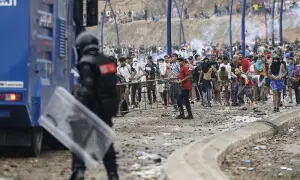
BANGLADESH is once again in the grip of a political crisis. Although an interim government under President Iajuddin Ahmed has assumed control in Dhaka, the atmosphere continues to be tense. Over the weekend, there were violent street clashes between the activists of the two major political parties that have run the country alternately since 1991. This week’s troubles have left 25 persons dead and hundreds injured. It is a pity that the country’s political volatility has prevented Bangladesh from evolving a stable, democratic system for which it had initially shown great potential. In 1989-90, the two political leaders, Khaleda Zia of the BNP and Hasina Wajid of the Awami League, had, by joining hands, dislodged the military dictatorship of Lt General Mohammad Ershad.
In 1991, when an elected government was ushered in under the stewardship of Begum Ziaur Rahman, it was widely believed that the country was firmly set on the road to democracy. These hopes were belied as the two leaders, who inherited their husband’s and father’s mantle respectively, have failed to show the political maturity and statesmanship needed to run a democratic system. The decade and a half of democracy in Bangladesh has been marked by violence and turmoil, boycott of parliament’s proceedings for months at a stretch by the opposition party and not much of constructive work in the country. If Bangladesh has managed to survive economically, the credit goes to the dynamism of some of the NGOs which have been working there. In 1996, when the 13th amendment was introduced in the constitution providing for an interim government to hold fair and impartial elections, there were hopes that the two parties would find a way out of the lingering political impasse.
That did not happen as the events of the last few days have shown. The retired chief justice, K.M. Hasan, who was appointed chief adviser (as the caretaker prime minister is called), was regarded to be pro-BNP in his leanings and therefore unacceptable to the Awami League. Anticipating troubles ahead, he declined the offer. President Iajuddin, who stepped in to fill the vacuum, has now been asked to prove his credentials as an impartial head of government as well. With so little faith in each other, the two main political parties can hardly be expected to run a political system which basically calls for a lot of teamwork and trust. In the absence of political confidence, confrontation becomes inevitable.
In this troubled scenario, the beneficiary of the tenuousness of the political process has been the religious parties, especially the Jamaat-i-Islami. With neither the BNP nor the AL winning a clear majority in the legislature, they have had to turn to the Islamists who are extending their influence. In 2001, the JI won 18 seats and became a coalition partner of the BNP. The Islamists displayed their clout last year when explosions of nearly 500 bombs took place throughout the country. A few months later came the first suicide bombing, killing several lawyers and judges. Although an extremist militant group claimed responsibility, its links with the Jamaat-i-Islami were fairly well established. In the vacuum, created by the on-going conflicts between the two key parties, the Islamists have managed to step in and make their presence felt by the considerable work they have done at the grassroots level, hoping one day to win power on their own.
Hope for Siachen?
LET us hope that Mr Khurshid Kasuri is not being over-optimistic when he says that Pakistan and India are “very close” to a deal on Siachen. In an interview with the Press Trust of India, the foreign minister hoped that the focus of the meetings between the two foreign secretaries on Nov 14-15 and of the two foreign ministers subsequently would be to achieve “a breakthrough” on the controversial glacier that has turned into the world’s highest battleground. Such a breakthrough, he said, would help Indian Prime Minister Manmohan Singh’s proposed visit to Pakistan to be “substantive”. During his visit to Pakistan in July 1989, Mr Rajiv Gandhi seemed determined to solve the Siachen issue politically, but after his assassination, a degree of confrontation between the two sides has continued.
Ironic as it may sound, Siachen means “the land of roses”, even though not a blade of grass grows on that icy wasteland, with temperatures as low as -40 degrees C. Over the decades, the two sides have acquired new gadgets to make their troops’ lives less hazardous, but the continued deployment of troops is a huge financial drain on both. On average, according to statistics, supplying their troops costs Pakistan Rs15 million and India Rs50 million a day. Common sense demands that this unnecessary loss of lives and money is avoided, though given their track record one should not be surprised if the two sides fail to achieve what Mr Kasuri calls “a breakthrough”. Mr Pranab Mukherjee is now India’s foreign minister and has a reputation for being hawkish. Mr Kasuri should have kept his optimism to himself before meeting Mr Mukherjee. There is hope, though, because of the many confidence-building measures which are in place. An agreement on Siachen will indeed be a landmark achievement that will go to the credit of the present leaderships in Islamabad and New Delhi. More important, a Siachen settlement could have a positive impact on the on-going peace and normalisation process between the two countries.
Another gang rape
IT IS simply appalling. The reported gang rape of a 20-year-old woman in Multan by her former, cleric fiancé and three of his accomplices on Sunday is the latest act of violence against women in the long list of such crimes that have gone unpunished in recent months. Details speak of the accused, one Hafiz Mohammed Idrees, having tried to kill his fiancée back in August after she refused to marry him. She had to jump down from the second floor to save her life; the fall left her with broken bones. The police had arrested the cleric then, only to release him on bail the next day. Thus emboldened, the accused allegedly threatened the victim’s family of avenging the insult of rejection. Sunday’s brutal assault came when the victim was alone at home and unable to protect herself because of her immobility. She was later taken to hospital by her mother, who, on returning home, found her daughter in a semi-conscious condition. However, citing ‘inconsistency’ in the accounts of the assault given by the mother and daughter, the police have refused to arrest the cleric and his accomplices — a common practice in cases involving violence against women.
It should come as an affront to civil society and to those at the helm, that the government has been tarrying with a bill aimed at curbing violence against women by amending the Hudood laws and those pertaining to admissibility of evidence of women in a court of law. As a consequence, the latest rape victim has been added to the long list of women like Mukhtaran Mai, Shazia Khalid and Sonia Naz, who in recent times have suffered equally in pursuit of justice because of state apathy. There are hundreds more whom justice has eluded, reinforcing the country’s bad image at home and abroad.
Islam-Christianity relationship
JOSEPH RATZINGER became Pope Benedict XVI and we have come to know of a man very different from his much loved predecessor Pope John Paul II, a man of God.
Giving a lecture at a German university, he quoted a 14th century Byzantine emperor who declared that the Prophet of Islam commanded “to spread by the sword the faith he preached.” The Pope relied on the accuracy of this statement and exhorted that Christianity appeals, instead, to reason and logic.
Since the statement attributed to Islam’s Prophet is clearly contrary to the Quranic text the Pope cited the Quranic verse, “there is no compulsion in religion” (2:256) but then attempted to water down its import by stating that, “according to experts, this is one of the suras of the early period, when Mohammed was still powerless and under threat”. Thus implying that this “early period” sura was replaced by subsequent Revelations recommending the use of the sword or else the Prophet stopped following the Quranic prescription? Neither of these propositions was supported by any reference to the Quran or Hadith literature.
Let us examine the Quran and whether the necks of infidels may be severed. “Never should a believer kill a believer” (4:92). “If a man kills a believer intentionally, his recompense is Hell, to abide therein and the wrath and curse of Allah are upon him, and a dreadful chastisement is prepared for him” (4:93). The sacredness of the best of God’s creation, is such that: “Whosoever slew a person unless it be for murder or for spreading corruption in the land, it would be as if he slew all humanity” (5:35).
Suicide bombers also have no place in Islam and there are no exceptions. “O you who believe ... do not kill yourselves” (4:29). The sanctity of life is supreme. “Take not life, which Allah hath made sacred” (6:151). “Nor take life, which Allah has made sacred” (17:33). Just as destroying life is forbidden, the act of saving life is commendable. “And if any one saved a life, it would be as if he saved the life of the whole people” (5:35).
The Quran may not prescribe death, but can conversion be induced by intimidation, by destroying churches and synagogues? Muslims are enjoined to safeguard all places of worship in which “the name of Allah is commemorated in abundant measure”, and in this regard, the Quran makes specific mention of “monasteries, churches, synagogues and mosques” (22:40).
The Quran extols Muslims to protect the defenceless in their time of persecution, for “persecution is worse than death” (2:191). How about inquisitorial proselytising? The Quran even specifies the manner in which Islam is to be spread. It should be “with wisdom and beautiful preaching; and persuade them in ways that are the best and most gracious” (16:125). Not by the sword or by rattling sabers.
What about Muslims getting a psychological advantage by negating other faiths and by reviling their prophets? “Those who deny Allah and His Messengers and wish to separate between Allah and His Messengers saying: ‘we believe in some but reject others and wish to take a course midway’ they are in truth unbelievers and We have prepared for unbelievers a humiliating punishment” (4:150, 151). And, “to those who believe in Allah and His Messengers and make no distinction between any of the Messengers We shall soon give their rewards” (4:152). “Those who believe. Those who follow the Jewish and the Sabians and the Christians, any who believe in Allah and the Last Day, and work righteousness, on them shall be no fear, nor shall they grieve” (5:69).
Do we then hear a papal murmur that “there is no profession of love and respect in Islam for Christians and other faiths”? Christians, in the words of the Quran, are “nearest in love to Islam” (5:82). References to Jesus Christ, the Gospel and Christians in the Holy Quran are many. “We sent Jesus the son of Mary, confirming the Torah that had come before him: We sent him the Gospel: therein was guidance and light” (5:46). “We sent after them Jesus, the son of Mary, and bestowed on him the Gospel, and We ordained in the hearts of those who followed him compassion and mercy” (57:27).
“Behold! The angels said, ‘O Mary! Allah giveth thee glad tidings of a word from Him: his name will be Christ Jesus, the son of Mary, held in honour in this world and the hereafter and of those nearest to Allah” (3:45). “And we made the son of Mary and his mother as a sign” (23:50).
Islam accords an exalted status to Jesus Christ, who spoke in his cradle: “I am the slave of Allah. He hath given me scripture and hath appointed me a Prophet. And hath made me blessed wheresoever I may be, and hath enjoined upon me prayer and almsgiving so long as I remain alive; And (hath made me) dutiful toward her who bore me, and hath not made me arrogant, unblest. Peace be on me the day I was born, and the day I die, and the day I shall be arised alive” (19:30-33). We are told of the touching reaction of the Christians who upon hearing the Quran had “eyes overflow with tears because of the recognition of the Truth” (5:83).
The coming of the Prophet of Islam had been foretold by Jesus. “Jesus, the son of Mary, said ‘O children of Israel! I am the Messenger of Allah to you, confirming the Taurat before me, and giving glad tidings of a messenger to come after me, whose name shall be Ahmad” (61:6). A very special relationship exists between Christianity and Islam.
So the Christians’ special status saved them, but what about the adherents of other faiths? Couldn’t they be browbeaten to submit to Islam? “Every nation has its messenger” (10:47). “To every one of you [Messengers] we have appointed a right way and revealed law” (5:48). Revelation is recognised as a universal phenomenon and all believers are brought together and protected under the umbrella of Islam.
Does the Holy Quran prevent rebuking or reviling other faiths and peoples? “Revile not those unto whom they pray beside Allah lest they wrongfully revile Allah through ignorance” (6:108).
There is a widespread perception that under the sword people were persuaded to turn to Islam. Actually the word ‘sword’ (saif) does not find mention even once in the entire Holy Quran. So, where does this sword myth come from? With respect to the Pope, it is in Bible. “And ye shall chase your enemies and they shall fall before you by the sword” (Leviticus XXVI, 7). “Let the praises of God be in their mouth, and a two-edged sword in their hands to be avenged of the heathen, and to rebuke the people” (Psalm CXLIX, 6-8)
The Papacy must also remember well its relations with the Eastern Orthodox Church. The “insane hatreds between the so-called Christians had placed all the cards in the hands of the Muslims” (‘The Last Centuries’ From the Muslim Empire to the Renaissance of Europe 1145-1452, by Sir John Glubb). In 1182 the Papal legate was beheaded by a sword and his head tied to the tail of a dog, which was chased through the streets of Constantinople. The Fourth Crusade brought the Latins (Roman Catholic Church) against the Byzantines (Eastern Orthodox Church). The crusaders launched an attack on Constantinople and it fell.
In the words of the contemporary Byzantine historian Nicetes, “To the sound of trumpets and waving their drawn swords the Latins began to plunder the houses and the churches. I do not know how to tell of the iniquities committed by these scoundrels... they smashed the altar of Santa Sophia and divided the fragments between them. They violated all the women...the whole city was nothing but despair, tears, crying and groans.”
Jalal al-Din Rumi addressed ignorance and folly among his co-religionists: “Not wanting people to mock them, these fools show themselves as all turbans and beards... In their fine exterior you see ascetics, but inwardly — God does not inhabit the house” An attempt can be made to enlighten the ignorant but some just adamantly revel in their ignorance. But the treatment that should be meted out to such ignoramuses is one of utmost gentleness. “And the servants of the Most Gracious (Allah) are those who walk on the earth in humility, and when the ignorant address them, they say, ‘Peace!’” (25:63).
Globalisation & schools
BACK IN 1979, the average worker with a college degree earned 75 per cent more than the average high school graduate in the US. Because of technology and globalisation, the gap has leapt to 130 per cent.
This rising “college premium” does much to explain the growth of inequality over the past generation, so any serious response to inequality must make access to college broader and fairer. It should be broader because a higher rate of college attendance would share the fruits of globalisation more widely.
It should be fairer because, if the prizes for attending college are growing, it’s essential that everyone begin life with a decent shot at winning them.
Because education boosts economic growth, and because it threatens no powerful lobby, virtually everyone claims to support it.
The question is how it should be improved. Some commentators, pointing to the fact that schools in low-income districts already spend more per pupil than schools in affluent ones do, argue that failures at poor schools reflect complacent management rather than a lack of resources.
Signalling at least partial acceptance of that theory, the Bush administration has tried to improve schools by holding them accountable and subjecting them to competition.
— The Washington Post