Iran-bashing & fate of IPI
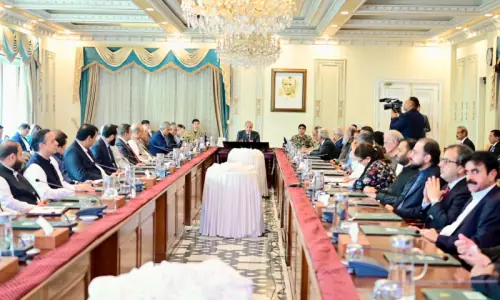
SO provoked is the American government by Iran’s nuclear policy that it is gunning for that country. On Monday, President Bush signed an executive order to extend US economic sanctions against Iran in effect since 1995. On Wednesday, the International Relations Committee of the House of Representatives voted to tighten these sanctions. This legislation provides for an end to American economic aid to any country that helps Iran by investing in its energy sector. True, the president has objected to the committee’s move on the ground that it would limit the administration’s ability to build and maintain an international consensus to confront Iran collectively. But after whipping up sentiments against Tehran on the nuclear issue and effectively sabotaging the Iran-EU3 dialogue, what else can Mr Bush hope for? He now laments the loss of control over policymaking. If this bill were to be adopted, it would “create tensions with countries whose help America needs in dealing with Iran,” to quote the State Department’s letter to Congress.
It is not just at home that Mr Bush is muddling up US policy. In the UN Security Council too he is facing some resistance to his effort to get a resolution asking Iran to cease all uranium enrichment-related activities and requiring the IAEA chief to submit a report within a fortnight on the state of Iran’s compliance. China and Russia have reached a stage where they are balking at the idea of going all out to punish Iran for refusing to submit to America’s unilateralism. The IAEA has so far not established Iran’s guilt and believes that its nuclear programme — including its uranium enrichment project — can be prevented from producing a nuclear weapon by the safeguards prescribed by the Additional Protocol. In fact, the general feeling is growing that Iran is being vilified without enough justification.
Washington’s anti-Iran thrust has deep implications for South Asia. India and Pakistan are in the process of negotiating a gas pipeline project with Iran. The Bush administration has been blowing hot and cold on the issue but it is plain that Washington would not want the Iran-Pakistan-India gas pipeline project to be undertaken. But it needs to be pointed out that Pakistan and India should not allow themselves to be browbeaten out of the project. If the two South Asian states present a unified front against US pressure, it would not be easy for Washington to have its way on the issue. If they join hands with other like-minded governments on the issue — Russia and China do not share America’s views — they could successfully resist US pressure. This is possible only if the countries, which are more directly affected by the happenings in this region, develop a common approach on geo-strategic issues, energy matters and economic cooperation. A positive development is that steps have been taken to facilitate the participation of India in TAP (Turkmenistan-Afghanistan-Pakistan gas pipeline project). India, Pakistan and Iran already enjoy observer status in the Shanghai Cooperation Organisation which groups China, Russia and four Central Asian republics together under one banner. India has also requested that it be made a partner in the Qatar-Pakistan pipeline project and its participation is a possibility. By creating this energy network in the region, India and Pakistan would not only benefit themselves, they would also create a countervailing force against America’s unilateralism.
NAB’s utility
AN MMA leader’s demand that the National Accountability Bureau be abolished does not seem wide off the mark against the background of NAB’s record. Reacting to the bureau’s decision to stop the inquiry into the sugar crisis, Sahibzada Abul Khair Mohammad Zubair, MNA, said in a statement in Hyderabad on Wednesday that NAB had become “irrelevant” and a burden on the exchequer. NAB’s “only function,” he said, was to harass the opposition. The decision to stop the inquiry into the sugar scam under pressure was indeed astonishing. A look at NAB’s performance since October 1999 shows a record characterized by some bold decisions as well as politically expedient ones. It has indeed netted some big fish — retired Admiral Mansrul Haq’s case comes readily to mind — besides the trial and conviction of many politicians and bureaucrats guilty of corruption. But then there is the other side of the story, too: we know, for instance, how accountability was used as a whip to make some newly-elected MNAs fall in line, how the PPP Patriots came into being and how NAB found it convenient to ignore the wrong-doings of such men as Mr Faisal Saleh Hayat and Mr Aftab Sherpao. Not that this government alone is guilty of using accountability as an instrument of persecution and blackmail. Gen Ziaul Haq was the first to use this unabashedly for persecuting political opponents — his main target was the PPP. Later, Mr Nawaz Sharif, too, used this instrument to persecute his main rival, Ms Benazir Bhutto, and her husband. Most — if not all — cases Ms Bhutto and Mr Asif Ali Zardari are facing today were registered during the Sharif government.
The basic philosophy behind this kind of accountability is skewed. Accountability must be an impartial and ongoing process, built into the system, and not one reluctantly used by successive governments. Both the Zia government and those following it enacted a number of special laws for accountability, even though they were not needed, because the laws already on the statute book were enough for proceeding against the corrupt. Ultimately, only an uninterrupted democratic process can ensure transparent governance. Besides, one wonders why generals must always head NAB. This is a job that is best left to a high court or supreme court judge.
Safe working conditions
WHILE general awareness of the social ills afflicting Pakistani society is growing by the day, there seems to be little debate on some very basic but persisting issues like unsafe working environments. It is an area where little research has been done. While national labour surveys indicate that there are approximately three cases per 100 of injury and disease among workers in the country, considering that few work-related deaths and accidents are reported to the labour department, the actual figures could be much higher. Unfortunately, most people have accepted the reality of hazardous working conditions, and are resigned to a fate that could see them sustain serious injuries at work, as in the case of six labourers who fell from a height of 50 feet at a cement factory in Iskandarabad recently. There are not many labour unions that are genuinely moved by the issues confronting the members, and few act to bring improvement in working conditions. The result is that it is quite common to hear of linemen being electrocuted or miners — most of whom are not even provided basic equipment like face masks — sustaining life-threatening injuries.
Most legislation on occupational safety is outdated and has not kept pace with growing industrialization and changing technologies that require more comprehensive protection laws at workplaces. Without appropriate legislation, even the carefully drafted Labour Protection Policy of 2005 holds little promise. While the government mulls over enacting new legislation aimed at improving working conditions, it would do well to enforce regular visits by labour department officials to docks, factories, mines, etc, to check and report on safety mechanisms in place at workplaces. This alone may not raise the level of workplace safety to international standards but should prove a good starting point for further improvement.
Core issues in Asian cities
ONE of the key subjects of discussion at the World Social Forum, to be held later in the month in Karachi, will be the contemporary situation of world cities that, owing to several factors, are undergoing tremendous changes at the turn of the millennium. The 20th century model of the welfare state, derived from western social democratic traditions, has been overtaken by market economy doctrines.
The allocation of land, the apportionment of development resources, citizens’ rights, the creation and operation of enterprises, industrial relations, the provision of social amenities and even the dispensation of justice are being adjusted according to the new approaches of state organization. Urban areas located in the developing countries have been more drastically affected by the change.
A comprehensive study on the status of Asian cities was conducted in 2005 by the Asian Coalition of Housing Rights under the supervision of the Karachi-based architect/planner Arif Hasan. The study outlines several core issues common to most urban centres.
Globalization has led to direct foreign investment in Asian cities along with the development of an aggressive business sector at the national level. This has resulted in the establishment of corporate sector industries, increased tourism and a rapid expansion of the middle classes. Consequently, there is a demand for strategically located land for industrial, commercial and residential purposes. As a result, poor communities are being evicted from the land they have occupied in or near the city centres.
They are being relocated to the city fringes, far away from their workplace, schools, recreational outlets and from proper health facilities. This process has also meant an increase in land prices.
Owing to their relocation, transport costs and travel time to and from work have also increased considerably, creating economic stress and social disintegration as earning members have less time to interact with the family.
An increase in the number of vehicles in cities across Asia has created severe traffic problems and this in turn has led to greater travelling time, stress and environment-related diseases.
New transport systems (such as the light rail) have not served the vast majority of the commuting public and in most cases have proved far too expensive for the poor.
There have been proposals for the privatisation of public sector utilities and land assets. In some cities the process of implementing this has already taken place. But there are indications that this process is detrimental to the interests of the poor and disadvantaged groups.
An important issue that has surfaced is the question of how the interests of the poor can be safeguarded in the privatisation process.
The culture of globalisation and structural adjustment has also meant the removal or curtailing of government subsides for the social sector, directly impacting on poor communities who have to pay more for education and health. In addition, private sector involvement in education, both at the school and university levels, has expanded, creating two systems of education: one for the rich, the other for the poor.
This is a major change from the pre-1990s era and can have serious political and social repercussions, especially since the largest section of the population of Asian cities is young, increasingly better-educated and with aspirations that cannot be fulfilled by unjust political and social systems.
As a result of these changes, there has been an enormous increase in real estate development. This has led to the strengthening of the nexus between politicians, bureaucrats, and developers, due to which building bye laws and zoning regulations have become easier to violate, and the natural and cultural assets of Asian cities are in danger of being wiped out.
There are multiple agencies that are involved in the development, management and maintenance of Asian cities. In most cases, these agencies do not coordinate among themselves. In addition, in most cities there are central government interests that often override local considerations. Examples from Pakistan show that most of the major urban development projects are federally funded and controlled.
As obvious, there have been responses from society to tackle these issues in cities across the developing world. Some of these responses are observed in the form of common currents. The organization of the urban poor communities, joint actions and collaborative attempts of civil society organizations, the creation and performance of government, NGO projects and decentralization of the formal institutional structure are some of the visible aspects of this ongoing process of adjustment.
The role of NGOs in preventing the evictions of slum and pavement dwellers in major Indian cities is an example.
At the World Social Forum, several issues related to cities in the developing world will be debated for developing a consensus and giving recommendations for a possible solution. The session on governance and municipal finance will address the emerging issues pertinent to the management of urban areas, new formats of governance, ties among different interest groups, the patterns of revenue generation, fund management, priorities in spending and other things.
Formerly, planning was a social enterprise where goals and objectives were set through an institutional process. This stage was followed by the allocation of resources through a politically validated approach. The implementation of this was handled by planning organizations and urban bureaucracies. All this has changed.
Developments in urban areas have been undertaken through projects and programmes formulated by a multitude of stakeholders. The criteria of choice and prioritization of projects are largely determined more by financial benefits than by social advantages.
The UN Conference on Human Settlements in 1996 in Istanbul resolved to facilitate access to housing for all on a universal basis.
The reality is otherwise. Marginalized urban communities are finding cities very difficult to survive in. Space for even the most basic residential needs has become inaccessible for the urban poor because of financial, administrative and social barriers. Being the most vulnerable and politically disenfranchised group, they are being evicted from their homes on a continuous basis. Development projects, commercial enterprises, governmental schemes and communal disharmony are some of the prevailing reasons for evictions.
The status and perception of land have drastically changed. In the past, land was considered as a collective asset which was carefully safeguarded for utilization by posterity. Its distribution was also based on social needs. However, with the intensification of market dictates, land is traded as a commodity. Its distribution and acquisition is based on internally adjusted valuation criteria. The state apparatus no longer affects the distribution of land, through the state remains one of the beneficiaries of land-related enterprises.
Thus, access to land is now determined by the capacity to meet the attached financial conditions. A new set of planning and management tools is needed for equilibrium.
Modes of transportation now reflect the social divide in urban societies. Emphasis has been laid on the construction and expansion of roads, highways/ motorways and flyovers all of which facilitate private cars. Pedestrians, modes of traditional transport (such as animal carts and rickshaws), public transport and motorbikes receive less priority in terms of road space allocation and utilization.
The concentration of low income groups in the periphery of urban areas makes commuting difficult. Railways, both at the inter and intra-city level, are being neglected. These issues call for a serious debate on finding solutions to transportation difficulties.
With the rising population graph and changes in consumption patterns, the water supply service is under a great deal of stress around the world. Over utilization from sources, a rise in the number of consumers, aging systems of supply, municipal inability to support development schemes and unequal access to supply are some of the key issues where consultation is needed for workable options.
Over time, conventional approaches to the provision of shelter have not benefited the target population. The provision of built housing, social housing and plots through land sales have all been tried with little impact on the scale of problem. Some innovative shelter strategies such as incremental housing development have to be developed. Several pilot projects have been successfully undertaken to support this approach. The approach has all the potential to be upscaled for the benefit of the lower income group.
In the wake of the 2004 tsunami and the Oct 8 earthquake in Pakistan last year, consultation is also needed on preparing a disaster management strategy as natural calamities appear to be on the rise and are capable of destroying habitat and leaving hundreds of thousands of people dead or displaced.