A touch of anarchy
A WEEK ago, I expressed in this space the apprehension that injection of violence in the protests against the blasphemous cartoons that raised their ugly head in Denmark and spread rapidly like a contagion to several other European countries would play into the hands of those who wanted a perpetual civilizational clash with Islam. There was an urgent need to discipline the Muslim rage and translate it into constructive initiatives at the state and non-state level for a better understanding with those elements of western society which would help us in defeating the project for a perpetual war of religions.
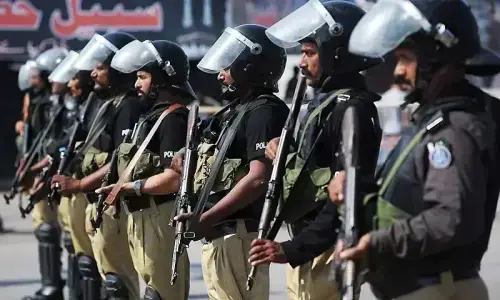
Demonstrations in Lahore, Peshawar and elsewhere in Pakistan have, however, turned the spotlight onto another dimension of street protests against the outrageous cartoons. There was a visible intrusion into them of forces that had nothing to do with the mainstream religious parties or even with the legions that western media people expected to pour out of religious seminaries. They brought a different kind of anger to what were meant to be peaceful marches and chose targets that demanded an altogether different perspective for analysis. Their blind fury was focused particularly on banks, glitzy shops, fast-food jaunts, mobile phone outfits, and billboards symbolizing a culture of conspicuous consumption in a society with a frightening percentage of people below the absolute poverty line.
The fleeting images on real time television carried intimations of anarchy. It was less of a religious protest and more of a revolt of the underclass, of the lumpen proletariat trying to put its signature on the troubled history of Pakistan. They were mounting a challenge to a society — indeed, to a government — which in their visceral understanding of social reality seeks to create an illusion of a shining Pakistan by a policy of persistent denial of their existence. They certainly succeeded in making their presence felt as flames roared through establishments showcasing the new prosperity.
There has been some comment in Pakistan and abroad that Islamic parties have seized the opportunity presented by the wave of indignation unleashed by an act of blasphemy to promote their own radical agenda. There is no hard evidence that these parties have lost all faith in the electoral process and are now propagating a revolutionary creed. Proponents of radical Islamic politics certainly tap into the anger directed against the impurity and injustice of elected and non-elected regimes created by the Pakistani elite. But by and large it is still a mobilization for electoral gains. Even if some Islamists had initially hoped for a revolutionary critical mass being generated by the anti-blasphemy movement, the outbreak of arson and loot now portends anarchy, not revolution.
In a comparative contemplation of American and French revolutions, Hannah Arendt had argued that France lapsed into a reign of terror because the revolution opened itself to the sans coullottes,, the naked and the hungry. What was to be a republic of virtue degenerated into a republic of terror. Pakistan’s body politic is generally inflamed at present and revolutionary politics will run a serious risk of dissolving into anarchy that in all likelihood would feed on passions whipped up by sub-national movements and sectarian tensions. The Islamic parties are aware of these dangers and are, therefore, anxious to distance themselves from the nihilism witnessed on the Pakistani street during the last few days.
It is also highly unlikely that the present ferment can be harnessed to launch the kind of mass movements that brought about major changes in Pakistan’s power configuration in the past.. The changes wrought by them were rearrangements within the ruling elite and made little impact on the fundamental structures. In fact, more often than not, they pre-empted or diffused revolutionary potential and consolidated Pakistan’s famous establishment. Even Bhutto’s historic role, in substance, was to overcome what for weeks following the massive defeat in Bangladesh looked like a yearning for a revolutionary change.
In broader political terms, Pakistan’s army and the fear of external intervention in a radical but inherently uncertain situation have acted as major deterrents against religious or secular revolutions. The people of Pakistan know that they cannot afford the luxury of a revolution; they have also discovered that mass upsurge often brings greater tyranny than before. This realization of the near impossibility of a radical transformation has helped the present government to depoliticize Pakistan more successfully than earlier military governments. One negative consequence of it, however, is the emergence of the alternative politics of terror and nihilism.
Strategies adopted to pull Pakistan out of the stagnant economy of pre-1999 period — macroeconomic stabilization and growth — have led, at least in the short term, to the exacerbation of social cleavages. It is debatable if the country has time to wait for the trickle down effect to transform the fortunes of the highly disadvantaged masses. The poverty amelioration project looks better on paper than on the ground. The percentage of people sliding below the absolute poverty line increases even as the GDP retains a healthy trend. In absolute terms, the number of people that are vulnerable to anti-social trends, lure of crime, sectarian strife and, at a higher plane of consciousness, to centrifugal forces in the body politic multiplies. The state is increasingly challenged even in the performance of its basic function of maintaining law and order.
Gathering storms in many areas of the country put a question mark before the success of otherwise well-thought out development plans. The state is unable to carry conviction even with the potential beneficiaries of these plans as we have seen in the management and development of water resources and a radical restructuring of the economy of Balochistan, without which Pakistan has no future.
It is now universally recognized that democracy helps by stretching the time required for negotiating the rough passages in the development process, and, more significantly, by accelerating economic growth. Democratic freedoms engage the deepest recesses of human soul. Creativity and innovation come more naturally to democratic societies. Democracy is also crucial to the daunting task of mediating competition for resources, power and influence in a federation like ours marked by ethnic diversity and economic disparity. It is, in any case, an inalienable right of every citizen to participate, however indirectly, in the decision-making process; democracy is, therefore, intrinsically, good. It fosters civil society which in turn imparts much strength to the state.
Democracy has had a chequered history in Pakistan. There have been long periods of direct military rule or experimentation with alternatives to parliamentary democracy, periods when the air was thick with ideas of governance based on technocrat-backed presidentism. Even when the country returned to parliamentary democracy from time to time, the political parties exhibited great fear of the people and tried to create what some political scientists call a “clientelistic machine” designed to appropriate the spoils of the state by a narrow band of supporters to the detriment of the society at large.
Instead of fortifying the building blocs of civil society, such as organizations of lawyers, human rights activists, writers, artists, teachers, scientists, intellectuals and independent journalists, the political parties relied on bureaucrats, law-enforcement agencies, intelligence services, and military officers to gain advantage against one another. For the masses, it meant greater hardship, social neglect, cultural degradation and a growing sense of alienation.
The Constitution of 1973 which represented a grand compromise made in the traumatic dismemberment of a united Pakistan is in disarray. The present degree of provincial assertion may or may not find an acceptable balance within its parameters. There is no social contract that seems to bind the state and the people. Respect for the fundamental principles of a law-based society gets eroded by the day. Education expands quantitatively but has no shared conceptual framework. In fact, student groups exhibit particularly polarized and intolerant attitudes. There is a serious disconnect between the foreign policy preferences of the ruling elite and the people. The cumulative effect is a tendency to take recourse to violence. There is wilful damage to property and infrastructure and an ever diminishing premium on the sanctity of life.
The prevalence of violence in our midst also leads to a high threshold of its tolerance. Violence is seen as banal, commonplace and ubiquitous. Individuals and groups erect their own fences against it and tend to lose sight of the damage to the collective good of the nation. More dangerously, we fail to remember the factor of time. What can be done today may not be possible tomorrow. This is particularly true of problems of federal balance. We have tried dismissing, with disastrous results in the past, sub-national movements as the handiwork of a few miscreants. When the floodgates burst open, we retreat into determinism. One common trait of the officers who surrendered to India in Dhaka was to claim historical inevitability of the break up.
Time is also of the essence in balancing economic growth with social justice. The arsonists of Lahore have shown up the symptoms of the underlying malaise. Disfranchisement, deprivation and dispossession have always sought the outlet of an orgy of violence. The day of the anarchist should open our eyes. Law enforcement has its limits and is never a substitute for corrective social action. One knows how the proud army of Raza Shah Pahlavi, equipped by the West with state-of-the art weaponry, disintegrated under the pressure of the people. But that demolition was carried out by a disciplined revolutionary movement and not by a mob which has no sense of an alternative structure.
State and society in Pakistan face the threat of disruption and paralysis. It is time for an open dialogue amongst all the stakeholders, including the opposition parties that the dispensation of October 12, 1999, sought to exile permanently from the political scene. It should not be difficult to rise to magnanimity, statesmanship and, above all, shared patriotism to reverse the drift into chaos. It is also necessary to exercise these virtues while there is still time.
The writer is a former foreign secretary. Email: tanvir.a.khan@gmail.com
Reinforcing ties with China
PRESIDENT General Pervez Musharraf’s current state visit to China at the invitation of the President Hu Jinato, will herald the events organized in connection with the 55th anniversary of the establishment of diplomatic relations between Pakistan and China.
Frequent bilateral interaction and exchanges at the highest level have been the hallmark of Pakistan-China relations. President Musharraf’s present visit to China is in consonance with this policy.
President Musharraf’s visit has, however, assumed greater importance as it is taking place at a time when important and exciting developments are taking place in the region and around it. It is hoped that apart from imparting greater content and substance to bilateral relations and holding indepth discussions on important regional and global issues of mutual interest, the US-India agreement establishing a global partnership between these two countries would also figure prominently in the talks between President Musharraf and his Chinese counterpart.
It is generally believed that the global partnership agreement between the United States and India, ostensibly aimed at boosting bilateral cooperation between the two countries in diverse fields, is predicated on their common desire of containing China’s growing military and economic power which is perceived by them as a major threat to their geopolitical interests in South Asia and beyond. However, there are no plausible reasons to justify this apprehension.
The US-India strategic partnership is likely to portend serious problems for all the countries in the region, including China, and therefore policymakers in Pakistan and China need to take a coherent and credible policy decision to safeguard their geopolitical interests that might be threatened in the wake of the US-India relations which are likely to be further enhanced by President Bush’s impending visit to India in March this year. In view of the strategic environment that is undergoing rapid political and military changes in the region, it is absolutely necessary to further consolidate the strategic relationship that traditionally exists between Pakistan and China.
It was generally believed that the end of the Cold War would free the United States from its overriding security concerns and it would be able to address some of the fundamental and more pressing issues it could not do earlier. However, its obsession with China’s growing importance in the emerging world order indicates that after the disintegration of the Soviet Union, Washington has merely replaced its Cold War rival with China. American policymakers, however, need to know that China has always adhered to principled policies and remained committed to a just political and economic order. It has never attempted to plant and foster communist regimes in other countries. Its only concern has been peace and stability in the world.
China’s rise to eminence has opened a new chapter in Asia’s history and it is now destined to have a predominant say in regional and international affairs. It has a proven track record of peaceful coexistence which leads one to believe that it will continue to act in a responsible manner in the future as well. There is every reason to believe that its future will not be different from the past. Although a powerful China may be more assertive in future, it is not likely to use its great military and economic power for offensive purposes or cause alarm among its neighbours. It is indeed a logical claimant to the leadership of Third World countries.
The end of the Cold War has altered Asia’s geopolitics and China’s foreign policy imperatives, once regional, have now become more global. Yet, China remains the most trusted and dependable friend of Pakistan. Over a period of time, Pakistan-China relations have acquired a unique character, and are often termed by the Chinese leaders as comprehensive, stable, time-tested and worthy of being a model for other countries.
The future prospects of Pakistan-China relations also seem bright. However, it must be realized that no relationship, however strong and vibrant can be sustained unless it keeps pace with events. Mere rhetoric was not sufficient to sustain it, at a desired level, unless, of course, more substance is instilled into it, from time to time, to save it from stagnation.
Pakistan’s search for security continues to be one of the reasons for structuring its policy around steady ties with China. For its part, China has also been consistent in its policy of maintaining good and constructive relationship with Pakistan.
However, it seems that vested interests, out of ulterior motives, are at work to dent this relationship. Three Chinese engineers, who were working at the Gawadar Port, were killed is a bomb blast in 2004 and recently, three more Chinese engineers, working for a cement plant at Hub (Balochistan), were gunned down.
It is possible that the recent killings of the Chinese engineers, on the eve of President Musharraf’s visit to China, may have been planned to cause him embarrassment. In any case, the government of Pakistan must make every possible effort to ensure that these unfortunate incidents, which are extremely painful, do not affect China’s traditional friendship with Pakistan. It would be detrimental to Pakistan’s long-term strategic interests if Chinese support waned because of these mishaps. An all-out effort, therefore, needs to be made by the government to apprehend the culprits and award them exemplary punishment for their heinous crime.
The writer is a former ambassador.
Islam from German perspective
SOMETIMES one feels a little sorry for those European diplomats serving in Islamic countries when they suddenly discover that their country has been placed on the black list of Muslim countries because some sensation-seeking newspaper back home had reproduced those disgraceful and blasphemous caricatures that have deeply offended the sensibilities of Muslims all over the world.
One of these emissaries, who agreed to run the political gauntlet and to dilate on this contentious issue after the publication of the cartoons, was Dr Gunter Mulack, ambassador of the Federal Republic of Germany in Islamabad. The choice was a sensible one, not only because he is a scholar of Islam and has a deep understanding of the Muslim religion, but also because the Germans have always been regarded as broadminded and friendly. Dr Mulack was invited to speak at a couple of functions in Karachi last week, the first of which was jointly hosted by the Karachi Council on Foreign Relations and the International Relations department of the University of Karachi.
This function got off to a bad start. In typical Pakistani fashion, it began 90 minutes after the scheduled time of 12:30, which was a little surprising as neither the governor nor the chief minister had been invited. PIA naturally got the blame as it usually does. But it wasn’t at all clear how the ambassador was expected to arrive at the function by 12:30 when his aircraft was due to land at Karachi airport 30 minutes earlier — unless, of course, he was being met on the tarmac by Schumacher in a Ferrari.
After much rumbling of voice and wafting of gesture Dr Mulack delivered his keynote address. But when he finished one got the impression that the ambassador hadn’t quite pulled it off. There were too many loose ends, too many imponderables, too much sermonizing. This is understandable, for in a sense, he was representing the collective views of a number of European powers. He had to be jolly careful in his choice of words and what he believed were the perceived policies of other countries.
Though he deplored and condemned the highly irresponsible act of the Danish newspaper, his talk was regrettably laced by the usual platitudes. There should be a limit to the amount of press freedom one enjoys in a democracy; rioting and violence and the burning of embassies are harming the image that the ulema is projecting of Islam as a religion of peace and tolerance; there is a desperate need for a vigorous dialogue between the Muslims and the West; and Muslims elsewhere should behave like their brethren in France and use the law courts to settle their grievances. The sort of things one hears on television and reads in the newspapers. The French experience is particularly unfortunate, for the newspaper editor who reproduced the caricatures in his paper is Jewish and one wonders if he has forgotten how the Nazis and the Soviets treated minorities in the 1930s.
If the audience felt a little cheated on the conclusion of the talk it was because there were no insights into the possible motives behind the blasphemous acts. There was no reference to the clash of cultures, the resurgence of a different kind of anti-Semitism and the rise of rightist governments in Europe. Or why countries like Ireland, Sweden, Finland, Portugal, Poland, Serbia, Russia and the Baltic states decided to give the offensive cartoons a wide berth. However, the audience did get a glimpse, albeit a small one, of the mischief right wing governments can play. As the old bard so rightly put it, there’s something rotten in the state of Denmark. The glimpse came right at the end, in the summing up.
General Moinuddin Haider, a former interior minister, is not known for his perspicacity or his sayings. But he came up with some trenchant observations when he delivered his vote of thanks. He didn’t mince his words and his bluntness was, in fact, quite refreshing. “I had been in the ministry for quite a while,” he said by way of introduction. “But I only came to learn that there was an organization called Al Qaeda after 9/11.”
This was followed by “If one of the reasons for the huge success of the western democracies is that they spend three per cent of their budget on research and development, surely the Danes would have known that those sacrilegious cartoons would have evoked widespread protest and devastation.” What he probably wanted to say but was prevented from doing so by the solemnity of the occasion, was that rightist Denmark is a flunkey of the United States and sent troops to Iraq and Afghanistan.
The general’s last pronouncement, delivered in response to a reference the ambassador had made about America being one country while Europe is a collection of neighbours, was a little tongue-in-cheek. “Perhaps there are differences, but Tony Blair is much closer to America than he is to Europe.”
The seminar would have ended there had it not been for the fact that the moderator invited audience participation. Now every speaker knows that questions often have little or no relevance to the subject of the discourse and invariably relate to a pet grouse or an unfortunate experience. One such question did surface and made the organizers wish they had broken up for lunch the moment the general had finished with Tony Blair. Why does the German visa form, a questioner wanted to know, ask Pakistani applicants if they are terrorists and if anybody in their family is a member of a terrorist organization? And how would Germans seeking to visit Pakistan like it if they had to fill up a visa form which asked them if they were Nazis and if any member of their family for the last three generations was ever involved in the gassing of Jewish children? It was a rhetorical question but it evoked an immediate positive response from the German consul general.
German interest in the religions of the East goes back a long way. It blossomed in the 19th and 20th centuries, a period of great scholarship, when a string of profound thinkers which included Rudolf Otto, author of that classic The Idea of the Holy headed for India whose soil sprouted three oriental religions.
German interest in Islam and in the people who practise this faith also goes back a long way. In fact, the country’s literary history is studded with the names of great thinkers who at some time in their lives were touched by the appeal of this world religion. Some of the great Germans who were known for their positive attitude to Islam were the poet Johann Wolfgang Goethe, the scholar and first translator of the Holy Quran into German Friedrich Rueckert, the scholar on Sufism Annemarie Schimmel, and the dissident Catholic theologian at Tuebingen. Hans Kueng. In fact, Shaykh ‘Abdalqadir Al-Murabit, in a lengthy, deeply researched article authorized by the amir of the Muslim community in Weimar, Hajj Abu Bakr Rieger, on December 19, 1995, asked with all sincerity the question: was Goethe a Muslim?
For quite some time the Germans have expressed a major interest in the Muslim world. There are around 2.8 million Muslims in Germany accounting for 3.2 per cent of the population, and Muslims are now the third largest religious group in the country, after the Protestants and the Catholics. The overwhelming majority of Muslims are of Turkish origin. But there are also immigrants from Arab countries, the former Yugoslavia, Iran, Afghanistan and Pakistan.
The importance that the Germans in Pakistan attach to Islam can be gauged from the fact that for a number of years the Goethe Institut has been in the forefront of the attempt to understand and appreciate Islam. Currently, the German cultural centre under the dynamic leadership of its director, Dr Petra Raymond, remains the only foreign cultural mission that regularly organizes and hosts workshops and study groups devoted to this fascinating subject.
In 2005 the centre organized two major and highly successful seminars. ‘Common values between Islam and the West’ tried to explore similarities between cultures which are generally believed to be mutually hostile. And ‘Different facets of the Islamic Ummah in a globalized world’ probed many of the misconceptions that westerners have about the ability of Muslims to adapt to changing circumstances. The tragedy is that the misconceptions don’t show any signs of disappearing. But that doesn’t stop Dr Raymond from trying.
UK’s ban on smoking
PARLIAMENT, so often maligned and so often ignorantly, has done itself and the nation proud by banning smoking in England. This week’s Commons debate was informed and articulate. It was also, in the end, irresistible and emphatic.
It seemed — and this was surely the case — as though the removal of the whip allowed MPs’ true beliefs to flower and their arguments to flourish. Feelings were strong — they could not be otherwise on this most emotive of all health issues — but were rarely doctrinaire.
And as the former health minister Sir George Young pointed out, it was not just the debate that clinched the decision. The votes would not have been possible without some skilful and principled work by the health select committee under Kevin Barron, which insisted in December on a full ban not the partial measure to which Labour was initially committed.
Last night’s results capped the whole parliamentary campaign in the best possible way. Unwhipped, MPs from the health secretary Patricia Hewitt down were able to say what they really felt, not what the apparatchiks would allow. By 384 to 184 they decided that a full ban on smoking in public places was better than a limited ban that exempted private clubs. They were right.
Here’s why. Smoking is an addiction. People who suffer from it need not just encouragement to stop, but help. Two-thirds of smokers say they want to kick the habit. More than four-fifths wish they had never started. Patches and other treatments are a help, but the new ban is still more of one. By adding England to the network of bans already in place across the British Isles, MPs have taken a major step towards the end of the tobacco age. That is nothing to apologise for, and everything to celebrate.
It would be quite untrue to pretend that there was not an issue of freedom at stake in yesterday’s debate. There clearly was - and it is one that will pose even more difficult dilemmas now that smoking remains legal only in private - where 95% of all passive smoking cases occur. But yesterday’s debate was about public, not private, health policy.—Dawn/Guardian Service