‘Yes’ vote in Iraq
EVEN though the official results in Iraq’s referendum will take some time to come, all indications are that the constitution has been approved by the Iraqi people. A negative vote in even three of Iraq’s 18 provinces by a two-thirds majority would have meant a rejection of the draft constitution. The turn-out was, of course, heavy, because — like the vote for the transitional assembly in January — Shias and Kurds turned out in large numbers to vote. On Saturday, too, an estimated 60 per cent of the voters went to the booths to mark Yes or No on the ballot paper. The Sunnis managed to get a 90 per cent No vote in the vast Anbar province, but in Nineveh and Diyala, Shia and Kurdish voters joined to defeat a No vote.
The post-referendum scene is full of both possibilities and dangers. The Sunni leadership must now broadly grasp the truth of the situation. Senseless violence is not going to solve Iraq’s problems, promote the Sunni cause, whatever it is, nor help secure the withdrawal of foreign forces. The majority is now positively on the side of the democratic process. First, 60 per cent of the voters took part in January’s elections to create a transitional assembly to draft a constitution; on Saturday the people again voted to approve of the Basic Law. Now there is going be another vote on Dec 15 to create a parliament, and finally a government will be in place on Dec 31. To oppose this political process and resort to violence is to perpetuate anarchy with no conceivable positive end in sight.
There is no doubt that Iraq is living through a trauma. The ouster of the Baathist regime in April 2003 has not given the people of Iraq the peace and freedom they wanted. Those who attacked Iraq on these two promises have failed to deliver. The presence of the US-led foreign troops is an affront to Iraqi self-respect and sovereignty. They would like to see Iraq free of foreign forces and united and happy to play its due role in Arab affairs — a role which its geographical position, its vast oil wealth and its talented people entitle it to. However, foreign troops cannot be made to withdraw by resorting to suicide bombings that kill more Iraqis than foreign soldiers. This also strengthens America’s argument that a withdrawal will only add to violence, and the country could descend into chaos.
If the Sunni leadership rejects the outcome of the referendum on the constitution, a conflict on ethnic and sectarian lines could dismember Iraq. The Kurdish-majority north has always been keen to get as much autonomy as it can. If the post-referendum violence aggravates, the extremists in the Kurdish north may then be tempted to make a bid for the region’s independence and opt out of Iraq. This will have repercussions beyond Iraq’s border and involve Turkey and Iran, both of which have large Kurdish populations in neighbouring areas. The only option the Sunni leadership has is to join the democratic process. That democracy should come on the platter of a conquering army is a harsh reality — but this is something that even Japan and Germany accepted, both of which are now functioning democracies. Any other course will add to the agony of the Iraqi people and provide an excuse for foreign forces to stay on in their country, a possibility that must be avoided at all costs.
More tents are needed
AFTER the October 8 calamity that destroyed most of Azad Kashmir and parts of the NWFP, the government faces a daunting challenge in providing shelter to the estimated two million rendered homeless by the earthquake. With winter fast approaching — the first snowfall has already been reported — there is a risk of people dying from hypothermia if urgent attention is not given to providing the victims with emergency shelter. Aid workers are racing against time (and bad weather) to get relief supplies to the remote areas where relief goods have been slow to reach. According to various estimates, between 100,000 to 200,000 tents are needed but the numbers that have come in so far — from within and outside Pakistan — fall hugely short of the requirement. Unfortunately, the local supply of tents has been exhausted, but they are not suited for the freezing climate and need to be supplemented with heavy bedding. Regrettably, the tent vendors have raised their prices two to threefold: a Rs 2,000 tent is being sold for Rs 5,000 and there are reports that tents meant for relief have been stolen and are being sold by unscrupulous elements. Nevertheless, even in these desperate times, every conceivable alternative is being put to use. Some digital billboard printers are using their PVC-based material to make tents, as they are fire and water-proof and can at least provide some shelter to the homeless. Such ingenious methods are appreciated. NGOs who have experience in temporary housing should also come forward and help in protecting people from the blistering cold and rains.
The government has made urgent appeals for tents from the international community and one hopes that countries like Saudi Arabia, whose support has been commendable, will include tents in their dispatches as it has huge stocks of them for use during Umra and Haj. Although 70,000 more tents are expected in the coming days, much more are needed. There is a need for an equitable distribution of relief goods for which organizations should network with those NGOs already working in affected areas to ensure that goods reach those most in need.
Wetlands in dire straits
ONE hopes that the approval of a Rs 700 million project for conserving Pakistan’s wetlands will result in a new lease of life for the country’s water spots, many of which are drying up or are heavily polluted, thus impacting negatively on wildlife and the livelihood of the local people. Nineteen of Pakistan’s wetlands have been designated by the 1971 Ramsar Convention as sites of international importance, but the state of many on this list indicates that Pakistan is not meeting its international obligations to protect its wetlands. Haleji, a major nesting spot in Sindh for migratory birds during the winter months, is a case in point. Successive years have seen a sharp drop in the number of migratory water fowl at Haleji, owing to the overgrowth of vegetation on the lake surface, salinity and silting. Meanwhile, the contamination of another important water spot in Sindh, the Manchar Lake — once a major livelihood source for local fishermen — by industrial and other waste led to several deaths among the local population last year.
Recognizing that wetlands have an important role to play not only in sustaining many ecosystems, but also by serving as a means of livelihood for millions of people, the government needs to review its conservation strategy. One of the aims of the multi-million project is to raise awareness among local communities so that they refrain from reducing its value with activities like over-fishing. That is a positive step. But what about the authorities that approve of controversial development projects without paying heed to the negative impact of these on waterways? There is no doubt that development works are needed to strengthen the existing infrastructure. But it is also important to keep in mind the ecological aspect while embarking on construction and industrial projects so that minimal harm is done to the already damaged water courses in the country.
Myth of historical right
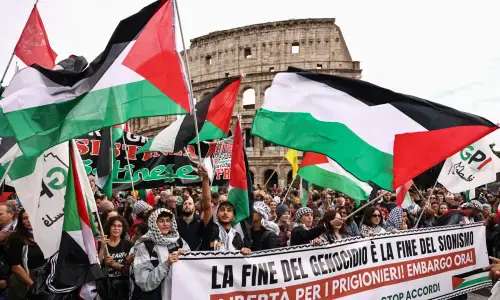
FOLLOWING the meeting between Foreign Minister Khurshid Kasuri and his Israeli counterpart, Silvan Shalom, in Istanbul on September 1, and President Pervez Musharraf’s speech to the American Jewish Congress in New York on September 17, a debate has begun in the Pakistani print and electronic media for and against the recognition of Israel. Each side is presenting its case with equal vehemence.
The opponents of Israel’s recognition assert that even if the Islamic dimensions of the Palestinian problem are set aside, the Zionist entity not only lacks legitimacy, its creation was an evil and a manifestation of perfidy against the Palestinian people whose sufferings and agonies continue unabated and are mounting with the passage of time. These elements, therefore, consider it absolutely preposterous and a cardinal sin to normalize relations with Israel, particularly at present, when the Palestinians are striving hard for the establishment of state on their own soil.
On the other hand, the exponents of Israel’s recognition, who remained anonymous and in a low key in the past, are now openly demanding a subtle change in Pakistan’s policy on this issue and are giving all sorts of arguments to justify their demand. The main thrust of their argument is that Pakistan has no direct clash of interests with Israel and, therefore, it should normalize its relations with that state, particularly when the Palestinians and a number of Muslim countries have already recognized its right to exist.
These elements, however, tend to overlook the fact that in the absence of any meaningful support from the Islamic world (except for empty rhetoric, expressions of sympathy), which has hindered their legitimate struggle against a powerful enemy enjoying the support of the United States and other western countries, the Palestinians had no option but to cave in to accept the Zionist entity’s right to exist.
There are many other spurious arguments proffered by the proponents of Israel’s recognition, the most preposterous among them being that the Jews have a “historical right” to the “Land of Israel”, a legacy from their forefathers. This assertion is, however, historically inaccurate and does not stand up to juridical scrutiny. It cannot, therefore, confer on Jews a “historic right” to the land of the Palestinians who, being the direct descendants of the original inhabitants of Palestine, are its rightful owners. False and illusory beliefs cannot be allowed to take a toll on the legitimacy of history.
The Zionist case for the creation of a Jewish state in Palestine is based on the claim that most of the last 1,200 years of the pre-Christian era, the Jews constituted the main settled population of what in Roman times become Palestine where they enjoyed long period of independence. The stark reality, however, is that the Jews were only one of many Semitic tribes which had penetrated the region in ancient times and the states they were able to establish there were relatively short lived and never at any time extended to the coastal plains which were inhabited by the Philistines, from whom the name “Palestine” is derived.
If such a transitory occupation can give them the “historic right” to Palestine, then the Arabs who occupied Spain continuously for 800 years can also claim that country today. If all nations were to adopt this strange logic, the world would be in utter chaos and despair.
When Palestine came under the control of the Romans in the first century BC, the Roman emperor, Titus, who captured Jerusalem, destroyed the Jewish temple, overthrew the Jewish regime at Judaea. After repeated rebellions by the Jews against the Romans, Jerusalem was razed to the ground in 135 AD and most of the Jewish inhabitants of Palestine were expelled from the country bringing an end to the Jewish connection with Palestine. Most of the Jews who remained there converted to Christianity and then to Islam.
The Zionists also invoke the concept of religious association of the Jews with Palestine. They refer to the Bible to justify the establishment of a Jewish state in Palestine. They draw attention to Genesis, which contains God’s promise to Prophet Abraham: ‘To your descendants I will give this land’ (the land of Canaan, now called Palestine). This was, however, a deliberate distortion of the Biblical text by the Zionists only to attain their political objectives. The term ‘descendants’ is not restricted to the Jews but includes Muslims and Christians as well as they are also the descendants of the Prophet Abraham. The Zionists continue to exploit the Bible to justify their occupation of the West Bank, which they describe by its Biblical name of Judaea.
It would also be pertinent to recall that when, in 1929, the Jews claimed the ownership of the Wailing Wall and the courtyard adjacent to it in Jerusalem, an international commission was appointed to examine this question. The commission, after hearing the representatives of the parties concerned and perusing historical records, gave the verdict that the Wailing Wall was the part of the Haram Sharif and belonged to the Muslims. The Jews did not pursue their claim after this verdict and only asked for permission to visit the wall.
Following the persecution of the Jews in Europe, Theodore Herzl, the founder of Zionism, advocated the creation of a Jewish state in Argentina or Palestine. In 1897, the first Zionist congress was held in Switzerland, which issued the Basle programme on the colonization of Palestine and established the World Zionist Organization to pursue the matter further. In 1904, the fourth Zionist congress decided to establish a national homeland for the Jews in Argentina. However, after about two years, the Zionist congress, under immense pressure from Britain and its allies, decided to establish the Jewish state in Palestine. The British support for the establishment of a Jewish homeland in Palestine, where the Jews were only a tiny minority, was aimed only to protect their own long-term geo-political and economic interests in the Middle East and was a grave injustice to the Palestinians.
In 1947, the UN General Assembly adopted a resolution, which approved the partition of Palestine. The Zionists proclaimed the state of Israel on May 14, 1948. A number of jurists are, however, of the view that the United Nations had no right to dictate a solution on Palestine unless a basis for exercising such authority had been worked out beforehand. Professor Quincy Wright questioned the legality of the UN partition plan and Professor Brownlie also maintained that the partition plan was ultra vires as the United Nations was not competent to take such a decision. The rejection of the repeated requests by the Palestinians to ascertain from the International Court of Justice if the United Nations had the jurisdiction to partition Palestine speaks volumes about the legitimacy of the creation of Israel.
Paradoxically, despite Pakistan’s pronounced anti-Israel stance and the fact that the Palestine issue figured high on its foreign policy agenda, the Zionist entity has been striving, since its creation in 1948, to seek Pakistan’s recognition and to establish some kind of modus vivendi with it.
A number of western countries, the United States, in particular, have been putting pressure on Pakistan, from time to time, to recognize Israel. Apparently, Pakistan was not of vital importance to Israel, and, therefore, its desire to seek Pakistan’s recognition was only aimed to drive a wedge between the Arab and non-Arab Muslim countries with a view to weakening the Palestinian struggle.
Pakistan, which has always remained a steadfast opponent to the recognition of the Zionist entity that came into existence through war, should continue to show the same determination against Israel’s recognition till the creation of a viable and sovereign Palestinian state, with Jerusalem as its capital.
The writer is a former ambassador.
A dreadful tragedy
THE horrifying earthquake in Pakistan and northern India has already claimed more than 30,000 lives — with many more injured — and the toll is still rising. It is an absolutely dreadful human tragedy with many innocent families wiped out and whole communities devastated.
Nothing can be done, at least not in the short-term, to prevent earthquakes or hurricanes, but it is possible to mitigate their effects over the long-term by better early warning mechanisms, speedier relief operations and the construction of homes and offices more likely to resist the impact of earth tremors when they happen.
This time, unlike some previous disasters when rescue efforts were slow to mobilise, a British relief team was sent to the scene soon after the scale of the disaster became apparent and had already pulled some survivors to safety.
The UK government has also pledged 100,000 pounds plus medical staff and aid workers. More will be needed, but at least this is a good start.
But as each disaster unfolds it becomes increasingly clear that what is needed is a rapidly responding international unit coordinating the activities of the charities as well as channelling government support, and ready to spring into action at a moment’s notice.
A Red Cross report earlier this month claimed that after the tsunami, rivalries between hundreds of groups led in some cases to duplication of effort and to delays in aid reaching the people it was intended for. It added that after the disaster, 300 to 500 charities had arrived in Sri Lanka, some of which had little or no experience.
— The Guardian, London
| © DAWN Group of Newspapers, 2005 |