0
0

Signs of a turnaround
PAKISTAN’s economy has made significant strides during the current financial year after having remained in a state of stagnation for over five years. Large-scale manufacturing is up by 10.2 per cent in the first ten months of the current year, exports by 20 per cent and tax revenue collection by 15 per cent. Meanwhile, the trade deficit, foreign debt and current account deficit have come down perceptibly. Speaking at pre-budget seminar in Lahore on Monday, Finance Minister Shaukat Aziz attributed these achievements to the government’s correct and timely economic decisions taken in the last three years. There is no denying the fact that in the last three years the government succeeded in raising the foreign exchange reserves to over 10 billion dollars. At the same time, as a result of various reforms carried out in this period, Pakistan has, for the first time in many years, achieved a modicum of macro-economic stability which is considered by many as the most essential plank for the economy to stage a take-off. The share of the value-added products in the textile exports has already crossed the 60 per cent mark and is likely to go up to 70 per cent by 2004-05. This is the result of large investments made in balancing, modernizing and replacement by the textile industry during the last few years. Meanwhile, the government has removed all the barriers to export/import of better count yarn and obtained better access to the European market for textile exports. Former commerce minister Razzak Dawood and his team had worked hard on these aspects of textile trade whose benefits are now being reaped in the shape of a jump in exports. Higher export demand has given a boost to the manufacturing sector which is yielding higher revenue collection.
The finance minister has very rightly proposed to focus on poverty alleviation in the next budget. This he wants to achieve by accelerating growth in agriculture, construction and the manufacturing sector. At the same time, he intends to enhance allocations for the public sector development to alleviate poverty. In his opinion, the textile and engineering sectors have emerged as ‘engines of growth’, indicating that these two sectors would perhaps receive further support from the government in the next budget. The Governor of the State Bank of Pakistan, Dr. Ishrat Hussain, in his inaugural speech at the seminar, held out the prospect that from next year onwards Pakistan’s annual growth rate would begin accelerating to reach six per cent by 2005-06 with tax revenue increasing by 10 per cent annually and public sector investment going up by 6.2 per cent. Both the finance minister and the SBP governor were, however, very candid in stressing that much more needed to be done to consolidate the gains made so far.
According to Dr. Ishrat, political stability, strong democratic institutions and local governments were essential to achieve and sustain fast economic growth. He also conceded that so far the economic strategy had focused almost exclusively on the restoration of macro-economic stability and neglected the economic growth rate, poverty reduction and employment generation, so that poverty and unemployment have become widespread, while basic services such as health, education, clean drinking water and transport are available only to a small section of the population. He also conceded that post-9/11 developments did help the domestic economy to an extent and that IMF help was sought mainly to obtain debt relief.
According to Dr. Ishrat, all political parties are agreed on the primacy of poverty reduction, employment generation and stable prices. However, agreeing on objectives does bind one to the strategy to be adopted to achieve those objectives. The present strategy is clearly based on the age-old IMF prescription which draws its inspiration from the discarded trickle-down theory which has not succeeded anywhere in the world in alleviating poverty. It has only served to make the rich richer and the poor poorer. It is, therefore, time to take a second look at this strategy and amend it to suit the conditions and needs of our people and to maximize the comparative advantages that Pakistan enjoys in relation to its trading partners. Pakistan is situated at the centre of very active trade routes. This is one of its major comparative advantages. Next, as the finance minister said, we have one of the best human resources. All that is needed to get them to give of their best is to train their skills according to the demands of the market. We should be planning to put these advantages to work before the year 2005 when textile quotas would be abolished worldwide.
We should also keep in mind that we do not enjoy any comparative advantage in engineering goods either in the region or in the world. Attempts to boost this industry through concessions and incentives over the last several years have only created a class of rent seekers. The aim should, therefore, be value addition in textile and, at the same time, we should adjust the trade barriers in such a manner that all kinds of goods in semi-manufactured and knocked-down conditions could come in and go out after value addition and assembling in our warehouses. Finally, our private sector, which has been spoon-fed all these years by the government, is still learning to cope with market forces. Therefore, at least for the next 10 to 15 years the public sector should continue to take the lead in investment in social and physical infrastructure.
Recurring power failures
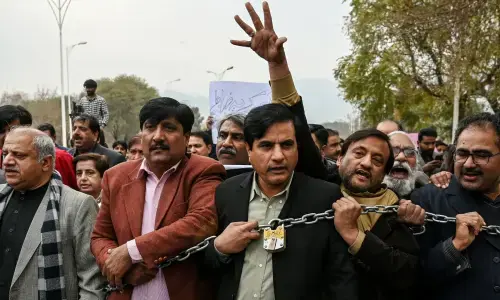
ANGRY citizens came out on the streets in many parts of Karachi on Sunday to protest against the recurring power failures they have had to endure in recent weeks. As the mercury soared to unbearable levels in the metropolis, the electric supply system simply collapsed under the strain, as it has done with monotonous regularity for many years. With entire localities deprived of power for hours on end, the Karachi Electric Supply Corporation added to the misery by simply failing to respond to the barrage of complaints. The army-run corporation also did not seem bothered about explaining the causes behind the frequent power breakdowns to the public, adding to widespread anger and frustration.
Clearly, the fault rests with the poor maintenance of the city’s power system that is unable to withstand any sharp rise in demand. There is a need to spruce up the system at routine intervals rather than wait for a big breakdown or a succession of small transmission failures before attending to long overdue repair, renovation and replacement needs. What irks consumers most is that they are being forced to pay more and more for electricity even though the system continues to deteriorate. Increasingly, citizens have to invest in generators rather than rely on the inefficient KESC system. For those who cannot afford to do so, the only alternative is to suffer silently or come out on the streets to protest. Responding to the angry protests on Sunday, the Sindh governor’s committee to examine the working of the KESC has instituted an inquiry to fix responsibility for the frequent breakdowns and take action against those at fault. While taking action against errant individuals is necessary, it is also important to look at the problem in a more holistic manner and take remedial steps. Apart from gradually building up capacity for a rapidly growing city like Karachi, it is also necessary to streamline the maintenance system and plug all leakages.