BISHKEK: Russia’s Vladimir Putin and China’s Xi Jinping are expected in Central Asia’s Kyrgyzstan on Monday for a two-day summit, also attended by Pakistan, Iran and India’s leaders, of a regional bloc seeking to be a counter-influence to the West.
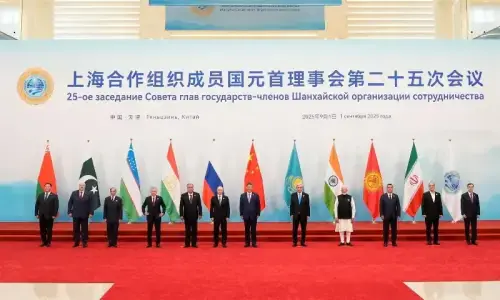
Around a dozen heads of states will head to the Kyrgyz capital Bishkek to mark 25 years of the Shanghai Cooperation Group (SCO).
The group brings together Russia, China, India, Pakistan, Iran, four Central Asian countries and Moscow-allied Belarus.
It takes place four-and-a-half years into Moscow’s Ukraine invasion and six months into the war between Washington and Tehran. Iran will be represented by its president, Masoud Pezeshkian.
PM Shehbaz and Modi to join them at SCO event
Putin, Xi, Pezeshkian as well as India’s Narendra Modi and Prime Minister Shehbaz Sharif are due to take part in a plenary session chaired by Kyrgyz leader Sadyr Japarov.
Putin is also expected to hold separate bilateral talks with Pezeshkian and Xi, among other leaders, Kremlin spokesman Yuri Ushakov said.
Russia and Iran, among the most sanctioned states in the world, have massively deepened their military and economic ties during the Ukraine war.
US President Donald Trump has warned Moscow and Beijing against arming Iran.
Putin’s meeting with Pezeshkian comes days after the CIA’s director John Ratcliffe made a rare trip to Moscow, with US media speculating he could have discussed Ukraine and Iran with his Russian counterparts.
The SCO has historically focused on economic issues. It gained momentum in recent years under Moscow’s and Beijing’s leadership.
The SCO’s founding declaration says the group is “not an alliance directed against other states”.
Real and trade wars
The Bishkek summit takes place as some SCO members are in the midst of real wars — the Ukraine and Iran conflicts — or trade wars, with the imposition of US tariffs on Chinese and Indian goods.
Mohammad Hassan Najmi, an international relations expert, told AFP that Tehran “believes its membership and active participation in these alliances can enable it to circumvent US and European sanctions”.
But concrete benefits of the group are uncertain, he said, as “in times of crisis, these alliances have rarely allowed Iran to resolve its difficulties”.
While the bloc claims to represent some 40 per cent of the world’s population and 25pc of global GDP, it remains diverse, with some disagreements among members.
Published in Dawn, August 30th, 2026