The world has failed to meet its main climate change target of limiting the rise in global temperatures to 1.5 degrees Celsius, and will likely breach this threshold in the next decade, the United Nations’ Environment Programme (UNEP) said on Tuesday.
The annual Emissions Gap report said that because of countries’ slow action to reduce planet-heating greenhouse gas emissions, it was now clear that the world would exceed the core target of the 2015 Paris Agreement — at least temporarily.
“This will be difficult to reverse, requiring faster and bigger additional reductions in greenhouse gas emissions to minimise overshoot,” UNEP said.
‘We can no longer totally avoid it’
Lead report author Anne Olhoff said deep emissions cuts now could delay when the overshoot happens, “but we can no longer totally avoid it”.
The 2015 Paris Agreement commits countries to limit the global average temperature rise to 2°C above pre-industrial levels, and to aim for 1.5°C. Yet governments’ latest pledges to cut emissions in future, if met, would see the world face 2.3-2.5°C of warming, UNEP said.
That’s around 0.3°C less warming than the UN’s projection a year ago — indicating that new emissions-cutting plans announced this year by countries, including top CO2 emitter China, have failed to substantially close the gap.
China pledged in September to cut emissions by seven to 10 per cent from their peak by 2035. Analysts note the country tends to set modest targets and exceed them.
Findings add pressure to COP30
The findings add pressure to the UN’s COP30 climate summit this month, where countries will debate how to kick-start and finance faster action to rein in global warming.
The Paris Agreement temperature goals were based on scientific assessments of how each increment of global warming fuels worse heatwaves, droughts and wildfires.
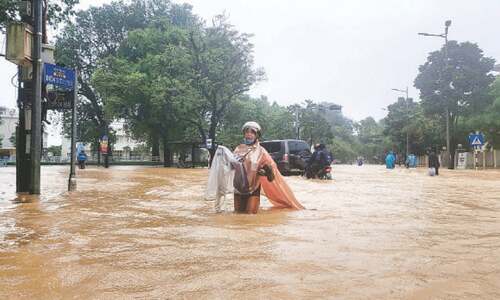
For example, 2°C of warming would more than double the share of the population exposed to extreme heat, compared with 1.5°C. Warming of 1.5°C would destroy at least 70pc of coral reefs, versus 99pc at 2°C.
Current policies — the ones countries already have in place — would lead to even more warming, of around 2.8°C, UNEP said.
The world has made some progress. A decade ago, when the Paris Agreement was signed, the planet was on course for around a 4°C temperature rise. But heat-trapping CO2 emissions continue to rise, as countries burn coal, oil and gas to power their economies.
Global greenhouse gas emissions increased by 2.3pc in 2024, to 57.7 gigatonnes of CO2 equivalent, UNEP said.