• Provincial authorities, law enforcement agencies tasked with collecting information on Afghan Citizen Card holders
• Authorities estimate around half a million returned during first phase
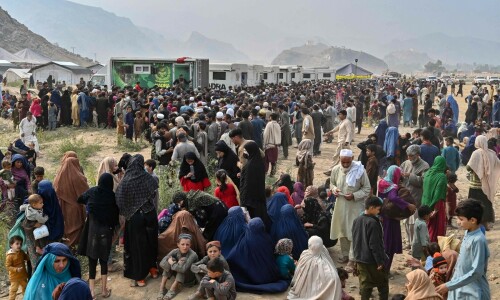
PESHAWAR: Pakistan has begun preparations to launch the second phase of its repatriation drive to send nearly one million ‘documented’ Afghans back to their homeland, with directives to district authorities and police to map and collect data of their whereabouts across the country, documents reveal.
An official privy to the development said instructions had been issued to district administrations and police to expedite the mapping of Afghan Citizen Card (ACC) holders.
No date has yet been announced, but an official said the campaign to repatriate hundreds of thousands of ACC holders could begin in early to mid-summer, following approval from the federal government.
“We have already started the mapping process,” Abid Majeed, Khyber Pakhtunkhwa’s additional chief secretary, told Dawn.
“It will pick up the pace after Ramazan and we hope to complete the survey before April 30,” he said.
According to UNHCR, the UN refugee agency, there are 2.18 million documented Afghan refugees in Pakistan. This includes the 1.3m refugees holding Proof of Registration (PoR) cards as per the census carried in 2006-07, as well as an additional 880,000 refugees granted ACCs following a registration drive in 2017.
The collapse of the neighbouring republic following the return of Taliban to power in August 2021 saw another influx of worried Afghans into Pakistan. Officials put their number anywhere between 600,000 and 800,000, some with valid travel documents, but an uncertain future.
1.7m — an exaggerated figure?
Pakistan launched the first round of repatriation of what it called “undocumented aliens” in November last year.
No official data has been released as to how many of the estimated 1.7m undocumented Afghans have left for their country since November 2023, though the figure likely fell hugely short of what is now being considered a grossly exaggerated number.
But according to informed sources, the total number of undocumented Afghans who have returned to Afghanistan via Khyber Pakhtunkhwa and Balochistan in the first round stands at around the half million-mark.
Amid mounting pressure to speed up the repatriation of undocumented Afghans in the face of a low exit headcount, officials approached the Ministry of Interior soon afterwards, wondering about the origin of the ‘1.7m undocumented Afghans’ claim and sought revalidation of the figure.
No one knows how many of the 880,000 ACC holders remain in the country, or how many of them have opted to return to Afghanistan voluntarily.
Officials say they have approached the Ministry of Interior to double-check the figure with the National Database and Registration Authority.
Also, the exercise to differentiate between the those with ACCs and those with PoRs could prove tricky, and put even more pressure on the already-strained relations between the two neighbours.
Taliban chief spokesman Zabihullah Mujahid, who had called the repatriation of undocumented Afghans “unacceptable”, struck a more conciliatory tone in an interview with Tolo News recently, calling for more refugee leniency from Pakistan.
However, undeterred by criticism from Kabul and the concerns voiced by human rights bodies and the UN, Islamabad appears to have made up its mind to continue with its repatriation programme and expand it further to include even documented Afghans.
The repatriation of Afghan refugees, which was part of the National Action Plan, has also now found its mention in Prime Minister Shehbaz Sharif’s 100-day working plan.
Accordingly, all provinces and the government of Azad Jammu & Kashmir have been asked to complete the mapping and verification process of ACC holders by March 25, 2024.
But officials say the mapping could take longer, and it may take at least another month to complete the process.
Sindh has already issued written directives to all concerned. In a letter dated March 13, the Home Department directed all concerned to complete the mapping process by March 25, referring to a meeting chaired by the Secretary MOI on the same date.
In a more detailed letter on Friday from KP’s Home & Tribal Affairs Department, the district administration and police were directed to “revitalise” the mapping of ACC holders, suggesting an eight-point modus operandi to complete the entire exercise by April 15, 2024.
The federal government is expected to announce a date for voluntary repatriation with a one-month cut-off once provinces and AJK complete the mapping survey, an official said.
No decision has yet been made, nor have there been any formal discussions on the repatriation of a relatively and significantly larger population of the PoR card holders, who are formally recognised by the UNHCR as refugees.
But more than a million Afghans with PoRs, who have been living in Pakistan for decades, worry their turn could come soon.
Published in Dawn, March 25th, 2024