



 0
0

 HONG KONG, April 6: A deadly pneumonia-like virus has claimed more victims in a growing number of countries as experts from the World Health Organization race to trace the origins of the highly infectious disease in southern China.
In the southern Chinese territory of Hong Kong, where the disease has killed 22 people and tourists are cancelling trips, an infected man barricaded himself at home in a standoff with police, but surrendered and was taken to hospital on Sunday.
Police were still hunting for six families exposed to the disease who fled their apartment block before it was quarantined last week.
More than 100 other families who fled from the same block have turned themselves in after authorities appealed urgently that they seek medical help.
Health officials believe everyone in the building in Kowloon, one of the most densely populated places on the planet, may have been infected and could have spread the disease.
China, which has been criticised for having been too slow to acknowledge the disease and warn its neighbours, said on Sunday its death toll from the virus had climbed to 51 with 1,247 infections as of April 5.
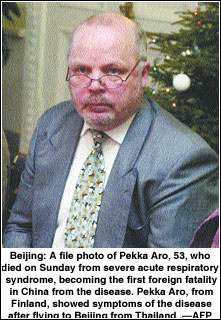
A Finnish man died in Beijing from the virus on Sunday, taking the number of deaths in China’s capital to four, a health official said. Pekka Aro, 53, arrived in Beijing from Thailand on March 23 to attend an international labour conference.
Premier Wen Jiabao, whose administration is grappling with its first big crisis since taking office in March, said China could control the spread of the disease, and welcomed visitors.
“The Chinese government and people warmly welcome friends worldwide to come to our country for tourism, visits or to engage in commercial activities,” the official Xinhua news agency quoted Wen as saying.
In China’s Guangdong province, the epicentre of the explosion of SARS (Severe Acute Respiratory Syndrome), a team of WHO investigators compared notes with Chinese experts for the third day in a bid to track down the the origin of the virus.
No details of the talks were immediately available, but not everyone in Hong Kong was convinced the Chinese authorities would turn over all their information.
“They might get something if they are clever,” said Terrence Tsai, a professor of business at the Chinese University in Hong Kong, referring to the WHO teams. “The Chinese only let you know what they want you to know. They’re very good at hiding data.”
Air travellers took the virus to 18 countries after it spread in Hong Kong. It has infected more than 2,600 people since emerging in southern China in November—Reuters


























