0
0


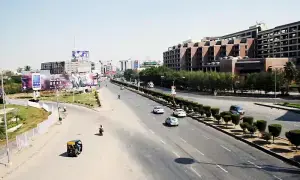
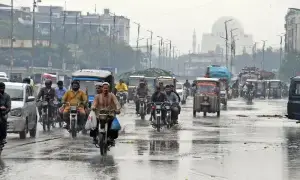
It's hard to describe the city of Karachi in a few adjectives. For how can you aptly sum up the character of one of the world's largest (population and area-wise) cities in a few words? This city has a complex temperament; one minute Karachi is the globalised post-colonial Third World metropolis moving at the speed of light. This is the city we all know and some have learnt to love.
But at other times it is a violent, crime-infested no-mans land without any semblance of law and/or order. This is the Karachi many of us would prefer not to know.
There are many things we love about this sun-kissed city by the mighty Arabian Sea; there are also a few ugly aspects most level-headed citizens absolutely despise about Karachi and would change in a jiffy if they had the power or resources to do so.The word metropolis is often used to describe Karachi. This is perhaps a befitting description as the city indeed has a cosmopolitan character. Though it might not have the history of Lahore, the fact that it is Pakistan's economic engine has ensured that a great number of languages are spoken here, a variety of cuisines are consumed in its countless eateries, and the Almighty is worshipped in a number of ways by its citizens.
This 'melting pot' situation has led to several problems, but we'll get to that later.
Talking about Karachi's ethno-linguistic diversity, the city is, no doubt (and to use a hackneyed cliché) a 'mini-Pakistan'. Urdu — being the national language — is the lingua franca here, also perhaps because the majority of Urdu-speakers from northern India migrated to this city after Partition. Sindhi is also spoken by a fair number of people, for the city is the capital of the fair land of Sindh, while its close proximity to Balochistan ensures that Balochi and Brahvi are also not alien languages.
Apart from these, languages from all over Pakistan can be heard on Karachi's streets, markets, tea houses and workplaces. Punjabi, Seraiki, Hindko, Pushto, Khowar, Shina and countless other tongues give voice to Karachi's polyglot population, as do Gujarati and Kutchi.
English is the language of the elite and thus the language of power. Hence, even lower middle-class folks strive to learn the language as best they can in order to ensure upward mobility. As a scholar observed at a seminar that I recently attended, English has pretty much become part and parcel of the city's (and nation's) fabric.
Giving the example of road signs, he said that if an English-speaking visitor landed at Jinnah International, he/she could easily find their way to Saddar thanks to the road signs (which are usually in both Urdu and English). This would not be the case in, say, Almaty, where road signs were purely in Kazakh.
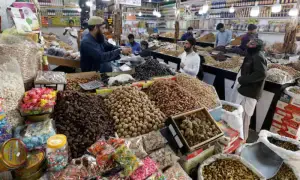
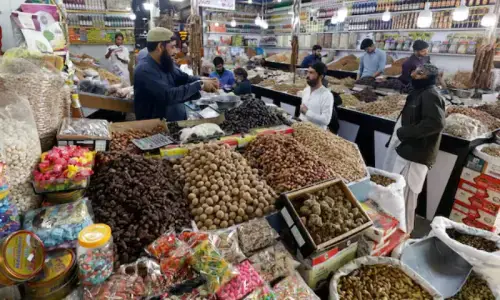
Coming to Karachi's culinary diversity, one can say — with a bit of poetic license — that the sky is the limit. Let's face it eating out is Karachi's national sport, and we are second to none when it comes to having a good time while gorging on epicurean delights. There are exorbitantly priced Japanese restaurants in gleaming five-star hotels. And then there are spicy little bun kebabs sold by street vendors in every nook and cranny of the city.
To paraphrase an Urdu saying, paisa phenk, tamasha dekh (throw money, and see what happens). Depending on the size of your wallet and your culinary disposition, food from around the world, as well as around the block, can be had in Karachi. I truly believe that in very few other cities are you able to rip into a good old Baloch Sajji, and then drive a kilometre or two down the road to enjoy a double cheese-burger sold by an American clown with such relative ease. Chinese, Thai, Korean, Italian, Arabic, Mughlai and countless other types of cuisines are found in Karachi. Perhaps the only thing missing is a few good Mexican restaurants!
Coming to matters of faith and devotion, Karachi houses mosques, temples and churches to ensure all God's creatures are able to worship Him in the manner they choose. In this city one can attend a Mehfil-i-Na'at at the Faizaan-i-Madina mosque, or attend a more conservative wa'az at the Binnori Town mosque. One can attend a Majlis at Mehfil Shah-i-Khurasan or lose oneself at a Mehfil-i-Sama at any of the city's reputed Sufi Takiyas.
For those practicing faiths other than Islam, one can pay their respects at the Swami Narayan temple in the heart of the old city, or visit the Dar-i-Meher in Saddar. For Sunday service one can go to any of the colonial-era protestant or Catholic churches in the city. There even used to be a synagogue in Karachi, but ever since the state of Israel unfortunately came into being, the structure has become obscure, perhaps purposefully to protect it from emotional vigilantes.
But with all these vibrant, positive things about Karachi, many negatives are also directly linked to these factors. The city's status as an economic powerhouse sometimes results in open power struggles that are given an ethnic/linguistic/political character. The naked power grab to gain control of limited resources and the city's booming economy often ends up in a spiral of brutal, deadly violence.
And ever since the rise of religious extremism — fuelled by the global dynamics of power and local, myopic policies of that many-headed hydra known as 'the establishment' — Karachi's confessional diversity has become a liability. Though religious minorities have been targeted off and on, when there is no clear non-Muslim 'enemy', the fanatics turn their guns on fellow Muslims they consider to be 'infidels'.
This has resulted in the ghettoisation — mental as well as physical in many cases — of a once peaceful, tolerant city. In the worst case scenario, sectarian killers have targeted congregations while they were offering prayers. Places of worship were targeted in Karachi in the bad old nineties, way before the Taliban sent suicide bombers to decimate Sufi shrines.
Perhaps what is needed is active citizenry that can stand up and say 'no' to the excesses meted out by various mafias and other shady groups that make life for Karachi's citizens miserable, sending a message to an ineffectual state that 'enough is enough.' After all, the city claims to be the most 'educated' in Pakistan. Then why can't the movement for true, genuine change start from the city of the Quaid? Change — to paraphrase Mr Obama — we can believe in!
Viva Karachi!