0
0

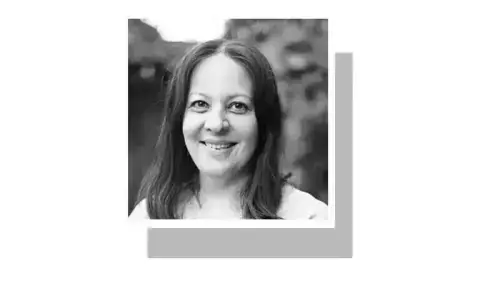
“Art has run in my family through the generations,” says Rabia Tahmina Shoaib, a teacher of fine arts at the Indus Valley School of Art and Architecture (IVSAA). Having done her bachelors in English Literature, Islamic History, Physiology and Microbiology followed by a master in Human Physiology, she finally followed her passion for creativity to take up fine arts. And her journey as a fulltime teacher began soon after receiving a distinction at IVSAA.
Being a part of a number of solo and group exhibitions, Rabia says, “Art should not be taken up just for art's sake. It should be for a purpose.”
Rabia's projects stress on an issue-based approach. She shares, “For a regional event of peace conflict management in India, I displayed my work on the Gujarat Godhra train burning. I linked up 'gajra' (flower bangle) with 'Gujarat'. Human forms were lifted by wires in place of flowers and in place of petals, human bodies were shown like they were falling and burning. Beauty and love were replaced by hate and death in order to represent the many forms of injustices associated with that event.”
Another project was about the Guantanamo prisoners with a stuffed kneeling down human dummy wearing orange prison clothes. Rabia talks further about one of her paintings related to the Lal Masjid incident in Islamabad, “I saw that in London people were being stopped from offering their Friday prayers in the mosque due to a minister's visit there. Though that kind of a thing doesn't happen in our country, there was still the Lal Masjid case back home, which was upsetting, too.”
Interestingly the fusion of microbiology and physiology in her current art practice comes from the background of having degrees in these subjects. Rabia shares, “Initially I made a whole lab; I tried to show the recovery of the human soul as humans undergo physical recoveries. Many of the fractures in our soul go unnoticed. Human diseases were renamed, one as 'intelligentsia colli', another as 'patience-cillin'. There were small organisms made to show that we overlook those things which we can't see through the human eye.
“Another display of an X-ray of the human body in the sajda position conveyed that the soul lifts by lowering the head, the highest part of the body. I do such value-oriented work, not for marketing but for opening the mind to such ideas.”
Rabia believes that if art is not created for any benefit, the circle of art will stay limited. “The same limited few will continue with creating art and the same few will be buying it,” she points out.
Regarding art education she says, “There is a difference in art education on the basis of quality and money. It very much depends on the teachers and how much they are open and accommodating towards their students and how much they dictate. In some departments, the teachers provide specific instruction for the thesis, which should not be allowed. Except for the beginner's level there is surely a set pattern of working here.”
Rabia believes that becoming a good or bad artist largely depends on how much liberty one has with ideas and work.
Talking a bit about her wide travels, she says that in Iran she was amazed to see the richness of civilisation, “Their miniature work is outstanding. You even see it on the roads and footpaths. The people, too, are very educated and proud of their culture. I am very lucky to have seen the ancient civilisations of Mohenjo-daro, Mesopotamia, Egypt and Rome.”
In comparison, she laments, “The problem is that Pakistani art is still unknown to many. If you just go to Sukkur, there's Sadhu Bela, the bridge, and the Makhdoom Shah Minaret. In Thatta, there is the beautiful mosque. Pakistan is rich with such sites.”
Rabia says that if you clean up the streets of Kharadar or Sukkur, they will be just like any other rich and cultured city. She suggests, “It can be done by encouraging the thesis students to work on the revival of our traditions by working in museums and likewise. Institutes can participate through long-term planning. It is not done like painting the walls once or constructing high-budget roads or roundabouts to be forgotten with the passing of time. If you talk about involving fine arts, take the example of Iran where they offer a masters degree in renovation.”
But growing optimistic, she says, “It's not that nothing is being done for art in our country. But the biggest problem is that there is no government patronising art here. There was a little initiation seen in Islamabad after much difficulty. But even there you have the ones in power installing the people of choice. Open merit must be valued.”
Finally, she says, “I don't think there is a need to take unnecessary liberties in art as far as the image of Pakistan is concerned. I don't agree with the message of 'Redo Pakistan' that is being conveyed by some artists here. We need to build upon what we have.”