0
0

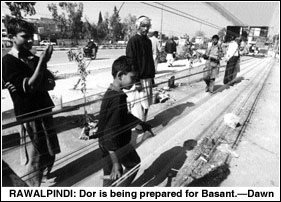 ISLAMABAD, Feb 22: Only a week is left before the skies of the twin cities are filled with the colourful kites of various sizes and designs during the Basant festival on February 28.
In the twin cities, a number of outlets have sprouted up, selling kites and string (Dore). But, the main selling spot remains to be the Purana Qilla (old fort) bazaar in Rawalpindi, where a dozen shops are selling kites.
Abdul Wahid, a shopkeeper, said these shops were seasonal and set up only for two months — January and February. “In the remaining 10 months, we deal in cosmetics and other related items,” he added. Hundreds of people from the twin cities visit this bazaar to buy kites and Dores of their choice.
The prices of kites here range from Re1 and Rs2 to Rs20, depending on the size. The finest-quality paper used in kite- making is of 20 grams, which is considered A-quality. The kites made of this paper show better performance against air resistance.
The other essentiality in kite flying is the string, the making of which is not an easy task and involves several people. Glass, usually of bottles of liquor and soft drinks, is grinded to powder form, cleansed and mixed with an adhesive component to form a thick paste. The paste is, then, applied to the string with a piece of cloth to make it sharp and unbreakable. The string prepared through this process is called Manja (coated) and is left to dry before being wound around a Charkhi (spool).
Manja is so sharp that it can even cut to the bone, and that is why some people wear a tubular leather round the index finger (the most used in flying kites) for protection. Despite a ban, some people also use metallic wire which often results in power breakdown when entangled with electricity lines.
Charkhi with different string lengths, ranging from minimum five Gotes to maximum 10 Gotes, is sold at Rs150 to Rs200. However, a Charkhi without string can be bought for Rs10. — Junaid Bahadur